
ParentVibes
Women's Health Library · parentvibes.in
STIs & Prevention: How to Protect Yourself & When to Test
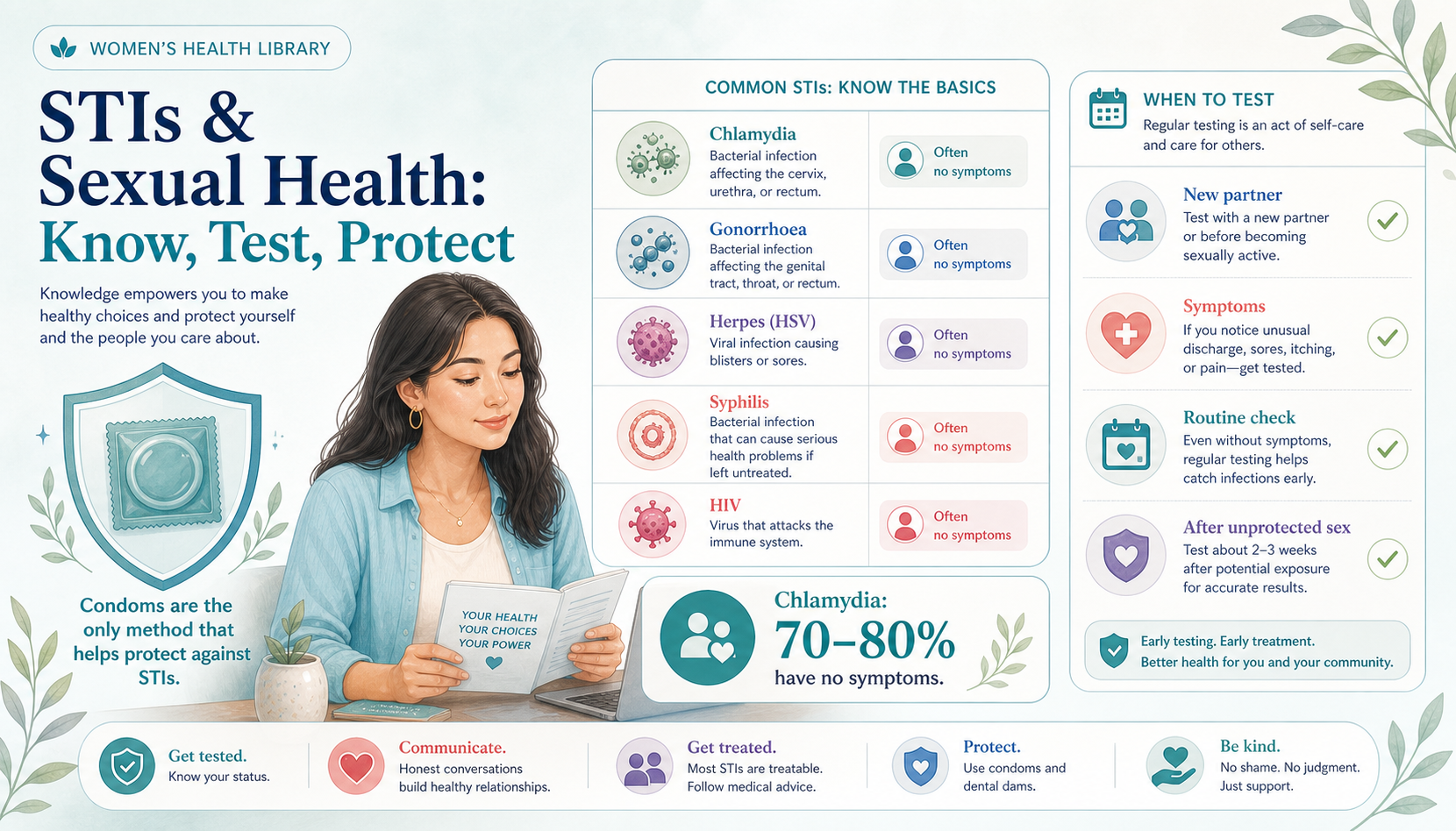
STIs at a glance
Sexually transmitted infections (STIs) — sometimes called sexually transmitted diseases (STDs) — are infections that pass from one person to another mainly through sexual contact. They're far more common than most people realise, and they can affect anyone who is sexually active, at any age. Having one doesn't say anything about who you are; it's simply a health matter, like any other infection.
One of the most important things to understand is that many STIs cause no symptoms at all. You can have an infection — and unknowingly pass it on — while feeling completely healthy. That's exactly why prevention and regular testing matter so much: you can't rely on how you feel to tell you whether you're infected.
The encouraging news is that STIs are largely preventable, and most are either curable with treatment or well managed with medication. This guide explains, in plain terms, what STIs are, the common ones to know about, how they spread, why so many are silent, how to protect yourself, and how to get tested without any shame.
Feeling fine doesn't mean you're clear
Because so many STIs have no symptoms, the only reliable way to know your status is to get tested. Testing is quick, confidential and routine — and the earlier an infection is found, the easier it is to treat.
Ask a Doctor →Useful tools
What Are STIs?
STIs are infections caused by bacteria, viruses or parasites that are passed mainly through vaginal, anal or oral sex, and sometimes through close skin-to-skin genital contact. Some can also pass from a pregnant person to their baby during pregnancy or birth, or through blood (for example, by sharing needles).
Broadly, STIs fall into two groups. Bacterial and parasitic STIs — such as chlamydia and gonorrhoea — can usually be cured with the right antibiotics. Viral STIs — such as herpes, HIV and most HPV — can't always be cured, but they can be managed very effectively with treatment, and some clear on their own. Knowing which type you may have helps you understand what treatment looks like.
STI or STD?
You'll see both terms. 'STI' (infection) is now preferred because a person can carry an infection without it ever causing a 'disease' or symptoms — which is exactly why testing matters.
STIs, in short
Often no symptoms
Many STIs are silent — you can carry one, and pass it on, while feeling completely well.
Condoms are key
Condoms are the only form of contraception that also protects against STIs. The pill, IUDs and others don't.
Vaccines help
The HPV vaccine protects against the types most linked to cervical and other cancers.
Testing is the only way to know
Because symptoms are unreliable, regular testing is how silent infections get found and treated early.
Most are treatable
Many STIs are cured with antibiotics; others, like herpes and HIV, are managed well with treatment.
No shame in it
STIs are common health conditions. Getting tested is sensible self-care, not a verdict on your character.
Symptoms — Why Many STIs Are Silent
The single most important thing to know about STI symptoms is that very often there aren't any. Many people with chlamydia, gonorrhoea, HPV, herpes or HIV feel completely well, especially early on. When symptoms do appear, they can be vague or easily mistaken for something else — so symptoms alone are never a reliable guide. Below are signs that should prompt a check, but remember: their absence does not mean you're clear.
Signs that can occur (but often don't)
- Unusual vaginal discharge, or a change in colour or smell
- Pain or a burning feeling when passing urine
- Pain during sex, or bleeding after sex or between periods
- Itching, soreness, blisters, sores or lumps around the genitals or anus
- Pain or aching in the lower tummy or pelvis
- Warts or small growths on the genitals (a sign of some HPV types)
- Flu-like feelings, swollen glands or a rash (can occur with HIV or herpes)
Why so many are 'silent'
- Chlamydia and gonorrhoea frequently cause no symptoms, especially in women
- Most HPV infections cause no symptoms and clear on their own — but some types can lead to cervical changes over time
- HIV may cause only mild, flu-like symptoms at first, then none for years
- Herpes can stay dormant, with outbreaks that come and go or never appear
- Because you feel well, an untreated STI can quietly cause harm or be passed on
Silent doesn't mean harmless
Left untreated, some STIs — chlamydia and gonorrhoea in particular — can affect fertility or cause longer-term problems, and HPV can lead to cervical changes. This is why regular testing matters even when you feel perfectly well.
How STIs Spread
STIs pass from person to person through specific kinds of contact. Understanding how they spread also makes clear how to prevent them — and helps clear up common myths (you can't catch an STI from toilet seats, sharing food, or hugging).
- Vaginal, anal and oral sex
- Most STIs spread through unprotected vaginal, anal or oral sex with someone who has an infection — whether or not they have symptoms. This is the main route for chlamydia, gonorrhoea, HIV and many others.
- Skin-to-skin genital contact
- Some STIs, such as herpes and HPV, can spread through close genital skin-to-skin contact even without penetration, because they live on the skin around the genitals. Condoms lower the risk but can't cover every area.
- Blood and shared needles
- HIV and some other infections can pass through blood — for example by sharing needles or other injecting equipment. They are not spread by everyday contact.
- From parent to baby
- Some STIs, including HIV, syphilis and herpes, can pass to a baby during pregnancy or birth. This is one reason STI testing is part of routine antenatal care — and why treatment in pregnancy is so protective.
You can pass on an STI without knowing
Because infections are often silent, someone can transmit an STI without realising they have one. That's not anyone's fault — it's simply why prevention and testing protect both you and your partner.
Getting Tested
Testing is the only sure way to know your STI status, because symptoms are so unreliable. The good news is that testing is simple, quick and confidential — and often involves no more than a urine sample, a swab or a small blood test.
What testing usually involves
- A urine sample (commonly used for chlamydia and gonorrhoea)
- A swab — which you can often take yourself — from the vagina, genitals, throat or anus
- A small blood test (used for HIV, syphilis and some other infections)
- For HPV-related screening, a cervical sample may be taken (linked to cervical screening)
- Results and any treatment are confidential, and trained staff are there to help, not to judge
When and how often to test
- When you start a new sexual relationship, or have a new partner
- If you've had unprotected sex, or a condom broke
- If a partner tells you they have an STI, or if you have any possible symptoms
- As part of antenatal care if you're pregnant or planning a pregnancy
- Regularly if you're sexually active — testing is routine health care, not a sign anything is wrong
Testing is for healthy people too
You don't need symptoms — or any reason to worry — to get tested. Many people test simply as part of looking after their health, the same way they would for any routine check. If you're unsure what you need, a doctor can guide you.
Ask a Doctor →Prevention & Treatment
STIs are largely preventable, and the good news doesn't stop there — most are either curable or very manageable with the right care. Prevention and treatment work together: protecting yourself lowers risk, and testing means anything that does occur is caught and treated early.
- Condoms (the only contraception that protects against STIs)
- External (male) and internal (female) condoms are the single most effective everyday way to lower STI risk during vaginal, anal and oral sex. No other contraceptive — not the pill, IUD, implant or injection — protects against STIs, so condoms are key even if you're using another method for pregnancy.
- Vaccination
- The HPV vaccine protects against the HPV types most linked to cervical and some other cancers, and is most effective when given before becoming sexually active. Vaccines also exist for hepatitis B. A doctor can advise on what's suitable for you.
- Bacterial STIs (e.g. chlamydia, gonorrhoea, syphilis)
- These can usually be cured with the right antibiotics prescribed by a doctor. It's important to complete the full course, avoid sex until treatment is finished and you're clear, and ensure partners are treated too — otherwise reinfection is easy.
- Viral STIs (e.g. herpes, HIV)
- These aren't always curable but are managed very effectively. Medicines can control herpes outbreaks, and modern HIV treatment lets people live long, healthy lives and greatly reduces the chance of passing it on. Most HPV infections clear on their own.
- Telling partners
- If you test positive, recent and current partners should be told so they can test and be treated. Clinics can help you do this confidentially. It can feel awkward, but it protects everyone's health and prevents reinfection.
Prevention is layered
No single step is perfect, but together — condoms, vaccination, fewer or mutual-monogamy partners, and regular testing — they protect you well. Choose what fits your life; even one of these lowers your risk.
Treatment is doctor-led
Never self-medicate for a suspected STI or share someone else's antibiotics — the wrong treatment can fail and worsen antibiotic resistance. STI medicines and the HPV vaccine must be prescribed and given by a qualified doctor, who will choose the right care for your situation.
Protecting Yourself Day to Day
Prevention is something you can build into ordinary life, without fear or shame. These habits lower your risk and look after both you and your partners.
Use condoms consistently
- Use a new condom for every act of vaginal, anal or oral sex
- Check the expiry date and open the packet carefully (no teeth or scissors)
- Store condoms somewhere cool and dry — not a hot glovebox or back pocket for long periods
- Remember condoms are the only contraception that also guards against STIs
Test regularly and together
- Make testing a normal part of your health routine when you're sexually active
- Consider testing with a new partner before having sex without condoms
- Don't wait for symptoms — many STIs are silent
Get vaccinated
- Ask a doctor about the HPV vaccine — most effective before becoming sexually active
- Ask about hepatitis B vaccination if you haven't had it
- Vaccines are a one-time investment in long-term protection
Talk openly with partners
- An honest conversation about testing and protection is a sign of respect, not mistrust
- Agree on what protection you'll use before things get intimate
- If a partner is diagnosed, get tested — even if you feel well
Look after the basics
- Keep up with cervical screening when it's offered — it catches HPV-related changes early
- Avoid sharing needles or any injecting equipment
- If you're pregnant or planning to be, ask about STI testing as part of antenatal care
Small steps, real protection
You don't have to do everything at once. Even one habit — using condoms, getting vaccinated, or testing once a year — meaningfully lowers your risk and is worth it.
When to See a Doctor
Please see a doctor or visit a sexual health clinic if:
- You're pregnant or planning a pregnancy and haven't had an STI check
- You'd simply like a routine test for peace of mind — no symptoms needed
- You want advice on contraception, condoms or the HPV vaccine
Unusual discharge, sores, blisters, lumps or warts around the genitals or anus
Get checked promptly — these can be signs of an STI
Pain or burning when passing urine, or pain during sex
Arrange a test soon
Bleeding after sex or between periods, or unexplained pelvic pain
See a doctor to find the cause
A partner tells you they have an STI
Get tested even if you feel completely well
You've had unprotected sex or a condom broke
Ask about testing and, where relevant, emergency options
Don't wait, and don't worry alone
If you have a high fever with severe pelvic pain, or you feel very unwell after possible exposure, seek medical care without delay. For anything else, a doctor or sexual health service can test and treat you confidentially — there is no judgement, only support.
Ask a Doctor →Continue learning
Frequently Asked Questions
Can I have an STI without any symptoms?
Yes — and it's very common. Many STIs, including chlamydia, gonorrhoea, HPV and HIV, often cause no symptoms at all, especially early on. You can feel completely well and still have an infection that you could pass on. This is exactly why regular testing matters: how you feel is not a reliable guide.
Does the contraceptive pill protect against STIs?
No. The pill, IUDs, implants and injections prevent pregnancy but offer no protection against STIs. Condoms are the only form of contraception that also protects against STIs, so it's wise to use condoms alongside another method if STI protection matters to you.
Are STIs curable?
Many are. Bacterial STIs like chlamydia, gonorrhoea and syphilis can usually be cured with antibiotics prescribed by a doctor. Viral STIs like herpes and HIV aren't always curable but are managed very effectively with medication, and most HPV infections clear on their own. The earlier an STI is found, the easier it is to treat.
How often should I get tested?
There's no single rule, but it's sensible to test when you start a new relationship or have a new partner, after unprotected sex, if a partner is diagnosed, or if you have any symptoms. If you're sexually active, regular testing is good routine care even when you feel well. A doctor can advise what's right for you.
Is getting tested embarrassing or judgemental?
It shouldn't be. STIs are common health conditions, and clinic staff and doctors test people every day — their job is to help, not to judge. Testing is confidential, quick and often as simple as a urine sample or swab. Looking after your sexual health is sensible self-care, not something to feel ashamed about.
What does the HPV vaccine do?
The HPV vaccine protects against the HPV types most strongly linked to cervical cancer and some other cancers. It works best when given before someone becomes sexually active, but a doctor can advise on whether it's suitable at other ages. It's a one-time course that offers long-term protection.
Was this guide helpful?
Understand your cycle better with ParentVibes
- Track your period dates
- Predict your next cycle
- Understand your fertile window
- Save health notes
- Get gentle reminders
Related tools

Period Tracker
Log periods and learn your personal cycle pattern.
Open tool
Ovulation Calculator
Estimate your ovulation date and fertile window.
Open tool
Fertility Window
See your most fertile days for trying to conceive.
Open tool
Pregnancy Tracker
Follow your pregnancy week by week once you conceive.
Open tool
Due Date Calculator
Estimate your baby's due date from your last period.
Open toolShare this guide with someone who needs it 💛
Medical review
- Last reviewed
- June 2026
- Medical reviewer
- Dr. Vinika G.
- Next review due
- June 2027
- Status
- Medically reviewed by Dr. Vinika G.
References
This article is for general information and education only and is not a substitute for professional medical advice, diagnosis, or treatment. Always consult a qualified doctor or a sexual health service about testing, prevention and any symptoms. STI medicines and vaccines must be prescribed and given by a doctor — never self-medicate or share antibiotics. If you feel very unwell after possible exposure or have severe pelvic pain with fever, seek medical care promptly. Content reviewed against guidance from the World Health Organization, the NHS, the CDC and MedlinePlus.
Women's Health Library journey
100%Related guides
Free resources
Start here
Your journey with ParentVibes
From your first period to your baby's vaccinations — one continuous, supported path.
Understand your cycle
Know your phases, hormones and what's normal.
Track your period
Log periods and learn your personal pattern.
Understand ovulation
Find your fertile window with the calculator.
Plan pregnancy
A calm, step-by-step start to trying to conceive.
Week-by-week pregnancy
Follow every week once you conceive.
Baby milestones
Track growth and development month by month.
Vaccination tracker
Stay on schedule and never miss a vaccine.
Medical disclaimer
This article is for educational purposes only and does not replace medical advice. If you have severe pain, heavy bleeding, missed periods, or unusual symptoms, please consult a qualified healthcare provider.