
ParentVibes
Women's Health Library · parentvibes.in
Missed & Late Periods: Common Causes, Pregnancy Testing & When to See a Doctor
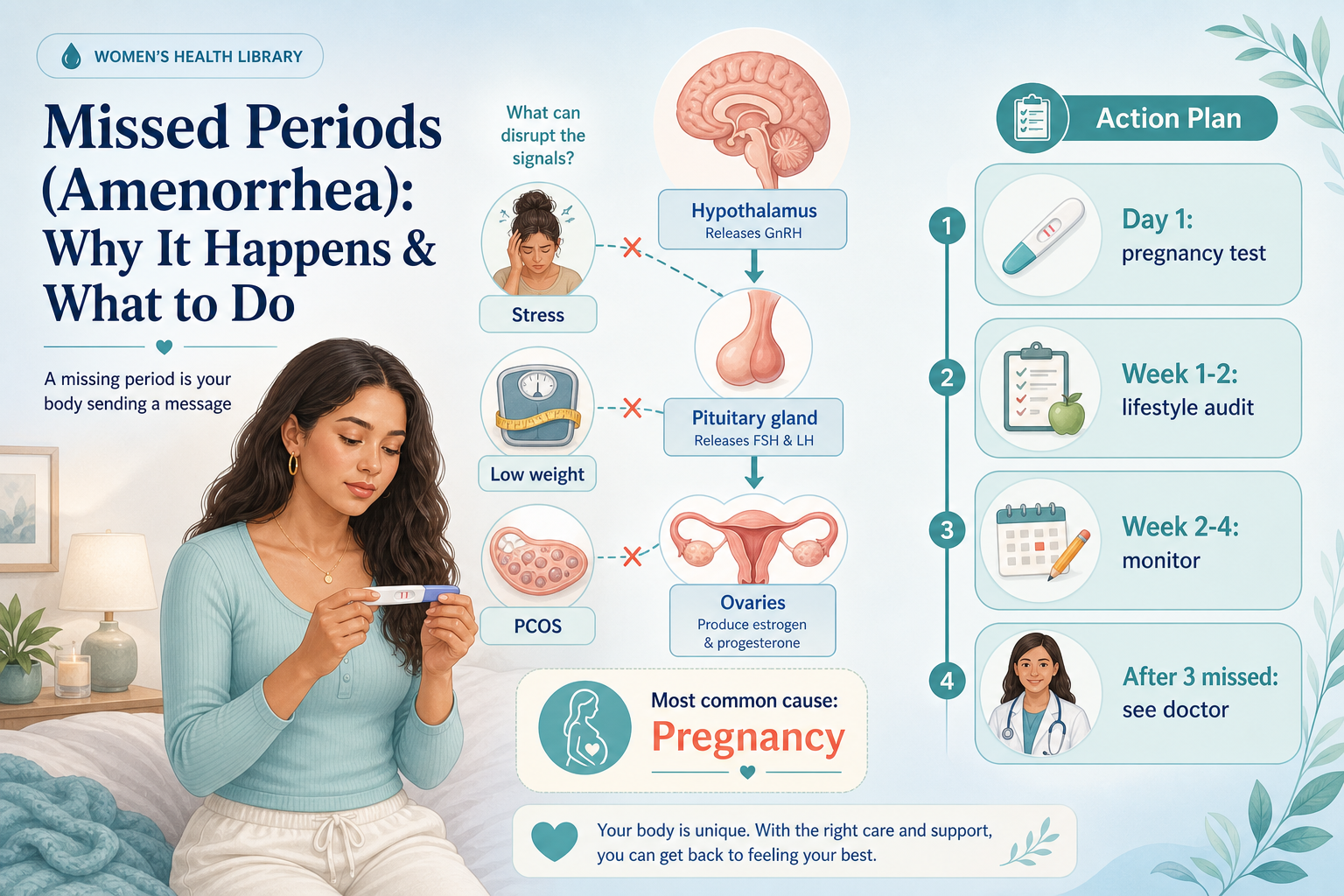
Quick Facts
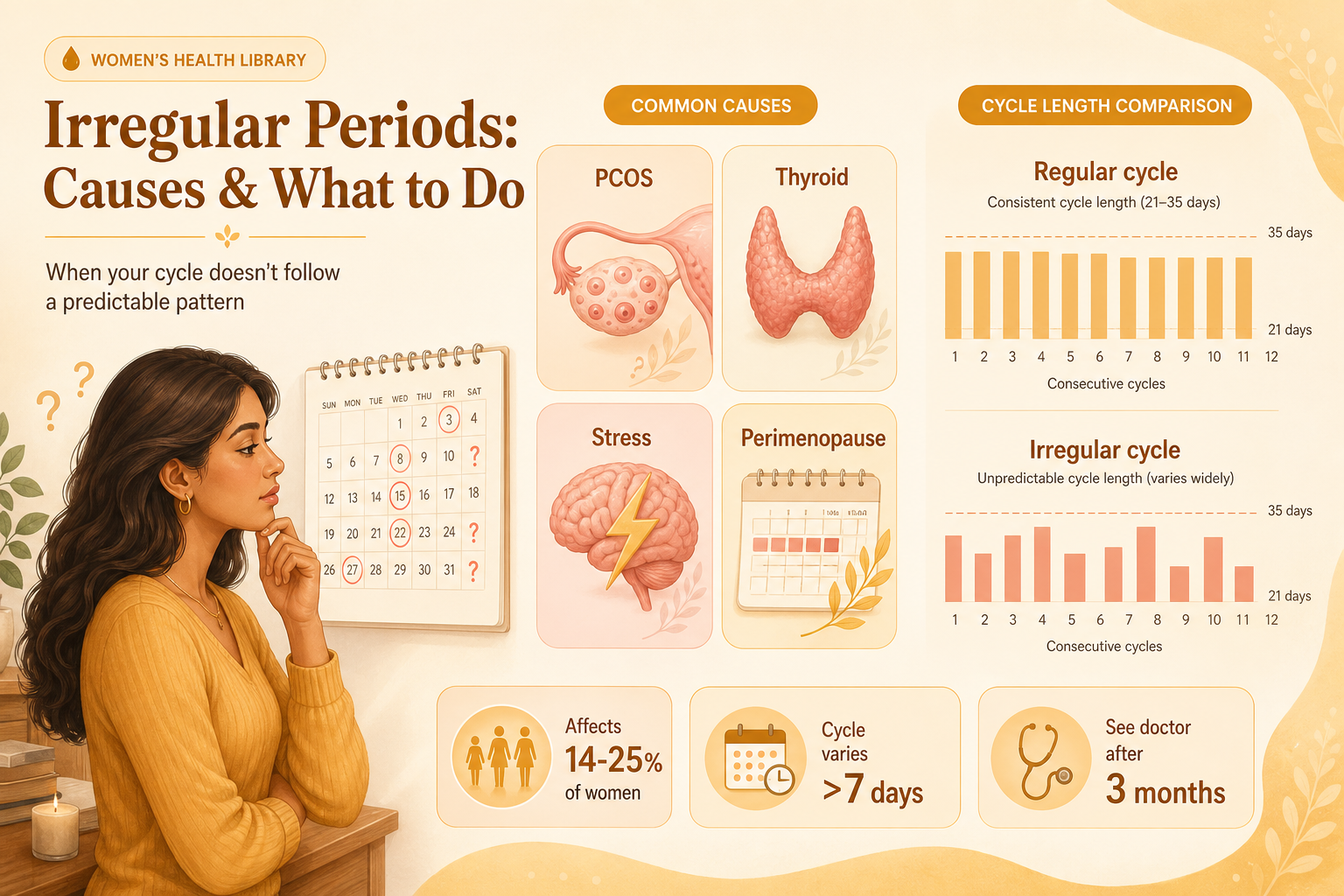
A period is usually called late when it hasn't arrived within about a week of when you expected it, and missed when a whole expected period doesn't come at all. Both are very common and often harmless — but the first question always has the same answer.
If you're sexually active, the single most important step is to take a pregnancy test. Pregnancy is the most common reason for a missed period, and ruling it in or out changes everything that follows. Once pregnancy has been excluded, a delayed or skipped period can come down to stress, a change in weight, intense exercise, hormonal conditions such as PCOS or a thyroid problem, high prolactin, perimenopause, your contraception, or breastfeeding.
This guide explains exactly what to do first, the common causes, how doctors find the reason, and the clear signs that mean you should book an appointment.
Sexually active? Test first
If there's any chance you could be pregnant, take a pregnancy test before looking for other explanations. A test taken from the first day of your missed period is the most reliable.
Track your cycle →Things worth knowing
Test for pregnancy first
If you're sexually active, a pregnancy test comes before any other explanation.
Late and missed are different
A late period is delayed; a missed period is a whole expected cycle that didn't arrive.
Stress can pause periods
Big stress, illness or travel can delay or skip a cycle by shifting cycle hormones.
Weight and exercise matter
Rapid weight loss/gain or very intense training can stop ovulation and periods.
Sometimes it's hormonal
PCOS, thyroid problems and high prolactin are common, treatable causes worth ruling out.
Tracking helps your doctor
Knowing your last period date and usual cycle length is the most useful thing to bring.
Causes at a Glance
A missed or late period has many possible causes. If you're sexually active, work through pregnancy first — then consider the rest:
| Possible cause | What points to it |
|---|---|
| Pregnancy | Sexually active, missed period — confirm with a test first |
| Stress / illness | Recent major stress, sleep loss, illness or travel |
| Weight change | Recent rapid weight loss or gain, or very low body weight |
| Intense exercise | Heavy training load or athletic activity, low energy intake |
| PCOS | Infrequent periods with acne, excess hair or weight gain |
| Thyroid problem | Tiredness, weight change, feeling too hot or cold |
| High prolactin | Milky nipple discharge, missed periods (not breastfeeding) |
| Perimenopause | Age 40s+, cycles spacing out, hot flushes, sleep changes |
| Contraception | Recently started, stopped or switched a hormonal method |
| Breastfeeding | Currently breastfeeding, especially exclusively |
Always rule out pregnancy first
In anyone who is sexually active, a missed period warrants a pregnancy test before any other cause is considered — even if you use contraception.
Quick definitions
- Late period — your period hasn't arrived within ~1 week of the expected date.
- Missed period — a whole expected period didn't come.
- Amenorrhoea — no periods for 3+ months (when previously regular), or periods that have never started by age 15–16.
What You Might Notice Alongside a Missed Period
A missed period can come on its own or with clues to the cause. Note any of these to share with your doctor:
Possible pregnancy signs
- Tender or swollen breasts
- Nausea or food aversions
- Unusual tiredness
- Needing to pee more often
- Light spotting around the time a period was due
Signs pointing to another cause
- Hormonal signs: excess facial/body hair, acne, scalp hair thinning (may suggest PCOS)
- Thyroid signs: weight change, tiredness, feeling too hot or cold, palpitations
- Milky discharge from the nipples when not breastfeeding (may suggest high prolactin)
- Hot flushes, night sweats or sleep changes (around perimenopause)
- Recent major stress, illness, travel, or a big change in weight or exercise
Track while you read
Tick the symptoms that apply to you. This is a self-check, not a diagnosis — saved on this device only.
If a pregnancy test is positive, contact a doctor to confirm and start antenatal care. If it's negative but your period still doesn't come, repeat the test in a few days before assuming another cause.
Causes
There are many reasons a period can be late or missed. If you're sexually active, pregnancy comes first — most other causes are treatable once identified:
- Pregnancy (check first if sexually active)
- The most common reason for a missed period in anyone who is sexually active. A pregnancy test confirms it — take this before considering anything else.
- Stress
- Significant emotional or physical stress, illness or major life change can delay or pause periods by disrupting the brain–ovary hormone signals.
- Weight change
- Rapid weight loss or gain, and being significantly under- or over-weight, can interfere with ovulation and stop periods.
- Intense exercise
- Heavy training loads, especially with low energy intake, can suppress the hormones that drive ovulation and pause periods.
- PCOS (polycystic ovary syndrome)
- A common hormonal condition that causes infrequent or absent periods, often with acne, excess hair or weight changes.
- Thyroid problems
- An under- or over-active thyroid can disrupt the menstrual cycle and cause late or missed periods.
- High prolactin
- Raised prolactin (the hormone that drives milk production) can stop periods, sometimes with milky nipple discharge when not breastfeeding.
- Perimenopause
- In the years before menopause (often 40s+), periods naturally space out and may be skipped before stopping altogether.
- Contraception
- Starting, stopping or switching hormonal contraception can pause periods. Some methods (e.g. the hormonal coil, injection or continuous pill) deliberately stop them.
- Breastfeeding
- Periods often pause while breastfeeding, especially exclusively, and may take time to return after feeds reduce.
A repeatedly missed period with a negative pregnancy test, or no period for 3 months, is a clear prompt to see your doctor.
Diagnosis
There's no single test for a missed period — the cause is worked out from your history, an exam, and targeted tests, starting with pregnancy.
Step 1 — Pregnancy test (first, if sexually active)
- A home urine pregnancy test is the essential first step — accurate, private and widely available.
- Test from the first day of your missed period for the most reliable result; if negative but your period still hasn't come, repeat after a few days.
- Use your first morning urine for the strongest result, and follow the kit instructions.
- A positive test should be followed up with a doctor to confirm and begin antenatal care.
Step 2 — History and examination
- Your cycle pattern, last period date, usual cycle length, other symptoms, weight, stress, exercise, contraception and family history (your tracker data is valuable here).
- Examination for signs of a hormonal cause — skin, hair, weight, blood pressure, and the thyroid.
Step 3 — Blood tests and ultrasound (if needed)
- Thyroid function (TSH)
- To check for an under- or over-active thyroid.
- Prolactin
- To check for raised prolactin as a cause of missed periods.
- Androgens (e.g. testosterone), FSH/LH
- To look for PCOS or other hormonal patterns.
- Glucose / HbA1c
- Sometimes checked, particularly when PCOS is suspected.
- Pelvic ultrasound
- To look at the ovaries and womb (often transabdominal for unmarried women in India, per comfort and clinician judgment).
Bring your history
Keep your cycle log, scans and results in ParentVibes Medical Records so every doctor has the full picture.
Treatment
A late or missed period is a symptom, not a disease — so treatment targets the cause once it's found. Often no treatment is needed beyond reassurance and monitoring.
- Pregnancy
- Not a problem to treat — start antenatal care with a doctor and confirm the pregnancy.
- Stress / lifestyle
- Managing stress, improving sleep, and balancing exercise and eating usually restores cycles over time.
- Weight-related
- Reaching and keeping a healthy weight, with balanced eating; specialist support if there's disordered eating.
- PCOS-related
- Lifestyle measures; the combined pill can help regularise periods; metformin for metabolic features — all under a doctor.
- Thyroid problem
- Treating the thyroid condition usually restores regular cycles.
- High prolactin
- Investigating the cause and, where needed, prescription medicines that lower prolactin, under specialist care.
- Contraception-related
- Reviewing or changing the method with your doctor; periods may take a few months to return after stopping.
- Trying to conceive
- Treating the cause and, if ovulation is absent, ovulation-supporting medicines under specialist care.
Trying to conceive with unpredictable cycles?
The ParentVibes Ovulation Calculator can help you estimate your fertile window and plan next steps.
Try Ovulation Calculator →Never self-medicate
Hormone tablets to 'bring on' a period, the combined pill, metformin, thyroid and prolactin-lowering medicines are prescription-only and must be chosen and monitored by a doctor.
Home Care
While you find the cause, these steps support a healthier, more predictable cycle:
Support your cycle
- If sexually active, take a pregnancy test first — don't wait to rule this out
- Aim for a healthy, stable weight — both very low and rapidly changing weight disrupt ovulation
- Eat regularly and balanced — don't skip meals or under-eat; build plates around fibre + protein + healthy fats with whole grains/millets
- Match exercise to your body — regular moderate activity helps; extreme training can stop periods
- Manage stress and sleep — both strongly affect cycle hormones (yoga, breathing, 7–9 hours' sleep)
- Track every cycle so you and your doctor can see whether things are improving
Daily habits for steadier cycles
- Balanced meals, no skipping
- Moderate (not extreme) exercise
- 7–9 hours sleep
- Stress check-in
- Cycle and last-period date logged
When to See a Doctor
See a doctor if:
- Your pregnancy test is positive (to confirm and start antenatal care)
- You've missed 3 periods in a row, or had no period for 3 months, with a negative test
- Periods stop suddenly after being regular, or keep being missed
- A missed period comes with milky nipple discharge, hot flushes, or thyroid/hormonal signs
- You're under 45 and periods stop, or you think you're entering early menopause
- You're struggling to conceive
- No periods have started by age 15–16
Seek emergency care
If you have a positive pregnancy test together with severe one-sided pelvic or tummy pain, shoulder-tip pain, dizziness or fainting, this could be an ectopic pregnancy — a medical emergency. Go to your nearest emergency department or call local emergency services straight away.
Continue learning

Frequently Asked Questions
My period is late — what should I do first?
If you're sexually active, take a pregnancy test first. Pregnancy is the most common reason for a missed period, and a test from the first day of your missed period is the most reliable. If it's negative but your period still doesn't come, repeat it in a few days.
How late can a period be before I should worry?
An occasional period that's a few days to a week late is common and usually not a concern. After ruling out pregnancy, see a doctor if you miss 3 periods in a row, have no period for 3 months, or periods keep being missed.
Can I get a negative test and still be pregnant?
Yes, if you test too early. If your test is negative but your period still hasn't arrived, repeat it after a few days and see a doctor if it stays negative and your period doesn't come.
Can stress really stop my period?
Yes. Significant emotional or physical stress, illness or major life changes can delay or pause periods by disrupting the hormones that control your cycle. Cycles usually return once the stress eases.
I'm breastfeeding and have no period — is that normal?
Yes. Periods often pause while breastfeeding, especially exclusively, and may take time to return as feeds reduce. Note that you can still ovulate and conceive before your first period returns.
Could a missed period mean menopause?
If you're in your 40s, periods naturally space out and may be missed in the years before menopause (perimenopause). If periods stop before 45, or you have hot flushes and other symptoms, see a doctor.
Is it safe to take tablets to bring on my period?
Don't take hormone tablets to 'bring on' a period without medical advice. Rule out pregnancy first, and let a doctor find the cause — such medicines are prescription-only and must be chosen and monitored by a clinician.
Was this guide helpful?
Understand your cycle better with ParentVibes
- Track your period dates
- Predict your next cycle
- Understand your fertile window
- Save health notes
- Get gentle reminders
Related tools
Period Tracker
Log periods and learn your personal cycle pattern.
Open tool
Ovulation Calculator
Estimate your ovulation date and fertile window.
Open tool
Fertility Window
See your most fertile days for trying to conceive.
Open tool
Pregnancy Tracker
Follow your pregnancy week by week once you conceive.
Open tool
Due Date Calculator
Estimate your baby's due date from your last period.
Open toolShare this guide with someone who needs it 💛
Medical review
- Last reviewed
- June 2026
- Medical reviewer
- Dr. Vinika G.
- Next review due
- June 2027
- Status
- Medically reviewed by Dr. Vinika G.
References
This article is for general information and education only and is not a substitute for professional medical advice, diagnosis, or treatment. If you are sexually active and your period is late, take a pregnancy test first. Always consult a qualified doctor about missed or late periods and before starting, stopping, or changing any treatment or medication. In a medical emergency — including a positive pregnancy test with severe pain — contact your doctor or local emergency services immediately. Content reviewed against guidance from the NHS, ACOG, and WHO.
Women's Health Library journey
100%Related guides
Free resources
Start here
Your journey with ParentVibes
From your first period to your baby's vaccinations — one continuous, supported path.
Understand your cycle
Know your phases, hormones and what's normal.
Track your period
Log periods and learn your personal pattern.
Understand ovulation
Find your fertile window with the calculator.
Plan pregnancy
A calm, step-by-step start to trying to conceive.
Week-by-week pregnancy
Follow every week once you conceive.
Baby milestones
Track growth and development month by month.
Vaccination tracker
Stay on schedule and never miss a vaccine.
Medical disclaimer
This article is for educational purposes only and does not replace medical advice. If you have severe pain, heavy bleeding, missed periods, or unusual symptoms, please consult a qualified healthcare provider.