
ParentVibes
Women's Health Library · parentvibes.in
Fertility Awareness Methods (Natural Family Planning): How They Work & How Accurate They Are
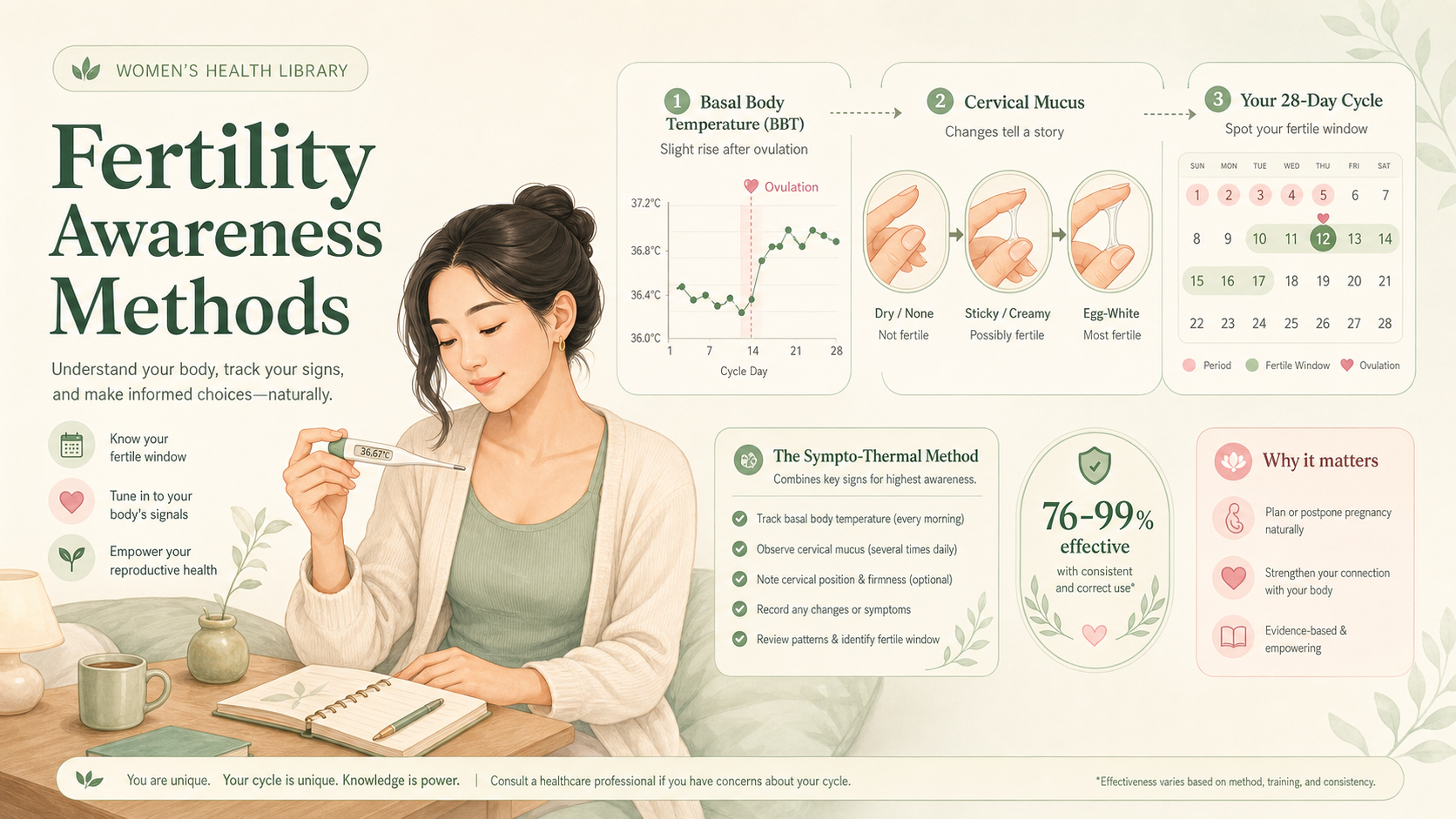
Fertility awareness-based methods (FABMs), also called natural family planning, mean tracking your body's fertility signs to work out the days you're most likely to get pregnant. You can use this knowledge either way — to time intercourse when trying to conceive, or to avoid unprotected sex on fertile days to prevent pregnancy without hormones or devices.
Done carefully, these methods can be effective: when used correctly and consistently, they're estimated at 91–99% effective at preventing pregnancy — but with typical, less-than-perfect use, effectiveness drops to around 76% (roughly 1 in 4 people could conceive in a year). They take commitment, daily tracking, and — when used to avoid pregnancy — real self-control and partner agreement.
Crucially, fertility awareness does not protect against sexually transmitted infections (STIs), and the signs are unreliable while breastfeeding or when cycles are irregular. This guide explains the methods honestly, how to combine them for best accuracy, and where they fit alongside other options.
Track with confidence
The ParentVibes Period & Ovulation trackers help you record temperature, mucus and cycle data in one place — but for using FABMs to avoid pregnancy, proper training is strongly recommended.
Open Ovulation Calculator →Useful tools
Everything You Need to Know (The Methods)
Fertility awareness combines several daily fertility signs. Using all of them together works best.
| Method | What you track | Notes |
|---|---|---|
| Temperature (BBT) method | Resting body temperature each morning | A small rise confirms ovulation has happened |
| Cervical mucus (Billings) method | Changes in vaginal secretions | Clear, stretchy "egg-white" mucus signals peak fertility |
| Calendar/rhythm method | Cycle length over many months | Estimates fertile days; least reliable alone |
| Symptothermal method | Temperature + mucus + calendar | The combined approach — most accurate |
Effectiveness in plain numbers
Up to 99% with perfect use, about 76% with typical use. That gap is bigger than for most other methods, because FABMs depend entirely on consistent, correct daily tracking and acting on it.
If you absolutely must avoid pregnancy right now, FABMs alone carry a higher real-world failure rate than long-acting methods. Consider this carefully and discuss with a doctor or family-planning clinic.
Fertility Signs You Track
These are the body signs FABMs rely on:
The signs
- Cervical mucus — dry/sticky early in the cycle → clear, slippery, stretchy "egg-white" around ovulation → thicker again afterwards
- Basal body temperature — a small sustained rise (~0.2°C) after ovulation, due to progesterone
- Cycle length — recorded over at least 6–12 cycles to estimate fertile days
- Secondary signs (supportive only) — mid-cycle twinge, breast tenderness, libido changes
Track while you read
Tick the symptoms that apply to you. This is a self-check, not a diagnosis — saved on this device only.
Illness, disturbed sleep, travel, alcohol and shift work can all affect temperature and mucus readings — note these so you don't misread a sign.
Why the Signs Work
The signs reflect the cycle's hormones:
- Rising oestrogen
- Before ovulation, oestrogen thins cervical mucus into the fertile "egg-white" type and helps sperm survive and travel.
- The LH surge
- Triggers ovulation.
- Progesterone
- After ovulation, progesterone raises body temperature and thickens mucus again — closing the fertile window.
- When signs are less reliable
- Anything that disrupts the hormones (PCOS, thyroid issues, breastfeeding, perimenopause, stress) makes the signs less reliable.
Assessing if FABMs Suit You
FABMs aren't "diagnosed," but it's worth assessing whether they fit your situation — ideally with a trained fertility-awareness practitioner.
What to consider
- Regular, predictable cycles make FABMs more reliable
- Irregular cycles, PCOS, perimenopause, or breastfeeding make signs unreliable — a poor fit for avoiding pregnancy then
- Your goal — TTC (more forgiving) vs strictly avoiding pregnancy (needs rigour and a backup plan)
- Training — learning from a qualified practitioner greatly improves accuracy
FABM teaching isn't always available routinely; sexual-health/family-planning clinics or accredited practitioners can help. In India, ask your gynaecologist or a family-planning clinic.
Using FABMs Well
FABMs aren't a treatment — they're a skill. Using them well:
- Trying to conceive
- Identify the fertile window and have intercourse every 1–2 days across it.
- Avoiding pregnancy
- Avoid unprotected sex on fertile days; use a barrier method (condoms) on those days as a backup; ideally train with a practitioner.
- STI protection
- FABMs give none — use condoms if STI protection is needed.
Trying to conceive instead?
The ParentVibes Ovulation Calculator turns your signs into a fertile-window estimate.
Try Ovulation Calculator →If avoiding pregnancy is essential
FABMs alone may not be reliable enough — discuss more effective options in the Contraception guide with a doctor.
Tracking Tips
To get the most reliable readings:
Reliable tracking
- Be consistent — same time, same routine for temperature each morning
- Learn the mucus pattern properly (a practitioner or course helps a lot)
- Track for several cycles before relying on the data — especially the calendar element
- Log disruptors (illness, alcohol, travel, poor sleep)
- Use a backup (condoms) on fertile days if avoiding pregnancy
- Be patient — accuracy improves with experience
Reliability habits
- Consistent morning temperature
- Daily mucus check
- 6+ cycles of data before trusting calendar estimates
- Backup method on fertile days (if avoiding pregnancy)
When to See a Doctor / Practitioner
Speak to a doctor or family-planning practitioner if:
- You want to learn FABMs properly, especially to avoid pregnancy
- Your cycles are irregular or you have PCOS/thyroid issues (signs unreliable)
- You're breastfeeding or perimenopausal (signs unreliable)
- You need STI protection
- You've been trying to conceive for 12 months without success (6 months if over 35)
- You think you might be pregnant
Use Ask a Doctor on ParentVibes, or book via Doctor Visits & Appointments.
Continue learning

Frequently Asked Questions
How effective is natural family planning?
Up to 99% with perfect use, but about 76% with typical use — so real-world reliability depends heavily on consistent, correct daily tracking.
What are the main fertility awareness methods?
Temperature (BBT), cervical mucus, and calendar tracking — used together (the symptothermal method) for best accuracy.
Does fertility awareness protect against STIs?
No. Use condoms if you need STI protection.
Can I use FABMs with irregular periods?
They're much less reliable with irregular cycles, PCOS, breastfeeding or around menopause.
Is fertility awareness good for trying to conceive?
Yes — it's a helpful, low-cost way to find your fertile window when TTC.
Do I need training?
Strongly recommended, especially to avoid pregnancy. A trained practitioner improves accuracy a lot.
How long before I can rely on it?
Often several cycles (6–12) of careful tracking, particularly for the calendar element.
Was this guide helpful?
Understand your cycle better with ParentVibes
- Track your period dates
- Predict your next cycle
- Understand your fertile window
- Save health notes
- Get gentle reminders
Related tools
Period Tracker
Log periods and learn your personal cycle pattern.
Open tool
Ovulation Calculator
Estimate your ovulation date and fertile window.
Open tool
Fertility Window
See your most fertile days for trying to conceive.
Open tool
Pregnancy Tracker
Follow your pregnancy week by week once you conceive.
Open tool
Due Date Calculator
Estimate your baby's due date from your last period.
Open toolShare this guide with someone who needs it 💛
Medical review
- Last reviewed
- June 2026
- Medical reviewer
- Dr. Vinika G.
- Next review due
- June 2027
- Status
- Medically reviewed by Dr. Vinika G.
References
This article is for general information and education only and is not a substitute for professional medical advice. Fertility awareness methods are less effective than many other contraceptive methods for preventing pregnancy and provide no protection against STIs. If avoiding pregnancy is important, consult a doctor or family-planning clinic about the most suitable method for you. Always seek professional guidance before relying on any method. In a medical emergency, contact your doctor or local emergency services immediately. Content reviewed against guidance from the NHS and peer-reviewed literature.
Women's Health Library journey
100%Related guides
Free resources
Start here
Your journey with ParentVibes
From your first period to your baby's vaccinations — one continuous, supported path.
Understand your cycle
Know your phases, hormones and what's normal.
Track your period
Log periods and learn your personal pattern.
Understand ovulation
Find your fertile window with the calculator.
Plan pregnancy
A calm, step-by-step start to trying to conceive.
Week-by-week pregnancy
Follow every week once you conceive.
Baby milestones
Track growth and development month by month.
Vaccination tracker
Stay on schedule and never miss a vaccine.
Medical disclaimer
This article is for educational purposes only and does not replace medical advice. If you have severe pain, heavy bleeding, missed periods, or unusual symptoms, please consult a qualified healthcare provider.