
ParentVibes
Women's Health Library · parentvibes.in
Painful Periods (Dysmenorrhoea): Causes, Relief & When to See a Doctor
Quick Facts
Cramping pain in the lower tummy or back during a period is so common it's almost expected — the medical name is dysmenorrhoea. For many, it's mild and passes in a day or two. For others, it's severe enough to disrupt school, work or daily life — and that level of pain is not something you simply have to "put up with."
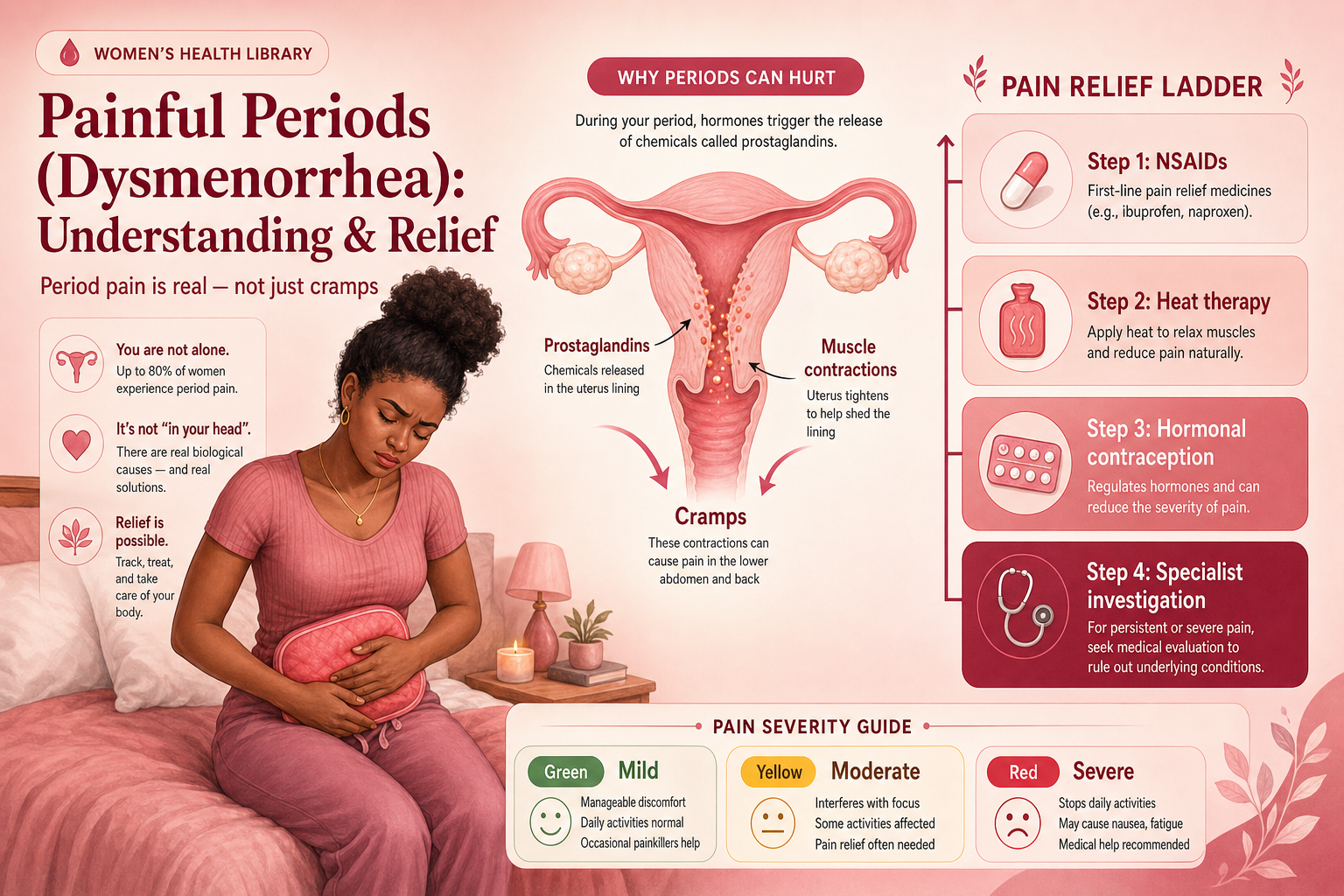
Doctors divide period pain into two types: primary dysmenorrhoea, which has no underlying disease and is caused by natural chemicals called prostaglandins that make the womb contract; and secondary dysmenorrhoea, where the pain is due to an underlying condition such as endometriosis, fibroids, adenomyosis, pelvic infection, or PCOS.
This guide explains why period pain happens, how to tell the two types apart, the relief that actually works, and the warning signs that mean you should see a doctor.
Track your pain
Logging pain levels and timing in the ParentVibes Period Tracker helps you and your doctor see patterns and judge what's normal for you.
Track your period →Useful tools
Things worth knowing
Heat genuinely helps
A warm bottle on the lower tummy works about as well as some painkillers.
NSAIDs target the cause
Ibuprofen and mefenamic acid lower prostaglandins — start them early.
Severe pain isn't normal
Pain that stops you functioning deserves a doctor's review, not endurance.
Worsening pain is a flag
Pain after years of easy periods can be the first sign of endometriosis.
Movement eases cramps
Gentle exercise and yoga release endorphins and improve circulation.
Tracking shows the pattern
Logging pain levels and timing helps you and your doctor judge what's normal for you.
Everything You Need to Know (Primary vs Secondary)
Understanding which type you have shapes the right response:
| Primary dysmenorrhoea | Secondary dysmenorrhoea | |
|---|---|---|
| Cause | No underlying disease — caused by prostaglandins | An underlying condition (endometriosis, fibroids, adenomyosis, PID, PCOS) |
| Typical onset | Often within 1–2 years of first periods, in teens/twenties | Often begins later, after years of relatively pain-free periods |
| Timing of pain | Starts just before/with bleeding; eases after 1–2 days | May last longer, start earlier, or persist beyond the period |
| Other features | Cramps, sometimes nausea, headache, loose stools | May include heavy bleeding, pain during sex, bleeding between periods |
Why it hurts
During a period, the womb lining releases prostaglandins, which make the uterine muscle and blood vessels contract to shed the lining. Higher prostaglandin levels mean stronger cramps — and levels are highest in the first days, which is why pain usually eases after that.
Pain that's getting worse over time, or that started after years of easy periods, is more likely to be secondary and should be checked — it can be the first sign of conditions like endometriosis.
Symptoms
Most period pain follows a familiar pattern — but some features point to a secondary cause.
Common features of period pain
- Cramping or throbbing in the lower tummy, sometimes spreading to the lower back and thighs
- Pain starting just before or as bleeding begins, usually easing within 1–3 days
- Nausea, loose stools, headache, dizziness or tiredness alongside cramps
Features that point to a secondary cause (get checked)
- Pain that is severe, worsening over time, or lasts beyond the period
- Heavy bleeding or large clots
- Pain during or after sex
- Bleeding between periods
- Pelvic pain at times other than your period
Track while you read
Tick the symptoms that apply to you. This is a self-check, not a diagnosis — saved on this device only.
Unticked boxes are worth a doctor's review — Ask a Doctor on ParentVibes can help you decide.
Causes
Primary period pain is driven by prostaglandins; secondary pain is driven by an underlying condition.
- Prostaglandins (primary)
- Natural chemicals in the womb lining that trigger the contractions which cause cramps. Higher levels mean stronger pain.
- Endometriosis
- Womb-like tissue growing outside the womb — a common secondary cause.
- Adenomyosis
- Womb-lining tissue growing into the muscle wall of the uterus.
- Fibroids
- Non-cancerous growths in the womb.
- Pelvic inflammatory disease (PID)
- Infection of the reproductive organs.
- PCOS and other conditions
- PCOS and other gynaecological conditions; sometimes an IUD, especially early on.
- Things that worsen primary pain
- Smoking, high stress, and starting periods at a young age are associated with more severe cramps.
Diagnosis
A doctor distinguishes primary from secondary pain through your history, an exam, and tests if needed.
What your doctor may do
- History — when pain started (relative to your first periods), where it is, how long it lasts, severity, and any of the 'secondary' features above
- Examination — abdominal and, if appropriate, a pelvic exam
- Tests if a secondary cause is suspected — a pelvic ultrasound (often transabdominal for unmarried women in India, per comfort and clinician judgment); swabs if infection is possible; and in some cases referral for a laparoscopy to diagnose endometriosis
Primary dysmenorrhoea is often diagnosed from the typical history alone, once secondary causes are considered unlikely.
Treatment
The goal is effective relief and treating any underlying cause.
- Primary — first-line medicine
- NSAIDs (e.g. ibuprofen) are the evidence-based first line — they reduce prostaglandins, so they work best taken as pain starts (only as directed, and if safe for you). Paracetamol is an alternative.
- Primary — hormonal options
- A doctor may recommend hormonal options (e.g. the combined pill) to reduce pain by thinning the womb lining and lowering prostaglandins.
- Primary — self-care
- Heat, gentle exercise and the self-care below genuinely help.
- Secondary dysmenorrhoea
- Treatment is directed at the underlying cause (e.g. endometriosis, fibroids or infection), guided by a specialist.
Time your relief
The ParentVibes Period Tracker can remind you to start relief early in your cycle, when it works best.
Open Period Tracker →Use medicines safely
Don't exceed recommended doses; some painkillers aren't suitable for everyone (e.g. certain stomach, kidney or asthma conditions). Hormonal treatments are prescription-only. Check with a doctor or pharmacist.
Home Care
Proven, doctor-supported self-care for cramps:
Relief that works
- Heat — a hot-water bottle or heat pad on the lower tummy or back (as effective as some medicines for many people)
- Gentle movement — light walking, stretching or yoga eases cramps
- Warm bath, rest, and relaxation/breathing techniques
- Stay hydrated; some find reducing very salty, sugary or caffeinated foods helps bloating
- Iron-rich foods if your periods are heavy (leafy greens, dals, jaggery, eggs)
- A TENS machine or gentle massage helps some people
Period-pain relief kit
- Hot-water bottle / heat pad
- Pain relief (as advised)
- Comfortable clothing
- Water bottle
- 10-minute gentle yoga routine
If you're regularly missing school/work or home care isn't enough, that's a signal to see a doctor — not to push through.
When to See a Doctor
See a doctor if:
- Period pain is severe or stops you doing normal activities
- Pain isn't relieved by usual measures (heat, simple pain relief)
- Pain is getting worse over time, or started after years of easy periods
- You have pain during/after sex, bleeding between periods, or unusually heavy bleeding
- You have pelvic pain at times other than your period
- You also have fever, unusual vaginal discharge, or feel generally unwell (possible infection)
Seek urgent care
For sudden severe pelvic pain with fever, fainting, or very heavy bleeding — these need same-day assessment.
Continue learning
Frequently Asked Questions
Why are my periods so painful?
Period pain is usually caused by prostaglandins making the womb contract (primary dysmenorrhoea). Severe or worsening pain can be due to an underlying condition like endometriosis (secondary dysmenorrhoea) and should be checked.
What's the fastest relief for period cramps?
Heat (a hot-water bottle), gentle movement, and an NSAID like ibuprofen taken as pain begins (if safe for you) are the most evidence-backed options.
Is severe period pain normal?
Mild–moderate cramps are common, but pain that stops you living normally is not something to just endure — see a doctor.
Does period pain mean something is wrong?
Often not (primary dysmenorrhoea). But pain during sex, between periods, heavy bleeding, or pain that's worsening can signal a treatable condition.
Will period pain get better with age or after childbirth?
For some people primary period pain eases with age or after childbirth, but this isn't guaranteed — and it shouldn't be a reason to ignore severe pain.
Can exercise really help cramps?
Yes — gentle activity and stretching can reduce cramp severity for many people.
Are painkillers safe to take every month?
NSAIDs are commonly used short-term for period pain, but they aren't suitable for everyone and shouldn't be overused — check with a doctor or pharmacist about what's right for you.
Was this guide helpful?
Understand your cycle better with ParentVibes
- Track your period dates
- Predict your next cycle
- Understand your fertile window
- Save health notes
- Get gentle reminders
Related tools
Period Tracker
Log periods and learn your personal cycle pattern.
Open tool
Ovulation Calculator
Estimate your ovulation date and fertile window.
Open tool
Fertility Window
See your most fertile days for trying to conceive.
Open tool
Pregnancy Tracker
Follow your pregnancy week by week once you conceive.
Open tool
Due Date Calculator
Estimate your baby's due date from your last period.
Open toolShare this guide with someone who needs it 💛
Medical review
- Last reviewed
- June 2026
- Medical reviewer
- Dr. Vinika G.
- Next review due
- June 2027
- Status
- Medically reviewed by Dr. Vinika G.
This article is for general information and education only and is not a substitute for professional medical advice, diagnosis, or treatment. Severe or worsening period pain should be assessed by a doctor. Always consult a qualified doctor or pharmacist before taking any medicine, and before starting, stopping, or changing any treatment. In a medical emergency, contact your doctor or local emergency services immediately. Content reviewed against guidance from ACOG, the NHS, and peer-reviewed literature.
Women's Health Library journey
100%Related guides
Free resources
Start here
Your journey with ParentVibes
From your first period to your baby's vaccinations — one continuous, supported path.
Understand your cycle
Know your phases, hormones and what's normal.
Track your period
Log periods and learn your personal pattern.
Understand ovulation
Find your fertile window with the calculator.
Plan pregnancy
A calm, step-by-step start to trying to conceive.
Week-by-week pregnancy
Follow every week once you conceive.
Baby milestones
Track growth and development month by month.
Vaccination tracker
Stay on schedule and never miss a vaccine.
Medical disclaimer
This article is for educational purposes only and does not replace medical advice. If you have severe pain, heavy bleeding, missed periods, or unusual symptoms, please consult a qualified healthcare provider.