
ParentVibes
Women's Health Library · parentvibes.in
Excess Hair Growth (Hirsutism) in Women: Causes & What Helps
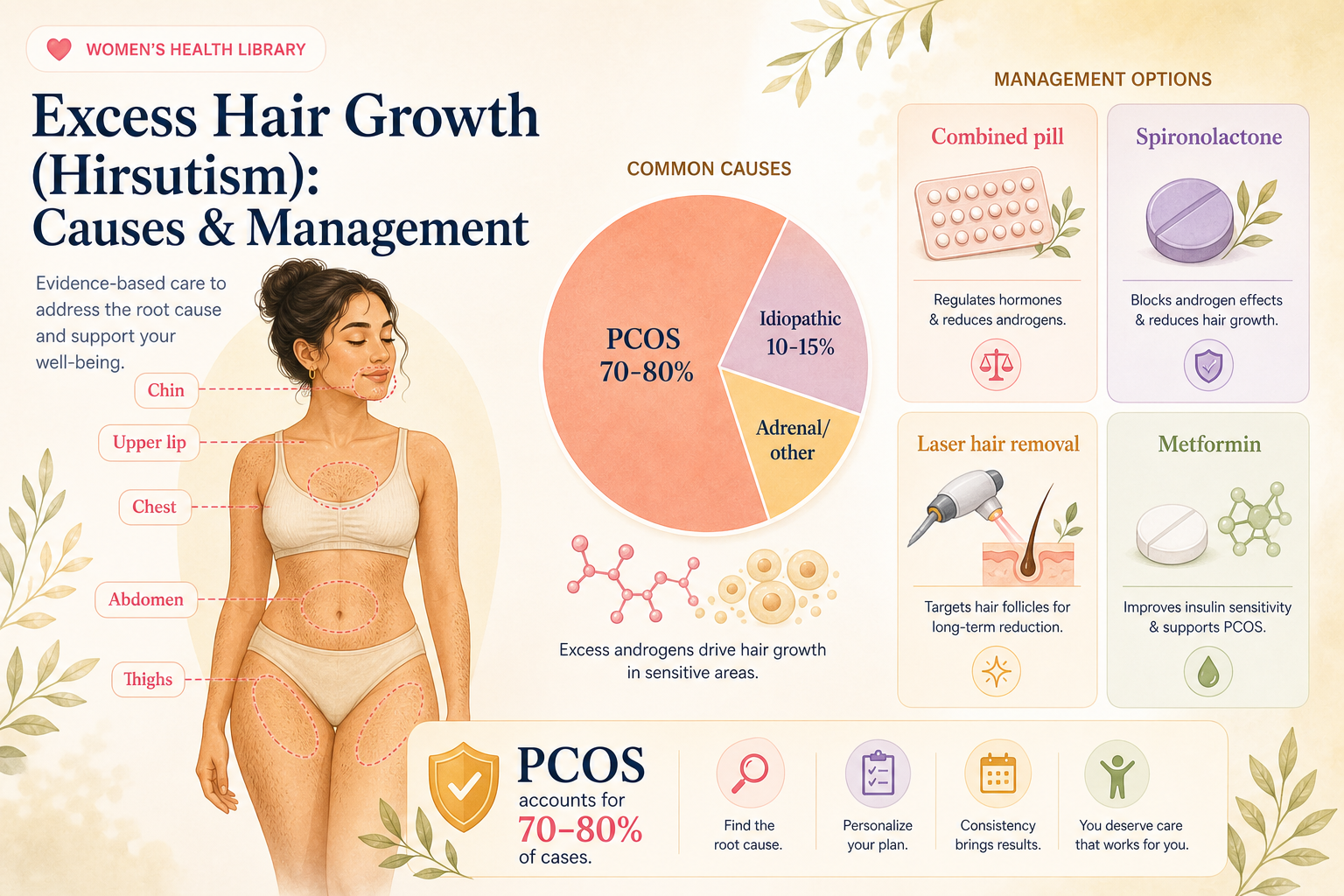
Hirsutism at a glance
Many women notice darker, coarser hair appearing where they'd rather it didn't — on the chin, upper lip, jawline, chest, tummy or lower back. When this hair grows in a 'male pattern' (the areas where men typically grow hair), it's known as hirsutism. It's far more common than most people realise, and it is nothing to feel ashamed of.
The key thing to understand is that hirsutism is almost always linked to androgens — a group of hormones, sometimes called 'male hormones', that every woman's body makes in small amounts. Either there are slightly higher levels of these hormones, or your hair follicles are simply more sensitive to normal levels. The most common underlying reason is PCOS (polycystic ovary syndrome), though there are other causes too.
Excess hair growth is not a sign of poor hygiene, and it is not a failure of femininity — it's a medical sign with real, treatable explanations. This guide explains why it happens, the everyday hair-removal options and the medical treatments that help, and when it's worth seeing a doctor to check for an underlying cause.
It's a sign, not a flaw
Hirsutism is common and treatable. Because it's often linked to a hormonal cause like PCOS, noticing it is actually useful — it can be the clue that helps you and a doctor understand your wider health.
Read about PCOS →What Is Hirsutism?
Hirsutism means excess hair growth in women in a pattern more typical of men — coarse, dark, terminal hair on the face (chin, upper lip, jaw), chest, upper abdomen and back. It's different from the fine, pale 'vellus' hair that covers most of the body. It's also different from hypertrichosis, which is excess hair all over the body (not in a male pattern) and has separate causes.
Normal body and facial hair varies hugely between women, families and ethnic groups — many women of South Asian and Mediterranean heritage naturally have more visible body hair, and that on its own is not a medical problem. Hirsutism specifically describes coarse hair in the androgen-sensitive, male-pattern areas, often when it's new, increasing, or appearing alongside other changes.
If body hair has always been part of your normal and isn't changing, that's usually just natural variation. It's a noticeable change — new, increasing or rapid hair growth — that's most worth checking with a doctor.
Excess hair growth, in short
It's usually about androgens
Hirsutism is most often driven by androgens — male-type hormones all women make — or by hair follicles being extra sensitive to them.
PCOS is the most common cause
Polycystic ovary syndrome is the leading hormonal reason for hirsutism, often alongside irregular periods and acne.
You're not alone — and it's not your fault
Excess hair is common and is not about hygiene, diet alone or femininity. It's a medical sign, not a flaw.
There are real options
From everyday hair removal to longer-term methods and medical treatment, there's a lot that genuinely helps.
Treatment takes patience
Because hair grows in cycles, medical treatments can take several months to show clear results — that's normal.
A check-up is worth it
Sudden or fast-growing excess hair, or hair with other changes, deserves a doctor's assessment to find the cause.
Signs & Associated Symptoms
Hirsutism itself is the visible sign — coarse, dark hair in male-pattern areas. Because it's often part of a wider hormonal picture, it can come with other changes that are worth noting together.
The hair pattern itself
- Coarse, dark hair on the upper lip and chin
- Hair along the jawline, sideburns or neck
- Hair on the chest, around the nipples or down the midline of the tummy
- Hair on the upper back, shoulders or lower back
- Hair on the inner thighs or buttocks
Other changes that can occur together
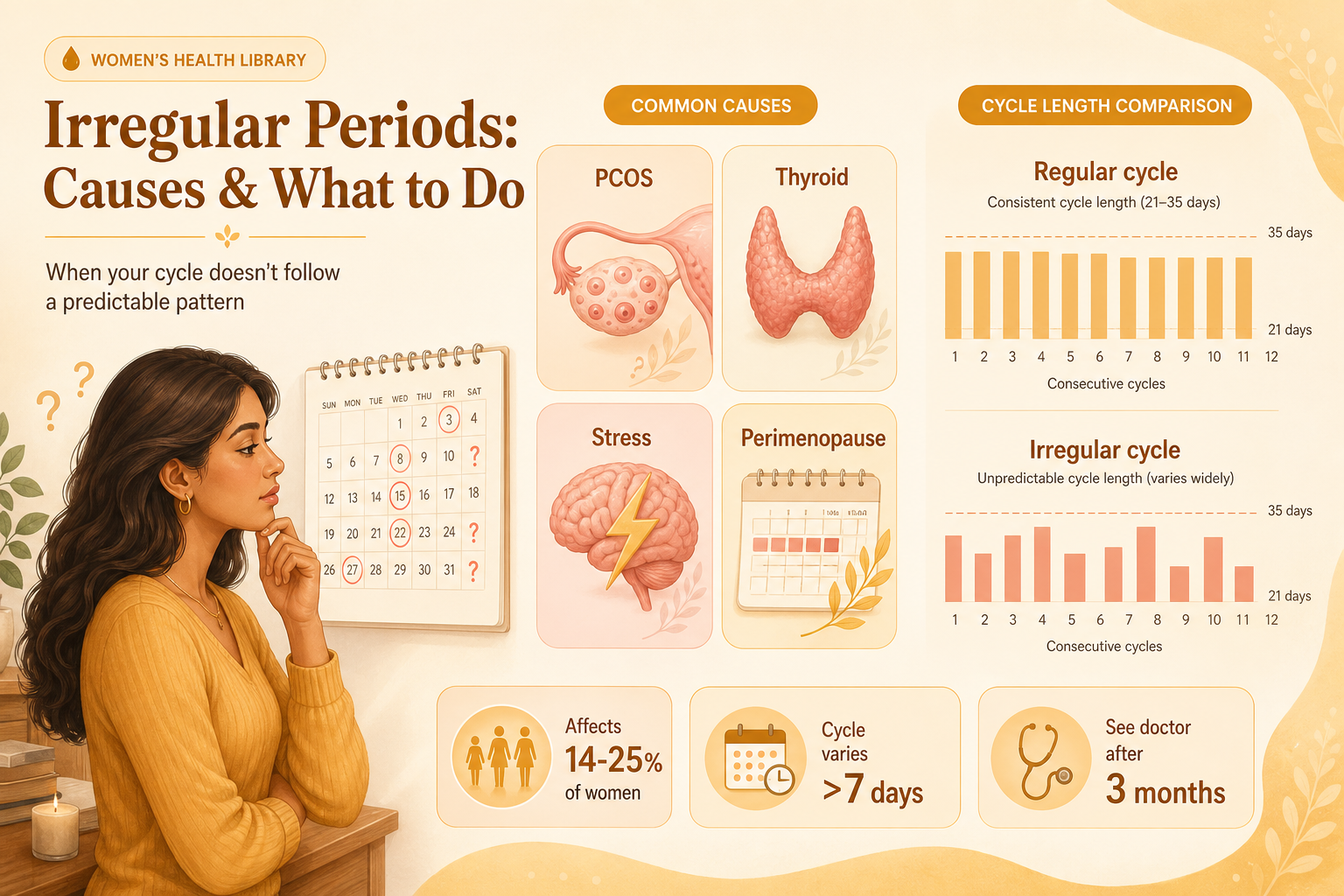
- Irregular, infrequent or absent periods
- Acne or oily skin
- Thinning hair on the scalp (male-pattern thinning)
- Difficulty losing weight or weight gain around the middle
- Darkened patches of skin (often in folds such as the neck or armpits)
Track while you read
Tick the symptoms that apply to you. This is a self-check, not a diagnosis — saved on this device only.
Notice it together
Excess hair alongside irregular periods and acne is a common combination pointing to a hormonal cause like PCOS. Tracking your cycle helps you and your doctor see the full picture.
Track your cycle →What Causes Excess Hair Growth?
Hirsutism is driven by androgens — hormones such as testosterone that all women make in small amounts — or by hair follicles that are extra sensitive to normal androgen levels. In many women no single 'disease' is found and it simply runs in the family; in others, an underlying hormonal cause is at play.
- PCOS (the most common cause)
- Polycystic ovary syndrome is by far the most common reason for hirsutism. PCOS is linked to higher androgen levels and often shows up alongside irregular or absent periods, acne and difficulty managing weight. Excess hair is one of its most recognised features.
- Family and ethnic background
- Sometimes there's no hormone imbalance at all — the hair follicles are just more sensitive to normal androgen levels, and this tendency runs in families. Naturally fuller body hair is also more common in some ethnic groups, including many South Asian women.
- Other hormonal conditions
- Less commonly, conditions affecting the adrenal glands (such as congenital adrenal hyperplasia or, rarely, tumours) or other endocrine problems can raise androgens and cause excess hair. These are uncommon but important reasons a doctor may check.
- Certain medicines
- Some medications can promote hair growth — for example, certain hormone treatments (including some androgen or anabolic steroids) and a few other drugs. A doctor can review whether anything you take could be contributing.
- Idiopathic hirsutism
- When tests are normal and periods are regular, excess hair with no identifiable cause is called idiopathic hirsutism. It's still real and still treatable — it simply means no underlying condition was found.
Why PCOS comes up so often
Because PCOS is the leading hormonal cause, doctors often check for it when excess hair appears with irregular periods or acne. Understanding PCOS can make the whole picture clearer.
Learn about PCOS →Hair Removal & Medical Treatment
There are two parts to managing hirsutism: removing or reducing the hair you have, and — where there's an underlying hormonal cause — treating that cause so less new hair grows. Many women use a combination. Because hair grows in cycles, give any approach time before judging it.
- Everyday hair removal
- Shaving, plucking, threading, waxing and depilatory creams remove hair temporarily and safely. They don't make hair grow back thicker (a common myth) — they simply manage it day to day, which is perfectly fine.
- Longer-lasting hair reduction
- Laser hair reduction and electrolysis can reduce hair more durably over a course of sessions. Results vary with skin and hair type, and several sessions are usually needed; a qualified, experienced provider matters.
- Prescription creams
- A doctor may prescribe a topical cream that slows facial hair growth. It doesn't remove existing hair but can reduce regrowth over time, and is often combined with other methods.
- Hormonal treatment
- Where androgens or PCOS are involved, a doctor may discuss the combined hormonal pill or anti-androgen medicines to lower androgen activity and slow new hair growth. These are prescribed and monitored individually and take several months to work.
- Treating the underlying cause
- If a condition such as PCOS or an adrenal problem is found, treating it — alongside healthy lifestyle steps where weight and insulin play a role — is the foundation that makes other treatments more effective.
Combine and be patient
Most women do best with a combination — hair removal for the here-and-now, plus medical treatment for the underlying cause. Because of the hair-growth cycle, give medical treatments at least a few months before expecting clear results.
Ask a Doctor →Hormonal and prescription treatments need a doctor
The combined pill, anti-androgen medicines and prescription creams must be assessed, prescribed and monitored by a doctor — never started or stopped on your own, and anti-androgens in particular are not suitable in pregnancy. Choose qualified, reputable providers for laser or electrolysis, and discuss any supplement with a doctor first.
Caring for Yourself at Home
Hair removal manages the hair you can see, while everyday habits support the hormonal picture underneath — especially when PCOS or insulin resistance is involved. None of this is about blame; it's about giving your body steady support.
Choose hair removal that suits you
- Pick methods you find comfortable and affordable — shaving, threading, waxing or creams are all fine
- Shaving does not make hair grow back thicker or faster; that's a myth
- Patch-test creams and be gentle with sensitive facial skin to avoid irritation or ingrown hairs
Support steady hormones with food
- Eat regular, balanced meals — include fibre, protein, dal, vegetables and whole grains to keep blood sugar steady
- Go easy on very sugary and heavily processed foods, which can worsen insulin-related issues in PCOS
- There's no 'magic' diet, but steady eating supports the hormonal picture behind excess hair
Move regularly
- Aim for regular activity through the week — brisk walking, cycling, dancing or strength work
- Movement improves how the body handles insulin, which can help with PCOS-related hirsutism
- Even a daily 20–30 minute walk is a meaningful start
Look after your mind
- Excess hair can affect confidence and mood — those feelings are valid and common
- Talk to trusted friends or family, and be kind to yourself; this is a medical sign, not a flaw
- If it's weighing on you, a doctor or counsellor can help — you don't have to manage it alone
Your feelings matter too
It's completely normal for unwanted hair to affect how you feel. Caring for your emotional wellbeing is part of treatment — not an afterthought.
When to See a Doctor
Please speak to a doctor or gynaecologist if:
- Excess hair is new, increasing or growing quickly, especially over weeks to months
- It appears alongside irregular, infrequent or absent periods
- You also notice acne, scalp thinning, weight changes or darkened skin patches
- Hair removal isn't enough and you'd like to explore medical options
- The excess hair is affecting your confidence, mood or daily life
Rapidly growing excess hair over weeks to a few months
See a doctor promptly to check for a hormonal cause
A deepening voice, increasing muscle bulk or clitoral enlargement
See a doctor promptly — these signs of stronger androgen effects need assessment
Excess hair with periods that have stopped, or signs of other illness
Arrange a medical review to find and treat the cause
Sudden or rapid changes deserve a prompt check
Excess hair that appears suddenly and grows quickly, or comes with a deepening voice or other strong androgen signs, should be assessed promptly. It's usually treatable, but a doctor needs to identify the cause.
Ask a Doctor →Continue learning
Frequently Asked Questions
What is hirsutism?
Hirsutism is excess, coarse, dark hair growing in women in a male pattern — on the chin, upper lip, jaw, chest, tummy or back. It's usually linked to androgens (male-type hormones all women make) or to hair follicles being extra sensitive to them, and it's common and treatable.
Does excess hair growth mean I have PCOS?
Not necessarily, but PCOS is the most common hormonal cause — especially when excess hair comes with irregular periods and acne. It can also run in families with no hormone imbalance, or have other, less common causes. A doctor can check what's behind it.
Does shaving make facial hair grow back thicker?
No — that's a myth. Shaving cuts hair at the surface and can make regrowth feel coarse for a few days, but it does not change how thick, dark or fast your hair actually grows. Shaving is a safe, simple way to manage unwanted hair.
What's the best way to remove unwanted facial hair?
There's no single 'best' — it depends on your skin, budget and preference. Shaving, threading, waxing and creams work day to day; laser hair reduction and electrolysis can reduce hair more durably over several sessions. Many women combine a removal method with medical treatment for the underlying cause.
Can hirsutism be cured?
It can usually be managed well, and treating an underlying cause (like PCOS) can reduce new hair growth significantly. Because hair grows in cycles, medical treatments take several months to show results, and many women continue some hair removal alongside them.
When should I worry about excess hair growth?
See a doctor if the hair is new, increasing or growing rapidly, if your periods are irregular or absent, or if you notice a deepening voice, scalp thinning or other changes. Sudden, fast-growing excess hair in particular should be checked promptly to find the cause.
Was this guide helpful?
Understand your cycle better with ParentVibes
- Track your period dates
- Predict your next cycle
- Understand your fertile window
- Save health notes
- Get gentle reminders
Related tools
Period Tracker
Log periods and learn your personal cycle pattern.
Open tool
Ovulation Calculator
Estimate your ovulation date and fertile window.
Open tool
Fertility Window
See your most fertile days for trying to conceive.
Open tool
Pregnancy Tracker
Follow your pregnancy week by week once you conceive.
Open tool
Due Date Calculator
Estimate your baby's due date from your last period.
Open toolShare this guide with someone who needs it 💛
Medical review
- Last reviewed
- June 2026
- Medical reviewer
- Dr. Vinika G.
- Next review due
- June 2027
- Status
- Medically reviewed by Dr. Vinika G.
References
This article is for general information and education only and is not a substitute for professional medical advice, diagnosis, or treatment. Always consult a qualified doctor or gynaecologist about excess hair growth, especially if it is new, rapidly increasing, or accompanied by other changes such as irregular periods, acne, scalp thinning or a deepening voice. Prescription creams, the combined hormonal pill and anti-androgen medicines must be prescribed and monitored by a doctor, and some are not suitable during pregnancy. Choose qualified, reputable providers for laser hair reduction or electrolysis, and discuss any supplement before starting it. Content reviewed against guidance from the NHS, ACOG, MedlinePlus and the WHO.
Women's Health Library journey
100%Related guides
Free resources
Start here
Your journey with ParentVibes
From your first period to your baby's vaccinations — one continuous, supported path.
Understand your cycle
Know your phases, hormones and what's normal.
Track your period
Log periods and learn your personal pattern.
Understand ovulation
Find your fertile window with the calculator.
Plan pregnancy
A calm, step-by-step start to trying to conceive.
Week-by-week pregnancy
Follow every week once you conceive.
Baby milestones
Track growth and development month by month.
Vaccination tracker
Stay on schedule and never miss a vaccine.
Medical disclaimer
This article is for educational purposes only and does not replace medical advice. If you have severe pain, heavy bleeding, missed periods, or unusual symptoms, please consult a qualified healthcare provider.