
ParentVibes
Women's Health Library · parentvibes.in
Trying to Conceive: How to Boost Your Chances & When to Seek Help
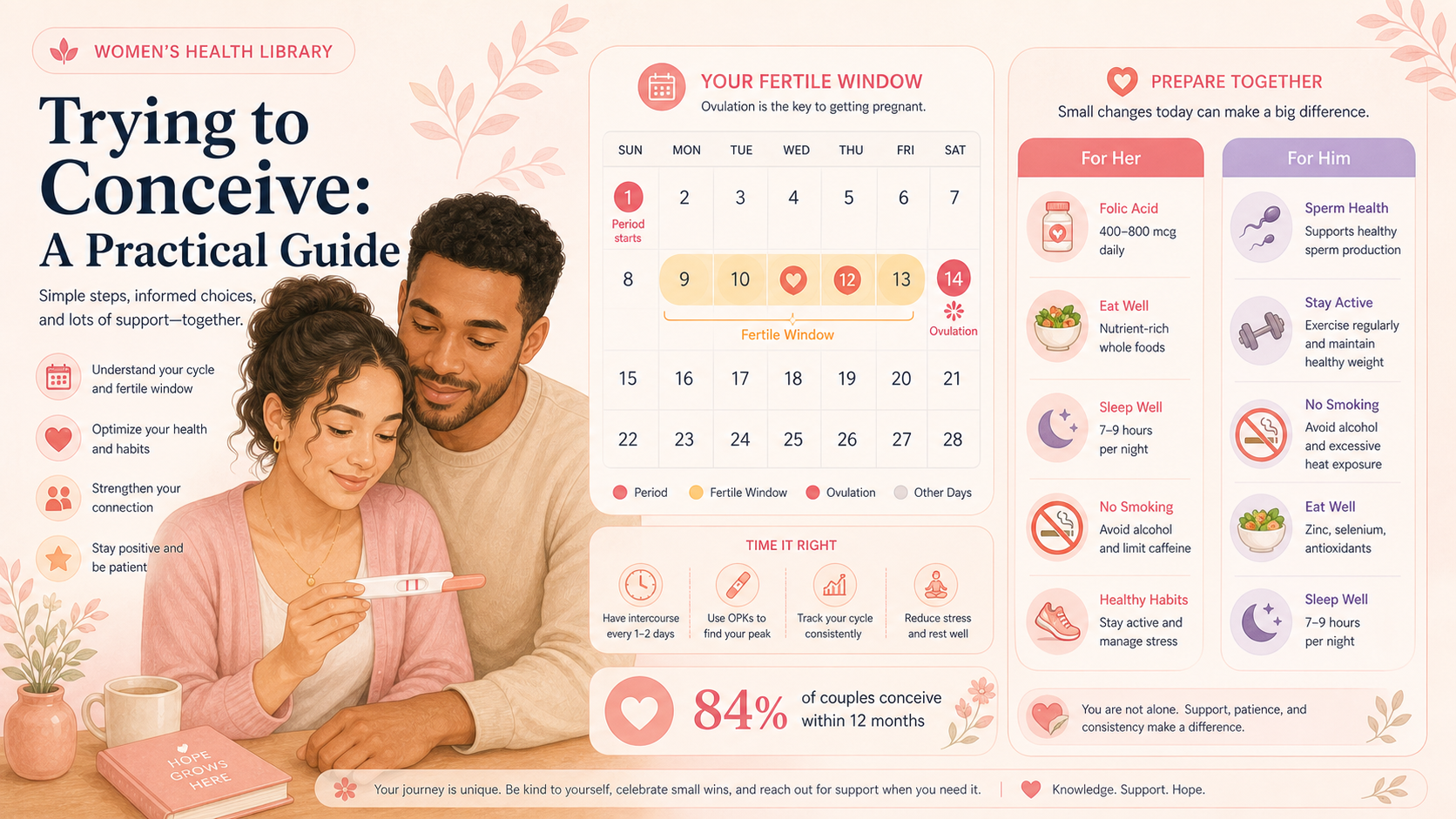
Quick Facts
Deciding to try for a baby is a big, hopeful step. The reassuring news is that for most couples it happens naturally within a year: more than 8 in 10 couples (where the woman is under 40) conceive within one year of regular unprotected sex, and around half of the rest conceive in the second year.
Getting pregnant comes down to a few things you can influence — timing sex around ovulation, looking after both partners' health, and giving it time — and some things you can't. This guide brings them together: how to maximise your chances each cycle, the pre-conception steps that matter most (like folic acid), realistic timelines, and the clear point at which it's wise to see a doctor.
Whether you're just starting out or have been trying for a while, you're in the right place — and you don't have to figure it out alone.
Time it right
The ParentVibes Ovulation Calculator estimates your fertile window so you can focus your efforts where they count.
Open Ovulation Calculator →Things worth knowing
Most couples conceive within a year
Over 8 in 10 (woman under 40) conceive within one year, and about half the rest in the second.
Regular sex beats obsessive timing
Sex every 2–3 days naturally covers your fertile window without overthinking it.
The fertile window is ~6 days
It ends on ovulation day; you're most fertile in the 1–2 days before.
Start folic acid early
400 micrograms daily from at least a month before conception helps prevent neural-tube defects.
It takes two
Fertility involves both partners, so healthy habits and any checks apply to both.
Age and time both matter
Female fertility declines after the mid-30s, so seek advice sooner if the woman is 36+.
Everything You Need to Know (Maximising Your Chances)
The biggest levers are timing and health. Here's what the evidence supports:
| Lever | What to do |
|---|---|
| Have regular sex | Every 2–3 days throughout the month covers your fertile window without overthinking timing |
| Know your fertile window | The ~6 days ending on ovulation day; most fertile in the 1–2 days before |
| Take folic acid | Start 400 micrograms daily at least 1 month before conception |
| Optimise health | Healthy weight, balanced diet, no smoking, limit alcohol — for both partners |
| Give it time | Most conceive within a year; don't lose heart early |
You don't have to track obsessively
Regular sex every 2–3 days means you'll naturally cover the fertile window. Tracking can help, especially with irregular cycles — but stress-free consistency works for most.
It takes two
Fertility involves both partners, so healthy habits and (if needed) checks apply to both.
Fertile Window & Early Pregnancy Signs
Knowing the signs helps you time things — and spot a possible pregnancy.
Signs you're in your fertile window
- Clear, stretchy "egg-white" cervical mucus
- A small rise in temperature after ovulation
- A positive ovulation predictor kit (LH surge)
Possible early pregnancy signs (after a missed period)
- A missed period (take a test)
- Tender breasts, tiredness, nausea, needing to wee more often
- Note: signs vary and aren't reliable until a positive test
Track while you read
Tick the symptoms that apply to you. This is a self-check, not a diagnosis — saved on this device only.
Take a pregnancy test from the first day of a missed period for reliable results; test again if negative but your period doesn't come.
What Affects Your Chances
Several factors influence how quickly you conceive:
- Age
- Fertility (especially female) declines with age, more noticeably after the mid-30s.
- Timing
- Sex needs to fall within the fertile window.
- Ovulation
- Regular ovulation is essential; conditions like PCOS can disrupt it.
- Sperm health
- Quantity and quality of sperm matter.
- Reproductive health
- Blocked tubes, endometriosis, fibroids, or past infections can affect fertility.
- Lifestyle
- Weight, smoking, alcohol, and stress affect both partners.
Most couples have no single "problem" — conception is partly a numbers game across cycles, which is why time and consistency matter.
When & How Fertility Is Assessed
If pregnancy isn't happening, a doctor can help find out why. Both partners should be assessed.
When to seek evaluation
- After 12 months of regular unprotected sex without conceiving
- After 6 months if the woman is 36+ (or there's a known fertility issue)
- Sooner / immediately if the woman is 40+, or there are known risk factors (e.g. very irregular periods, prior pelvic infection, previous cancer treatment)
What an assessment may include
- Both partners' history and examination
- Female: ovulation check (e.g. progesterone blood test), hormone tests, and tubal/uterine checks
- Male: a semen analysis
- Referral to a fertility specialist if needed
Keep cycle data and any reports in ParentVibes Medical Records to bring to appointments.
Help If You Need It
If natural conception isn't working, there are effective options, chosen by a specialist based on the cause:
- Ovulation problems (e.g. PCOS)
- Lifestyle measures; ovulation-inducing medicines (letrozole/clomifene).
- Mild male factor / unexplained
- Lifestyle changes; IUI (intrauterine insemination) in some cases.
- Blocked tubes / more complex
- IVF or other assisted reproduction.
- Male factor
- Treatment of the cause; ICSI with IVF in some cases.
Support through treatment
The ParentVibes IVF Dashboard helps you follow assessment and treatment with your specialist.
Open IVF Dashboard →Specialist care only
Fertility medicines and treatments are prescription-only and need monitoring — never self-medicate. A fertility specialist will tailor the plan to you.
TTC Lifestyle (Both Partners)
Healthy habits genuinely help — and they apply to both of you:
Habits that help
- Folic acid — the woman takes 400 mcg daily, ideally from 1+ month before
- Healthy weight — both very low and high weight affect fertility (female and male)
- Balanced diet — fibre, protein, healthy fats, whole grains
- Stop smoking; limit alcohol — both reduce fertility for both partners
- Manage stress and sleep — high stress can affect cycles and wellbeing
- Limit excess heat for men (e.g. hot tubs) and avoid recreational drugs
- Regular, relaxed sex every 2–3 days — keep intimacy enjoyable, not pressured
Couples' TTC habits
- Folic acid (her), healthy diet (both)
- No smoking, limited alcohol (both)
- Healthy weight goals (both)
- Stress care & good sleep
- Relaxed, regular intimacy
When to See a Doctor
See a doctor (ideally both partners) if:
- You've tried for 12 months without success (under 36)
- You've tried for 6 months without success and the woman is 36+
- The woman is 40+ — seek advice promptly
- There are known issues: very irregular or absent periods, PCOS, endometriosis, previous pelvic infection/surgery, undescended testes or other male factors, or previous cancer treatment
- Either partner is worried, or has a relevant medical condition
Use Ask a Doctor on ParentVibes for guidance, or book a fertility review via Doctor Visits & Appointments.
Continue learning

Frequently Asked Questions
How long does it usually take to get pregnant?
More than 8 in 10 couples (woman under 40) conceive within a year of regular unprotected sex; about half of the rest conceive in the second year.
How often should we have sex to conceive?
Every 2–3 days throughout the month naturally covers the fertile window.
When are the most fertile days?
The 1–2 days before ovulation and ovulation day itself.
Should I take folic acid before getting pregnant?
Yes — 400 micrograms daily, starting at least a month before conception, to help prevent neural-tube defects.
When should we see a doctor?
After 12 months of trying (or 6 months if the woman is 36+, or promptly if 40+ or there are known issues).
Does stress stop you getting pregnant?
High stress can affect cycles and wellbeing; while many stressed couples conceive, looking after your mental health helps.
Can we choose the baby's sex naturally?
No reliable natural method exists; be cautious of myths.
Was this guide helpful?
Understand your cycle better with ParentVibes
- Track your period dates
- Predict your next cycle
- Understand your fertile window
- Save health notes
- Get gentle reminders
Related tools
Period Tracker
Log periods and learn your personal cycle pattern.
Open tool
Ovulation Calculator
Estimate your ovulation date and fertile window.
Open tool
Fertility Window
See your most fertile days for trying to conceive.
Open tool
Pregnancy Tracker
Follow your pregnancy week by week once you conceive.
Open tool
Due Date Calculator
Estimate your baby's due date from your last period.
Open toolShare this guide with someone who needs it 💛
Medical review
- Last reviewed
- June 2026
- Medical reviewer
- Dr. Vinika G.
- Next review due
- June 2027
- Status
- Medically reviewed by Dr. Vinika G.
References
This article is for general information and education only and is not a substitute for professional medical advice, diagnosis, or treatment. Fertility varies between individuals and couples. Consult a qualified doctor or fertility specialist if you have concerns or meet the timelines above, and before taking any medicine. In a medical emergency, contact your doctor or local emergency services immediately. Content reviewed against guidance from the NHS, CDC, ACOG and WHO.
Planning Parenthood Library journey
100%Related guides
Free resources
Medical disclaimer
This article is for educational purposes only and does not replace medical advice. If you have severe pain, heavy bleeding, missed periods, or unusual symptoms, please consult a qualified healthcare provider.