
ParentVibes
Women's Health Library · parentvibes.in
Contraception: Methods, Effectiveness & How to Choose the Right One
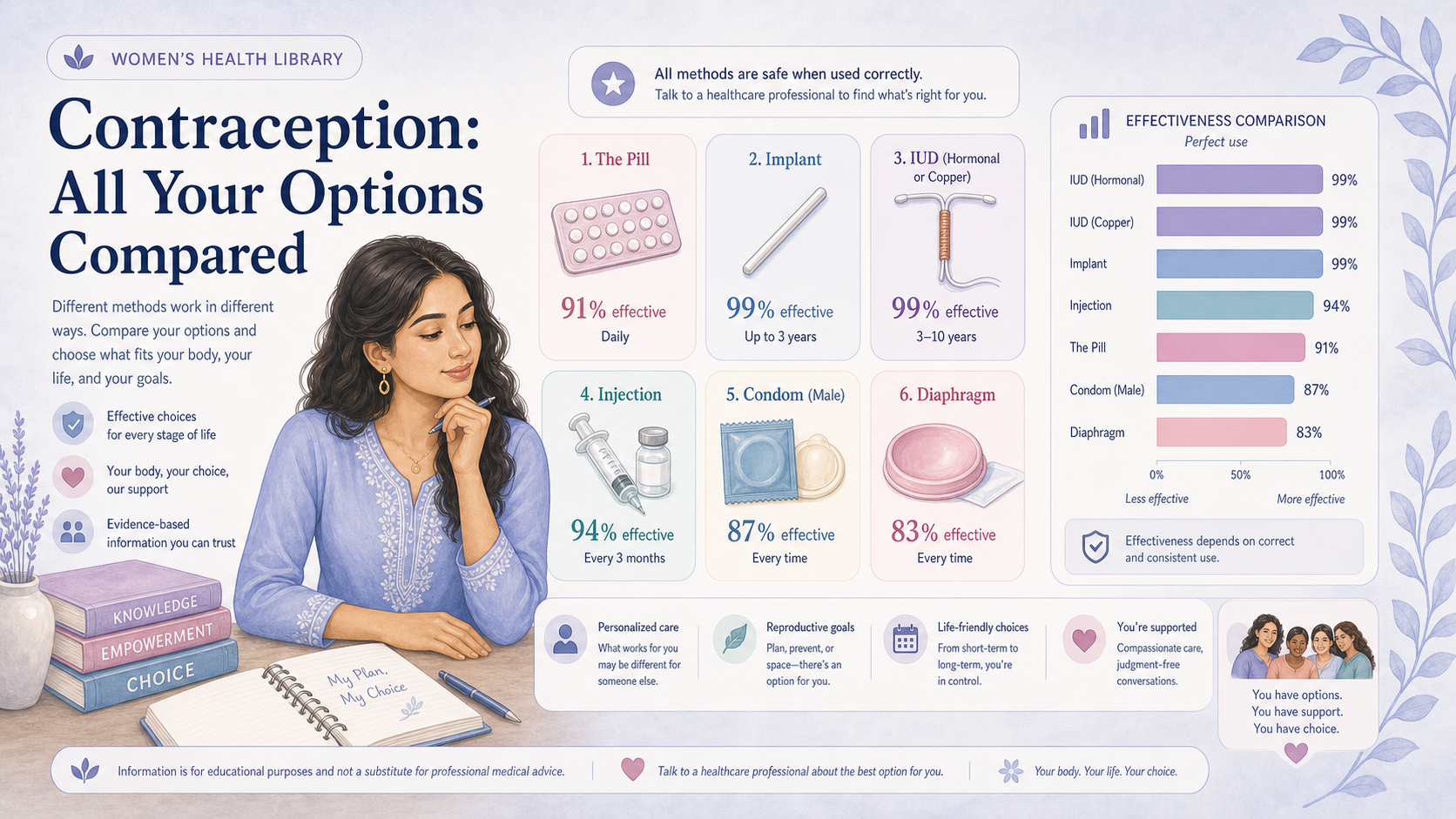
Contraception (birth control) lets you decide whether and when to have a baby. There's no single "best" method — the right one depends on your health, your plans, how reliable you need it to be, and your preferences. The good news: there are many safe, effective options.
Methods fall into two broad groups. Long-acting reversible contraceptives (LARCs) — the implant, intrauterine device (IUD), intrauterine system (IUS) and injection — work without you having to remember anything daily, and the implant, IUD and IUS are over 99% effective. User-dependent methods — the pill, patch, ring and condoms — can be over 99% effective with perfect use, but in real life are less reliable because they're easy to forget or use incorrectly. Condoms, used correctly, are about 98% effective and are the only methods that also protect against STIs.
This guide walks through every main method, how well each works, and the questions that help you and a doctor choose. It's information, not a recommendation — the choice is yours, made with a qualified doctor.
Stay on track
If you choose a method with a routine (pill, patch, ring, injection), ParentVibes reminders and Medical Records help you keep to it and store your prescription details.
Explore the Period Tracker →Useful tools
Everything You Need to Know (The Methods)
Here's the landscape at a glance. Effectiveness shown is with correct/consistent use; typical real-world use is lower for methods that rely on you remembering.
| Method | Type | Effectiveness (correct use) | STI protection? |
|---|---|---|---|
| Implant | LARC (progestogen) | Over 99% | No |
| IUD (copper) | LARC (hormone-free) | Over 99% | No |
| IUS (hormonal coil) | LARC (progestogen) | Over 99% | No |
| Injection | LARC (progestogen) | Over 99% | No |
| Combined pill | User-dependent | Over 99% (lower in typical use) | No |
| Progestogen-only pill | User-dependent | Over 99% (lower in typical use) | No |
| Patch / Vaginal ring | User-dependent | Over 99% (lower in typical use) | No |
| Male / female condoms | Barrier | ~98% / ~95% | Yes |
| Fertility awareness | Natural | Up to 99% (≈76% typical) | No |
| Sterilisation (female/male) | Permanent | Over 99% | No |
LARCs are the most reliable in real life
Because they don't depend on daily action — and they're cost-effective even within the first year. They're fully reversible (except sterilisation).
Only condoms protect against STIs
If STI protection matters, use condoms — even alongside another method ("dual protection").
What to Expect (Side Effects & Changes)
Each method can have effects worth knowing (most are manageable and not everyone gets them):
By method
- Hormonal methods (pill, patch, ring, implant, IUS, injection): possible changes to bleeding (lighter, irregular, or no periods), and some report mood, skin or weight changes. Some can help heavy or painful periods
- Copper IUD: hormone-free, but periods may become heavier or more crampy, especially at first
- Condoms: no hormonal effects; occasional latex sensitivity (latex-free options exist)
- Injection: periods often change; return of fertility can take longer after stopping
Track while you read
Tick the symptoms that apply to you. This is a self-check, not a diagnosis — saved on this device only.
Some methods aren't suitable with certain health conditions (e.g. some combined-hormone methods and a history of blood clots or migraine with aura). A doctor will check what's safe for you.
How Methods Prevent Pregnancy
Different methods work in different ways:
- Stopping ovulation
- Combined pill, patch, ring, implant, injection (mainly).
- Thickening cervical mucus
- To block sperm — progestogen methods.
- Thinning the womb lining
- Many hormonal methods.
- Creating a barrier
- Condoms; the copper IUD also makes the womb hostile to sperm/eggs (copper is toxic to sperm).
- Avoiding fertile days
- Fertility awareness.
- Permanent blocking
- Of the tubes — sterilisation.
Choosing & Getting Started
There's no test — choosing is a guided conversation with a doctor or family-planning clinic.
What a consultation covers
- Your health history — conditions, medicines, migraines, blood-clot risk, smoking, blood pressure, breastfeeding status
- Your priorities — reliability, convenience, period effects, STI protection, future pregnancy plans
- Fitting/prescribing — LARCs (implant/IUD/IUS) are fitted by a trained clinician; pills/patches/rings are prescribed; condoms are available over the counter
- Follow-up — checks after fitting and routine reviews
In India, contraception is available through gynaecologists, family-planning clinics and government health services. Ask a Doctor on ParentVibes can help you prepare questions.
Method Guidance
Matching method to need (always confirmed with a doctor):
- Most reliable, low effort
- Implant, IUD, IUS (LARCs) — over 99%.
- STI protection
- Condoms (alone or with another method).
- Help with heavy/painful periods
- Hormonal IUS or combined pill (doctor-assessed).
- Hormone-free
- Copper IUD, condoms, fertility awareness.
- Planning pregnancy soon
- Condoms or short-acting methods that stop quickly.
- Permanent, no more children
- Sterilisation (after counselling).
- Missed a method / unprotected sex
- Emergency contraception — most effective as soon as possible; see a doctor/pharmacist quickly.
Prescription & fitting needed
Most hormonal and long-acting methods require a doctor's assessment, prescription, or fitting. Don't start or switch methods without medical advice. Emergency contraception is time-sensitive — act quickly.
Using Your Method Well
To get the most from your chosen method:
Method tips
- Pills/patch/ring: take/change on time; set reminders; know what to do if you miss one (check the leaflet/your doctor)
- Condoms: check expiry, store properly, use a new one each time and correctly
- LARCs: note your fitting and replacement-due dates
- Injection: book your repeat on schedule
- All methods: keep condoms available for STI protection; know how to access emergency contraception if something goes wrong
Method-maintenance checklist
- Reminder set (if daily/weekly/monthly)
- Replacement/repeat date noted
- Condoms available for STI protection
- I know my "missed dose / accident" plan
When to See a Doctor
See a doctor or family-planning clinic if:
- You want to start, change or stop a method
- You have side effects that bother you (don't just stop a method without advice)
- You missed pills/patches or had unprotected sex (ask about emergency contraception quickly)
- You have a health condition or new medicine that may affect your method
- You think you might be pregnant, or want to plan a pregnancy
- You need STI testing or protection
Seek urgent care
For signs of a blood clot on combined-hormone methods (severe leg pain/swelling, chest pain, breathlessness) or a severe sudden headache — these are rare but need immediate attention.
Continue learning
Frequently Asked Questions
What's the most effective contraception?
Long-acting reversible methods — the implant, IUD and IUS — are over 99% effective and don't rely on you remembering anything.
Which contraception protects against STIs?
Only condoms. You can use them alongside another method for both pregnancy and STI protection.
How effective is the pill?
Over 99% with perfect use, but lower in typical use because it's easy to miss pills.
Will contraception affect my future fertility?
Most methods don't affect long-term fertility, and fertility usually returns after stopping (the injection can take a bit longer).
Can contraception help with heavy or painful periods?
Yes — some hormonal methods (like the IUS or combined pill) can reduce heavy or painful periods. A doctor can advise.
What if I forget a pill or have unprotected sex?
Emergency contraception is available and works best the sooner it's taken — see a doctor or pharmacist quickly.
Are hormonal methods safe?
They're safe for most people, but not everyone — a doctor checks your health to find a suitable option.
Was this guide helpful?
Understand your cycle better with ParentVibes
- Track your period dates
- Predict your next cycle
- Understand your fertile window
- Save health notes
- Get gentle reminders
Related tools
Period Tracker
Log periods and learn your personal cycle pattern.
Open tool
Ovulation Calculator
Estimate your ovulation date and fertile window.
Open tool
Fertility Window
See your most fertile days for trying to conceive.
Open tool
Pregnancy Tracker
Follow your pregnancy week by week once you conceive.
Open tool
Due Date Calculator
Estimate your baby's due date from your last period.
Open toolShare this guide with someone who needs it 💛
Medical review
- Last reviewed
- June 2026
- Medical reviewer
- Dr. Vinika G.
- Next review due
- June 2027
- Status
- Medically reviewed by Dr. Vinika G.
References
This article is for general information and education only and is not a substitute for professional medical advice, diagnosis, or treatment. Contraceptive suitability depends on your individual health; some methods are not safe for everyone. Always consult a qualified doctor or family-planning clinic before starting, changing or stopping any method, and read the information leaflet for your method. Only condoms protect against STIs. In a medical emergency, contact your doctor or local emergency services immediately. Content reviewed against guidance from the NHS.
Women's Health Library journey
100%Related guides
Free resources
Start here
Your journey with ParentVibes
From your first period to your baby's vaccinations — one continuous, supported path.
Understand your cycle
Know your phases, hormones and what's normal.
Track your period
Log periods and learn your personal pattern.
Understand ovulation
Find your fertile window with the calculator.
Plan pregnancy
A calm, step-by-step start to trying to conceive.
Week-by-week pregnancy
Follow every week once you conceive.
Baby milestones
Track growth and development month by month.
Vaccination tracker
Stay on schedule and never miss a vaccine.
Medical disclaimer
This article is for educational purposes only and does not replace medical advice. If you have severe pain, heavy bleeding, missed periods, or unusual symptoms, please consult a qualified healthcare provider.