
ParentVibes
Women's Health Library · parentvibes.in
Self-Care for Women: Real, Sustainable Ways to Look After Yourself
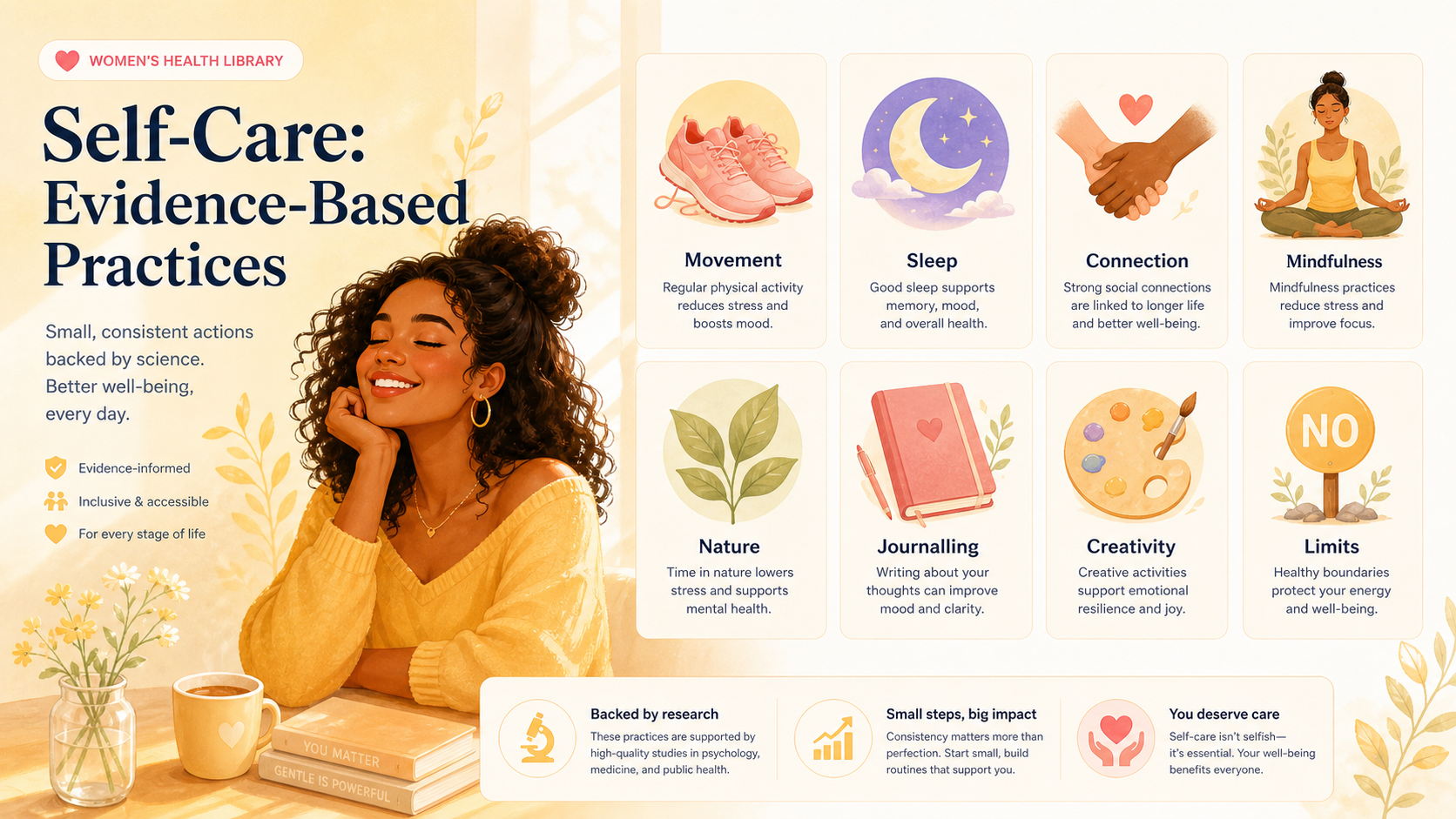
Self-care at a glance
Self-care has become a busy, glossy word — scented candles, spa days, shopping treats. Those things can be lovely, but they're not really what keeps you well. Real self-care is quieter and far more ordinary: getting enough sleep, eating regularly, moving your body, taking breaks, staying connected to people you trust, and being able to say 'not right now' when you're stretched too thin.
For many women, this is exactly the part that slips. When you're holding down a home, a job, children, ageing parents, and everyone else's needs, your own can drift to the very bottom of the list. In close-knit Indian families, where caring for everyone else is often quietly expected, pausing for yourself can even feel selfish or self-indulgent. It isn't. You simply cannot pour endlessly from a cup that's never refilled.
This guide is here to reframe self-care as something sustainable and realistic — not another thing to feel guilty about getting wrong. We'll look at what self-care really is (and isn't), simple practices grouped around rest, body, mind, connection and boundaries, ideas that work with your cycle, and — gently — how to recognise when low mood or anxiety needs more than self-care can give.
Start with one small thing
You don't need a perfect routine or more hours in the day. Pick a single, tiny habit — a glass of water in the morning, a ten-minute walk, lights out a little earlier — and let it be enough. Small and repeated beats big and unsustainable.
Useful tools
What Self-Care Really Is (and Isn't)
Self-care is simply the everyday things you do to look after your physical, mental and emotional health — the steady habits that keep you functioning and feeling like yourself. It's far less about treats and far more about basics: rest, sleep, food, movement, managing stress, and protecting your time and energy. It isn't a reward you earn only after everyone else is taken care of, and it isn't a luxury reserved for people with money or free time. It also isn't about being perfectly calm, productive or 'glowing' — some days, self-care is just doing the bare minimum gently and forgiving yourself for the rest.
It helps to think of self-care less as an event ('I'll relax once everything's done') and more as a practice — a handful of small, repeatable habits woven through ordinary days. It will look different for everyone: for one woman it's an early-morning walk, for another it's ten quiet minutes with chai before the house wakes, or a firm 'no' to one more commitment. There is no single right way to do it.
Self-care is not selfish
Caring for yourself isn't taking away from the people you love — it's what makes it possible to keep showing up for them. A rested, steadier you is a gift to your whole family, not a withdrawal from it.
Self-care, in short
It's a practice, not a purchase
Real self-care is small, repeated habits — not a one-off splurge or a perfect routine.
It isn't selfish
Looking after yourself lets you show up for your family, work and the people who need you.
The basics come first
Sleep, food, movement and rest do the heavy lifting — long before anything fancy.
Boundaries are self-care
Saying 'not right now' or asking for help is a caring act, not a failing.
Connection matters
Time with people who feel safe is one of the most protective things for your wellbeing.
Know the limit
Self-care supports wellbeing — it doesn't replace support when mood or anxiety persist.
Simple, Sustainable Self-Care Practices
These aren't a checklist to complete perfectly — they're a menu to draw from. Pick what fits your life, start small, and let the basics carry most of the weight. Consistency matters far more than intensity.
Rest — give yourself permission to stop
- Build small pauses into the day — a few minutes of doing nothing, without guilt
- Rest isn't only sleep: a quiet sit with a cup of chai, stepping away from your phone, or simply lying down counts
- Notice the urge to be productive every waking minute, and let some moments just be
- On hard or low-energy days, lower the bar — the basics done gently are enough
Body — sleep, food and movement
- Protect your sleep: a consistent bed and wake time, a calm dark room, and winding down off screens
- Eat regular, balanced meals — don't skip them while feeding everyone else; include dal, vegetables, whole grains, fruit and enough protein
- Stay hydrated through the day; it quietly affects energy and mood more than we expect
- Move in ways you enjoy — a daily walk, dancing, yoga, stretching — rather than punishing exercise you'll dread
Mind — calm and headspace
- Try a few minutes of slow breathing, meditation, prayer or simply sitting quietly each day
- Let yourself enjoy small things — a hobby, music, a book, time in nature or sunlight
- Be kind in how you talk to yourself; speak to yourself as you would to a dear friend
- Limit doomscrolling and comparison online, which quietly drain mood and add pressure
Connection — you're not meant to do it alone
- Make time for people who feel safe and easy — a friend, sister, partner or neighbour
- A short call or a cup of tea together can lift a whole day; connection is genuinely protective
- Share how you're really doing with someone you trust, rather than carrying it all silently
- Ask for and accept help with household and caring tasks — it's a strength, not a failure
Boundaries — protecting your time and energy
- It's okay to say 'not right now', or 'no', without a long justification or guilt
- Notice what consistently drains you, and where you can gently step back or delegate
- Let go of the idea that you must do everything for everyone, perfectly, all the time
- Protecting a little time for yourself is a caring act — for you and for those who rely on you
Boundaries can feel uncomfortable at first
If saying no feels awkward, especially within a close family, that's normal — it gets easier with practice. A boundary isn't rejection; it's how you stay well enough to keep loving and caring for the people around you.
Cycle-aware self-care
- If you menstruate, notice how your energy shifts across the month and plan kindly around it
- Around your period and the days before, allow more rest, gentler movement and a lighter schedule
- In the higher-energy days mid-cycle, you may feel more up for activity, socialising or bigger tasks
- Tracking your cycle and mood helps you anticipate dips and care for yourself before you're depleted
Work with your body, not against it
There's no need to push at the same pace every day of the month. Matching your rest and activity to where you are in your cycle is a simple, powerful form of self-care.
Track your cycle →When Self-Care Isn't Enough
Self-care supports your wellbeing, but it isn't a cure for everything — and it isn't meant to be. Low mood, anxiety and burnout are common, real and treatable, and they sometimes need more than good habits alone. Reaching out for support is itself a form of self-care. Please consider speaking to a doctor or mental-health professional if:
- You've felt low, flat, tearful or hopeless on most days for two weeks or more
- Anxiety, worry or feeling on edge is hard to switch off and interferes with daily life
- You've lost interest or pleasure in things you usually enjoy
- Sleep, appetite or energy have changed noticeably and aren't improving
- You feel constantly exhausted, overwhelmed or 'burnt out', and self-care isn't shifting it
- Everyday tasks, work or caring for others have become very hard to manage
- Those around you have gently noticed you don't seem yourself
Please reach out — you don't have to cope alone
If low mood or anxiety persists, talking to a doctor or counsellor genuinely helps — these are treatable, and seeking support is a strength. And if you ever have thoughts of harming yourself or feel unable to stay safe, please reach out now — to someone you trust, a mental-health professional, your local emergency services, or India's Tele-MANAS helpline on 14416 (or 1-800-891-4416), available 24/7. You are not alone, and help is available.
Continue learning
Frequently Asked Questions
Isn't self-care just an excuse to be selfish?
No. Looking after yourself is what makes it possible to keep looking after others. When you're rested, fed and less stretched, you have more patience, energy and warmth for your family, work and the people who depend on you. A refilled cup serves everyone — an empty one helps no one.
I have no time or money for self-care. Where do I even start?
Real self-care costs little and needn't take much time. Start with one tiny, free habit you can repeat — a glass of water in the morning, ten minutes of fresh air, lights out a little earlier, or a few slow breaths. Small and consistent beats big and unsustainable, and the basics matter far more than anything you have to buy.
What's the difference between real self-care and the kind I see online?
The glossy version — spa days, treats, perfect routines — can be lovely, but it isn't what keeps you well. Real self-care is the quieter, everyday basics: sleep, food, movement, rest, connection and boundaries. It's a steady practice, not an occasional purchase, and it often looks quite unglamorous.
How can mothers and carers find time for themselves without guilt?
Guilt is very common, especially in close families where caring for everyone else is expected. It helps to remember that caring for yourself isn't taking from your family — it's what lets you keep giving. Start with small pockets of time, ask for and accept help, and try to let go of doing everything perfectly. You deserve care too.
What does cycle-aware self-care mean?
If you menstruate, your energy and mood naturally shift across the month. Cycle-aware self-care simply means working with that rather than against it — allowing more rest and gentler activity around your period, and leaning into higher-energy days mid-cycle. Tracking your cycle helps you anticipate dips and care for yourself before you're depleted.
How do I know when self-care isn't enough?
If you've felt low, anxious or overwhelmed on most days for two weeks or more, lost interest in things you enjoy, or find self-care just isn't shifting how you feel, it may be more than ordinary stress. Low mood and anxiety are common and treatable — please speak to a doctor or counsellor. If you ever feel unable to stay safe, seek help immediately.
Was this guide helpful?
Understand your cycle better with ParentVibes
- Track your period dates
- Predict your next cycle
- Understand your fertile window
- Save health notes
- Get gentle reminders
Related tools
Period Tracker
Log periods and learn your personal cycle pattern.
Open tool
Ovulation Calculator
Estimate your ovulation date and fertile window.
Open tool
Fertility Window
See your most fertile days for trying to conceive.
Open tool
Pregnancy Tracker
Follow your pregnancy week by week once you conceive.
Open tool
Due Date Calculator
Estimate your baby's due date from your last period.
Open toolShare this guide with someone who needs it 💛
Medical review
- Last reviewed
- June 2026
- Medical reviewer
- Dr. Vinika G.
- Next review due
- June 2027
- Status
- Medically reviewed by Dr. Vinika G.
References
This article is for general information and education only and is not a substitute for professional medical advice, diagnosis, or treatment. Self-care supports wellbeing but does not replace care from a qualified professional. If low mood or anxiety persists, please speak to a doctor or mental-health professional — these are common and treatable, and seeking support is a sign of strength. If you ever have thoughts of self-harm or feel unable to stay safe, please contact someone you trust, a mental-health professional, your local emergency services, or India's Tele-MANAS helpline on 14416 (or 1-800-891-4416), available 24/7. You are not alone, and help is available. Content reviewed against guidance from the NHS, the WHO, Mind and MedlinePlus.
Women's Health Library journey
100%Related guides
Free resources
Start here
Your journey with ParentVibes
From your first period to your baby's vaccinations — one continuous, supported path.
Understand your cycle
Know your phases, hormones and what's normal.
Track your period
Log periods and learn your personal pattern.
Understand ovulation
Find your fertile window with the calculator.
Plan pregnancy
A calm, step-by-step start to trying to conceive.
Week-by-week pregnancy
Follow every week once you conceive.
Baby milestones
Track growth and development month by month.
Vaccination tracker
Stay on schedule and never miss a vaccine.
Medical disclaimer
This article is for educational purposes only and does not replace medical advice. If you have severe pain, heavy bleeding, missed periods, or unusual symptoms, please consult a qualified healthcare provider.