
ParentVibes
Women's Health Library · parentvibes.in
Hair Loss in Women: Causes, Telogen Effluvium, PCOS & Regrowth
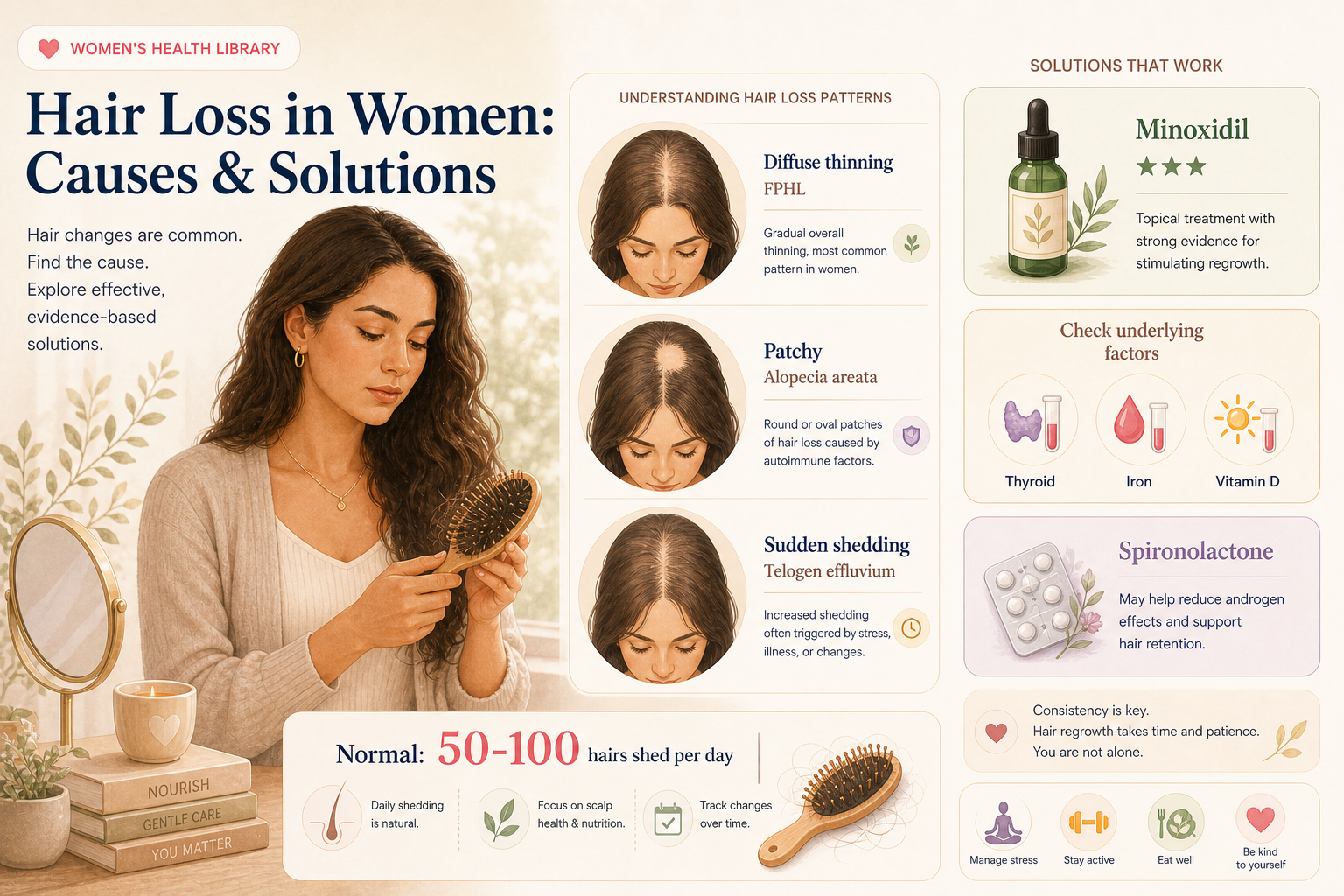
Hair loss at a glance
Noticing more hair in your brush, on your pillow or swirling down the drain can feel alarming — and for many women it stirs real worry about how they look and feel. Please take a breath: hair loss in women is common, often temporary, and in most cases linked to a cause that can be found and treated.
It helps to know that some shedding is completely normal. We naturally lose a certain amount of hair every day as old hairs make way for new ones. Hair grows in cycles, and at any time a portion of your hair is in a resting, shedding phase. So a few strands on the comb are nothing to fear — it's a noticeable, ongoing increase in shedding, or gradual thinning you can see, that's worth understanding.
The most common type of hair loss in women is telogen effluvium — a wave of extra shedding that tends to appear a couple of months after a trigger such as a high fever, illness, surgery, childbirth, crash dieting or a stretch of intense stress. It looks dramatic but usually recovers on its own. Hair loss can also be linked to low iron, thyroid problems, or the hormonal pattern of PCOS — all checkable. A separate pattern, female-pattern hair loss, causes gradual thinning over the top of the scalp. This guide walks through each cause, gentle everyday care, and when it's time to see a doctor or dermatologist.
The timing often holds the clue
If your shedding started 2–3 months after an illness, fever, childbirth, crash diet or a stressful stretch, that delay is the signature of telogen effluvium — a temporary, usually self-recovering type of hair loss. Noting when it began really helps a doctor.
Useful tools
What Is Hair Loss in Women?
Hair grows in a repeating cycle: a long growing phase, a brief transition, and a resting phase that ends with the hair shedding so a new one can grow in its place. At any given time, most of your hair is growing while a smaller share is resting and shedding — which is why losing some hair every day is entirely normal.
'Hair loss' becomes something to look into when shedding clearly increases beyond your usual, when you can see the scalp through thinning hair, when your parting widens, or when your ponytail feels thinner than it used to. In women, this can show up as a sudden burst of all-over shedding (telogen effluvium) or as gradual thinning over the top of the scalp (female-pattern hair loss) — and sometimes the two overlap.
The encouraging part: the cause matters more than the fear. Temporary shedding recovers as the trigger passes; iron, thyroid and hormonal causes can be checked and treated; and even longer-term thinning has options. Understanding which pattern you have is the first step to getting the right help.
Normal shedding vs hair loss
A handful of hairs in the brush or shower is normal. What's worth attention is a clear, sustained increase in shedding, visible thinning, a widening parting, or bald patches — these are signals to look at the cause rather than worry alone.
Hair loss, in short
Shedding is often temporary
Telogen effluvium is extra shedding after a trigger — it usually settles and regrows over several months.
The trigger came earlier
Shedding often shows 2–3 months after the event — so the cause may be an illness or stress you've nearly forgotten.
Iron and thyroid matter
Low iron and an under- or over-active thyroid are common, checkable causes of hair loss in women.
Hormones can play a part
PCOS and its higher androgen levels can cause thinning over the top of the scalp.
Be gentle with your hair
Tight styles, harsh heat and rough handling add stress — softer habits protect what you have.
A doctor can find the cause
Simple checks often reveal a treatable reason — you don't have to guess or wait it out alone.
Signs & Patterns to Notice
Hair loss shows up in different ways depending on the cause. Noticing which pattern fits you — and any clues elsewhere in your body — helps point to the reason.
How the hair loss looks
- A clear, sustained increase in shedding (more hair in the brush, shower or on your pillow)
- All-over thinning rather than bald patches — typical of telogen effluvium
- A widening parting or thinner ponytail — typical of female-pattern hair loss
- Shedding that began about 2–3 months after an illness, fever, childbirth, crash diet or stressful period
- Thinning over the top or crown of the scalp, with the front hairline staying put
- Hair feeling generally finer or less dense than it used to
Clues that point to a cause
- Tiredness, breathlessness or looking pale (possible low iron / anaemia)
- Changes in weight, energy, mood or feeling unusually hot or cold (possible thyroid issue)
- Irregular periods, acne or extra facial or body hair (possible PCOS / hormonal link)
- A recent illness, surgery, childbirth or major stress in the past few months
- Tight hairstyles, frequent heat or chemical treatments
- A family history of gradual thinning with age
Track while you read
Tick the symptoms that apply to you. This is a self-check, not a diagnosis — saved on this device only.
A few photos help
Taking dated photos of your parting and crown every few weeks makes it much easier to see whether things are stable, worsening or recovering — and gives a doctor or dermatologist something concrete to look at.
What Causes Hair Loss in Women?
There are several common reasons women lose hair, and more than one can be at play at once. The good news is that most are temporary or treatable once identified. Here are the patterns to know.
- Telogen effluvium (stress, illness & postpartum shedding)
- This is the most common type of hair loss in women — a temporary surge in shedding triggered by a physical or emotional stress on the body. Common triggers include a high fever, a viral illness or infection, surgery, childbirth, crash dieting or rapid weight loss, and periods of intense emotional stress or grief. Because of how the hair cycle works, the shedding usually appears 2–3 months after the trigger, then settles and regrows over the following months. The all-over thinning can feel frightening, but it is rarely permanent.
- Postpartum hair shedding
- Many women notice heavy shedding a few months after giving birth. During pregnancy, hormonal changes keep more hair in its growing phase, so hair often feels fuller; after delivery, that extra hair shifts into shedding all at once. It can look dramatic, but it's a normal, temporary form of telogen effluvium and usually settles over several months as your hair cycle rebalances.
- Iron deficiency & anaemia
- Low iron is a common and very checkable cause of hair loss in women, particularly with heavy periods, a diet low in iron, or during and after pregnancy. Iron deficiency can also bring tiredness, breathlessness and looking pale. A simple blood test can identify it, and treating the deficiency — with diet and, where a doctor advises, supplements — often helps hair recover.
- Thyroid problems
- Both an under-active thyroid (hypothyroidism) and an over-active thyroid (hyperthyroidism) can cause hair to thin. Thyroid issues often come with other clues — changes in weight, energy, mood, periods, or feeling unusually hot or cold. A blood test checks thyroid function, and treating the thyroid usually improves the hair over time.
- PCOS & the androgen link
- Polycystic ovary syndrome (PCOS) can raise androgen ('male-type' hormone) levels, which in some women leads to thinning over the top of the scalp — sometimes alongside other signs like irregular periods, acne or extra hair growth on the face or body. This hormonal pattern is one of the more treatable causes; addressing the underlying PCOS often helps the hair.
- Female-pattern hair loss
- This is a gradual thinning over the top and crown of the scalp, often showing as a widening parting, while the hairline usually stays put. It tends to run in families and becomes more common with age, especially around and after menopause. It develops slowly rather than as sudden shedding, and a dermatologist can advise on treatments that help slow it and support regrowth.
- Styling, scalp & other causes
- Tight hairstyles (tight buns, braids or ponytails), frequent heat styling, harsh chemical treatments and rough handling can stress hair and, over time, cause traction-related loss. Scalp conditions, certain medicines, and very restrictive diets lacking protein or key nutrients can also contribute. Some hair loss has other medical causes — which is another reason to get the cause checked rather than guessing.
Because so many causes of hair loss in women are temporary or treatable — and because more than one can overlap — finding the cause is far more useful than worrying about the strands. A doctor can usually narrow it down quickly.
Treatment & What Helps
The right approach depends on the cause — which is why finding it comes first. For many women, treating an underlying issue (or simply waiting out temporary shedding with good care) is enough. Here's how the main causes are generally approached.
- Telogen effluvium / postpartum shedding
- Usually no specific treatment is needed — it tends to recover on its own as the trigger passes. The focus is gentle hair care, good nutrition, managing stress and patience while the hair cycle rebalances over several months.
- Iron deficiency / anaemia
- Identified with a blood test and treated by addressing the cause and raising iron through diet and, where a doctor advises, supplements. Hair often improves as iron levels recover. Don't start iron supplements on your own — get tested first.
- Thyroid problems
- Diagnosed with a blood test and managed with treatment guided by a doctor. As thyroid function is brought back into balance, the hair usually improves over time.
- PCOS / hormonal hair loss
- Managed by addressing the underlying PCOS with a doctor — which may include lifestyle steps and, where appropriate, specific medical options. See our PCOS and hormonal-health guides for more.
- Female-pattern hair loss
- A dermatologist can advise on treatments that may slow thinning and support regrowth. Outcomes vary by individual, and these are best discussed and monitored with a specialist.
- Styling-related loss
- Easing off tight styles, heat and harsh chemical treatments, and handling hair gently, gives it the best chance to recover — the sooner the better.
Treat the cause, be patient with regrowth
Hair grows slowly, so even when the cause is being treated, visible improvement takes months. That's normal — steady, gentle care plus addressing the underlying reason is what works.
Ask a Doctor →Get tested before taking supplements or medicines
Don't start iron, other supplements or any hair-loss medicine on your own. Iron is only helpful (and safe) if you're actually deficient — confirmed by a blood test — and too much can be harmful. Thyroid, PCOS and prescription hair-loss treatments must be assessed, prescribed and monitored by a doctor, especially during pregnancy, breastfeeding or with other health conditions.
Gentle Care at Home
Whatever the cause, treating your hair kindly and feeding it well gives it the best chance to recover and protects what you have. These everyday habits matter most when done consistently.
Handle hair gently
- Avoid tight buns, braids and ponytails that pull on the roots
- Use a wide-tooth comb, detangle gently from the ends up, and avoid brushing wet hair roughly
- Pat hair dry rather than rubbing it hard with a towel, and loosen styles when you sleep
Go easy on heat & chemicals
- Limit straighteners, curling tools and very hot hairdryers; use the lowest comfortable heat
- Space out or avoid harsh chemical treatments like strong colours, bleaching, perming or chemical straightening
- Choose a mild, gentle shampoo and don't over-wash or scrub the scalp harshly
Eat to support your hair
- Eat balanced meals with enough protein — dal, beans, eggs, dairy, paneer, fish or chicken
- Include iron-rich foods (leafy greens, beans, lentils) and pair plant iron with vitamin C (lemon, amla, citrus) to absorb it better
- Avoid crash diets and very restrictive eating — sudden weight loss can itself trigger shedding
Care for stress & sleep
- Make space for rest, breathing exercises, yoga, prayer or time outdoors — stress can worsen shedding
- Protect a regular sleep routine; tiredness and stress feed off each other
- Be kind to yourself — worry about hair is real, and managing it gently helps both your mind and your hair
Be patient & gentle on yourself
- Remember a few strands on the comb is normal — focus on the overall trend, not single bad days
- Track gently with photos every few weeks rather than counting strands daily
- Give regrowth time — hair grows slowly, and recovery is usually gradual over months
When to See a Doctor or Dermatologist
Please see a doctor or dermatologist if:
- Your hair loss is troubling you or affecting how you feel about yourself
- Shedding hasn't settled after several months, or thinning is clearly getting worse
- You have irregular periods, acne or extra facial or body hair alongside thinning (possible PCOS)
- You're unsure of the cause and want it checked properly
- You want advice on treatments for gradual (female-pattern) thinning
Bald patches or hair coming out in clumps
See a doctor promptly — this needs assessment
Sudden or rapid hair loss
See a doctor — it should be checked to find the cause
An itchy, painful, scaly, red or scarred scalp
See a doctor — a scalp condition may need treatment
Hair loss with tiredness, weight, mood or period changes
See a doctor — possible iron, thyroid or hormonal cause
Seeing a doctor is worthwhile, not an overreaction
Many causes of hair loss in women are simple to check and treatable. A doctor can run basic tests (such as iron and thyroid), look at the pattern, and refer you to a dermatologist if needed. You don't have to figure it out — or worry about it — alone.
Ask a Doctor →Continue learning
Frequently Asked Questions
How much hair loss is normal?
Losing some hair every day is completely normal — old hairs shed to make way for new ones as part of the natural hair cycle. What's worth attention is a clear, sustained increase in shedding, visible thinning, a widening parting, or bald patches, rather than the few strands you see on a brush.
Why am I losing hair months after being ill or giving birth?
This is likely telogen effluvium — temporary shedding triggered by a stress on the body such as illness, fever, surgery or childbirth. Because of how the hair cycle works, the shedding often appears 2–3 months after the trigger. It looks dramatic but usually settles and regrows on its own over the following months.
Can low iron or thyroid problems cause hair loss?
Yes. Low iron (iron deficiency) and both under- and over-active thyroid are common, checkable causes of hair loss in women. A simple blood test can identify them, and treating the underlying issue often helps the hair recover over time. It's worth getting tested rather than guessing.
Does PCOS cause hair loss?
It can. PCOS can raise androgen levels, which in some women leads to thinning over the top of the scalp — sometimes alongside irregular periods, acne or extra facial or body hair. Addressing the underlying PCOS with a doctor often helps. See our PCOS and hormonal-health guides for more.
Will my hair grow back?
In most cases, yes — temporary shedding like telogen effluvium and postpartum shedding usually recovers on its own, and hair loss linked to iron, thyroid or PCOS often improves once the cause is treated. Hair grows slowly, so regrowth takes months. Gradual female-pattern thinning is more persistent, but a dermatologist can advise on options.
Should I take iron or hair supplements?
Not on your own. Iron only helps if you're actually deficient — confirmed by a blood test — and taking too much can be harmful. Eating well matters, but before starting iron or any hair supplement, get tested and speak to a doctor, especially during pregnancy, breastfeeding or with other health conditions.
Was this guide helpful?
Understand your cycle better with ParentVibes
- Track your period dates
- Predict your next cycle
- Understand your fertile window
- Save health notes
- Get gentle reminders
Related tools
Period Tracker
Log periods and learn your personal cycle pattern.
Open tool
Ovulation Calculator
Estimate your ovulation date and fertile window.
Open tool
Fertility Window
See your most fertile days for trying to conceive.
Open tool
Pregnancy Tracker
Follow your pregnancy week by week once you conceive.
Open tool
Due Date Calculator
Estimate your baby's due date from your last period.
Open toolShare this guide with someone who needs it 💛
Medical review
- Last reviewed
- June 2026
- Medical reviewer
- Dr. Vinika G.
- Next review due
- June 2027
- Status
- Medically reviewed by Dr. Vinika G.
References
This article is for general information and education only and is not a substitute for professional medical advice, diagnosis, or treatment. Hair loss can have several causes, and some need a doctor's assessment — always consult a qualified doctor or dermatologist about your symptoms, especially for sudden hair loss, bald patches, a painful or scarred scalp, or hair loss alongside other symptoms. Do not start iron, other supplements or any hair-loss medicine without being tested and advised by a doctor, particularly during pregnancy, breastfeeding or with other health conditions. Content reviewed against guidance from the NHS, the American Academy of Dermatology, MedlinePlus and the World Health Organization.
Women's Health Library journey
100%Related guides
Free resources
Start here
Your journey with ParentVibes
From your first period to your baby's vaccinations — one continuous, supported path.
Understand your cycle
Know your phases, hormones and what's normal.
Track your period
Log periods and learn your personal pattern.
Understand ovulation
Find your fertile window with the calculator.
Plan pregnancy
A calm, step-by-step start to trying to conceive.
Week-by-week pregnancy
Follow every week once you conceive.
Baby milestones
Track growth and development month by month.
Vaccination tracker
Stay on schedule and never miss a vaccine.
Medical disclaimer
This article is for educational purposes only and does not replace medical advice. If you have severe pain, heavy bleeding, missed periods, or unusual symptoms, please consult a qualified healthcare provider.