
ParentVibes
Women's Health Library · parentvibes.in
Emergency Contraception: The Morning-After Pill & Your Options
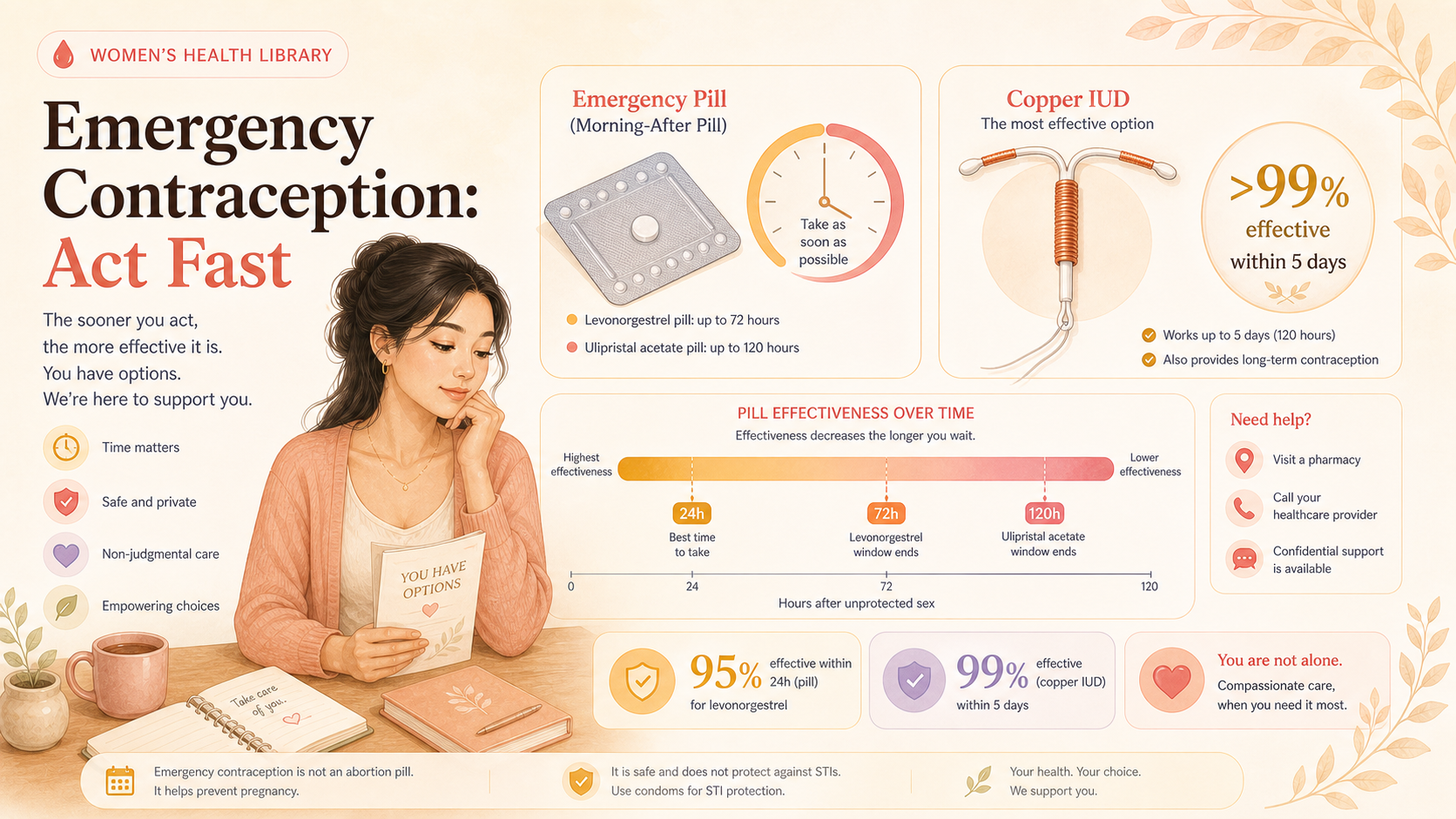
Emergency contraception at a glance
Emergency contraception is a safe, legal and widely used way to help prevent pregnancy after unprotected sex — or after a regular method has slipped up. That might mean a condom that broke or came off, a missed pill, a method you forgot, or sex you didn't plan or didn't want. Whatever the situation, needing emergency contraception is common, and there is nothing to feel ashamed of.
There are two main options. The first is the morning-after pill — most often a single tablet containing levonorgestrel — which is widely available over the counter at pharmacies across India. The second is the copper IUD (intrauterine device), a small device a doctor fits into the womb; it is the most effective emergency option and can also stay in as ongoing contraception.
The single most important thing to know is that timing matters. Emergency contraception works best the sooner it is used after unprotected sex, and its effectiveness drops the longer you wait. So if you think you need it, the best step is to act quickly rather than wait and worry. This guide explains how each option works, what to expect afterwards, and when to follow up — clearly and without judgment.
Sooner is better — don't wait
Emergency contraception is more effective the earlier it's used after unprotected sex. If you think you might need it, the best thing you can do is act now: head to a pharmacy for the morning-after pill, or speak to a doctor about a copper IUD. Don't wait for the 'right moment' — start as soon as possible, and check the pack insert or ask the pharmacist about the window for the specific product.
What Is Emergency Contraception?
Emergency contraception is a method used after unprotected sex to reduce the chance of becoming pregnant. It is a back-up — a safety net for when something went wrong or nothing was used — rather than a routine, day-to-day contraceptive.
The morning-after pill works mainly by delaying or preventing ovulation (the release of an egg), so that sperm cannot meet an egg. The copper IUD works by changing the environment inside the womb so that fertilisation and implantation are far less likely. Crucially, neither method ends a pregnancy that has already implanted — they work to stop a pregnancy from starting in the first place. That is why emergency contraception is not the same as the abortion pill, and why it is most effective when used quickly, before ovulation has happened. You might consider it after sex without contraception, if a condom broke or slipped, if you missed several regular contraceptive pills, or after non-consensual sex.
Two different products
The 'morning-after pill' (emergency contraception) and the 'abortion pill' are entirely different medicines used in different situations. Emergency contraception helps prevent a pregnancy from starting; it cannot end one that has already begun. If you're unsure which you need, a pharmacist or doctor can guide you.
The essentials, fast
Sooner is better
Emergency contraception is more effective the earlier you take it. If you need it, use it as soon as you can.
The morning-after pill
A single-dose tablet (usually levonorgestrel), sold over the counter at most pharmacies in India.
The copper IUD
Fitted by a doctor within the recommended window — the most effective emergency option, and ongoing contraception too.
Not the abortion pill
It works mainly by delaying ovulation. It does not end a pregnancy that has already begun.
Not for regular use
It's a back-up for emergencies — not as reliable or gentle as a regular contraceptive method.
Follow up matters
Take a pregnancy test if your next period is late or unusually light, and arrange ongoing contraception.
Your Options
There are two main types of emergency contraception. The right choice depends on how much time has passed, what's available to you, and your wider contraceptive plans. A pharmacist or doctor can help you decide — and reading the pack insert is important for any pill.
- The morning-after pill (levonorgestrel)
- The most common option in India, usually a single tablet taken by mouth and widely available over the counter at pharmacies, without a prescription. It works mainly by delaying ovulation, so it is most effective the sooner it is taken — ideally as soon as possible and within the window stated on the pack. Always check the pack insert or ask the pharmacist for the correct use and timing for that specific product.
- Another oral option (ulipristal acetate)
- In some places a different prescription pill (ulipristal acetate) is also used as emergency contraception and may have a longer effective window. Availability varies, and it usually needs a doctor's prescription. A doctor or pharmacist can advise whether it is an option for you.
- The copper IUD (intrauterine device)
- A small device fitted into the womb by a trained doctor or nurse, within the recommended window after unprotected sex. It is the most effective form of emergency contraception, and it can be left in place afterwards to provide reliable ongoing contraception for years. Because it must be fitted by a professional, you'll need to see a doctor or clinic promptly.
- If you're already on regular contraception
- Missing pills or other slip-ups can sometimes be managed without emergency contraception, depending on the method and timing. If you're unsure, a pharmacist or doctor can tell you whether you need emergency contraception and how to get back on track with your regular method.
Not sure which is right?
A pharmacist can supply and explain the morning-after pill; a doctor can advise on the copper IUD and on prescription options. Either way, choosing quickly matters more than choosing perfectly — emergency contraception works best when it's used soon.
Ask a Doctor →Doses and timing are on the pack — and individual
We don't give specific doses or timings here, because they differ by product and by person. Always follow the instructions in the pack insert, and ask the pharmacist or a doctor if anything is unclear. The copper IUD and prescription pills must be arranged through a clinician. Emergency contraception does not protect against sexually transmitted infections.
What to Expect Afterwards
Emergency contraception is generally safe and most people have few problems. Here's what's normal in the days and weeks afterwards, and how to look after yourself.
How you might feel
- Some people have mild side effects such as nausea, tiredness, headache, breast tenderness or lower-tummy cramping — these usually settle within a day or two
- You may feel a little off or emotional; that's understandable and tends to pass
- If you vomit shortly after taking a pill, it may not have been absorbed — check the pack insert or ask a pharmacist whether you need another dose
Your next period
- Your next period may come a little earlier or later than usual, and can be lighter or heavier
- Some light spotting before your period is common and not usually a concern
- If your period is more than about a week late, unusually light, or you're worried, take a pregnancy test
Protect yourself going forward
- Emergency contraception doesn't protect any sex you have afterwards — use a regular method (or condoms) until you start one
- It also doesn't protect against STIs; consider testing if there's any risk
- Use this as a prompt to set up reliable ongoing contraception that suits you
Be gentle with yourself
- Rest, stay hydrated, and eat normally — there's no special diet needed
- If the situation was stressful or unwanted, reach out to someone you trust
- There's no shame in needing emergency contraception — it exists precisely for these moments
A back-up, not a routine
Emergency contraception is brilliant in a pinch, but it isn't as effective or as gentle as a regular method used correctly. If you find you're reaching for it often, that's a sign it's worth talking to a doctor about an ongoing method that fits your life.
When to See a Doctor
Emergency contraception is usually straightforward, but please see a doctor or visit a clinic if:
- You want the copper IUD fitted, or advice on prescription options
- You'd like to start reliable ongoing contraception
- The sex was non-consensual, or you need support — a doctor or clinic can help with both medical care and where to turn next
- You're pregnant and need to talk through your options and care
A late, missed or unusually light period
Take a pregnancy test, and see a doctor if it's positive or you're unsure
Severe lower-tummy pain a few weeks later
Get seen promptly — this needs to be checked to rule out an ectopic pregnancy
You vomited soon after taking the pill
Ask a pharmacist or doctor whether the dose still counts or needs repeating
Heavy, prolonged or very painful bleeding
See a doctor to have it assessed
Any risk of a sexually transmitted infection
Arrange STI testing — emergency contraception doesn't protect against infections
Take a test if your period is late
Emergency contraception greatly reduces the chance of pregnancy, but it isn't guaranteed. If your next period is more than about a week late, lighter than usual, or doesn't come, take a pregnancy test. And if you ever develop severe one-sided lower-tummy pain, dizziness or shoulder-tip pain, seek medical care urgently to rule out an ectopic pregnancy.
Continue learning

Frequently Asked Questions
Is the morning-after pill the same as the abortion pill?
No — they are completely different. Emergency contraception (the morning-after pill) works mainly by delaying ovulation to help prevent a pregnancy from starting. It cannot and does not end a pregnancy that has already begun. The abortion pill is a different medicine used in a different situation. If you're unsure which you need, a pharmacist or doctor can guide you.
How soon do I need to take it?
As soon as possible. Emergency contraception is more effective the earlier it's used after unprotected sex, and its effectiveness drops the longer you wait. Don't delay — check the pack insert or ask the pharmacist about the specific window for the product you're using, and the copper IUD also has a recommended window for fitting.
Can I buy the morning-after pill in India without a prescription?
Yes. In India the levonorgestrel morning-after pill is widely available over the counter at pharmacies without a prescription. A pharmacist can supply it and explain how to use it. The copper IUD and some prescription pills must be arranged through a doctor or clinic.
Will it work if I'm already pregnant?
Emergency contraception works to prevent a pregnancy from starting; it does not end an existing pregnancy and won't harm it. If you think you may already be pregnant, see a doctor — emergency contraception isn't the right tool, and they can advise you properly.
Can I use it as my regular contraception?
It's not designed for that. Emergency contraception is a back-up for emergencies — it's less effective and less gentle than a regular method used correctly, and frequent use can disrupt your cycle. If you need contraception ongoing, a doctor can help you find a reliable method that suits you.
What if my period is late after taking it?
Your next period can come a little earlier or later, and may be lighter or heavier than usual. If it's more than about a week late, unusually light, or simply doesn't arrive, take a pregnancy test and see a doctor if it's positive or you're unsure. Severe lower-tummy pain in the following weeks should always be checked promptly.
Was this guide helpful?
Understand your cycle better with ParentVibes
- Track your period dates
- Predict your next cycle
- Understand your fertile window
- Save health notes
- Get gentle reminders
Related tools
Period Tracker
Log periods and learn your personal cycle pattern.
Open tool
Ovulation Calculator
Estimate your ovulation date and fertile window.
Open tool
Fertility Window
See your most fertile days for trying to conceive.
Open tool
Pregnancy Tracker
Follow your pregnancy week by week once you conceive.
Open tool
Due Date Calculator
Estimate your baby's due date from your last period.
Open toolShare this guide with someone who needs it 💛
Medical review
- Last reviewed
- June 2026
- Medical reviewer
- Dr. Vinika G.
- Next review due
- June 2027
- Status
- Medically reviewed by Dr. Vinika G.
References
This article is for general information and education only and is not a substitute for professional medical advice, diagnosis, or treatment. Emergency contraception is most effective the sooner it is used — always follow the instructions in the pack insert and ask a pharmacist or doctor if anything is unclear. We deliberately do not state specific doses or timings, as these vary by product and individual. The copper IUD and prescription options must be arranged through a qualified clinician. Emergency contraception does not protect against sexually transmitted infections and is not intended for regular use. If your period is late or you have severe lower-tummy pain, take a pregnancy test and seek medical care. If you have experienced non-consensual sex or feel unsafe, please reach out to someone you trust, a doctor or clinic, or your local emergency services — support is available. Content reviewed against guidance from the NHS, WHO, ACOG and MedlinePlus.
Women's Health Library journey
100%Related guides
Free resources
Start here
Your journey with ParentVibes
From your first period to your baby's vaccinations — one continuous, supported path.
Understand your cycle
Know your phases, hormones and what's normal.
Track your period
Log periods and learn your personal pattern.
Understand ovulation
Find your fertile window with the calculator.
Plan pregnancy
A calm, step-by-step start to trying to conceive.
Week-by-week pregnancy
Follow every week once you conceive.
Baby milestones
Track growth and development month by month.
Vaccination tracker
Stay on schedule and never miss a vaccine.
Medical disclaimer
This article is for educational purposes only and does not replace medical advice. If you have severe pain, heavy bleeding, missed periods, or unusual symptoms, please consult a qualified healthcare provider.