
ParentVibes
Women's Health Library · parentvibes.in
Healthy Weight for Women: A Balanced, Non-Shaming Approach
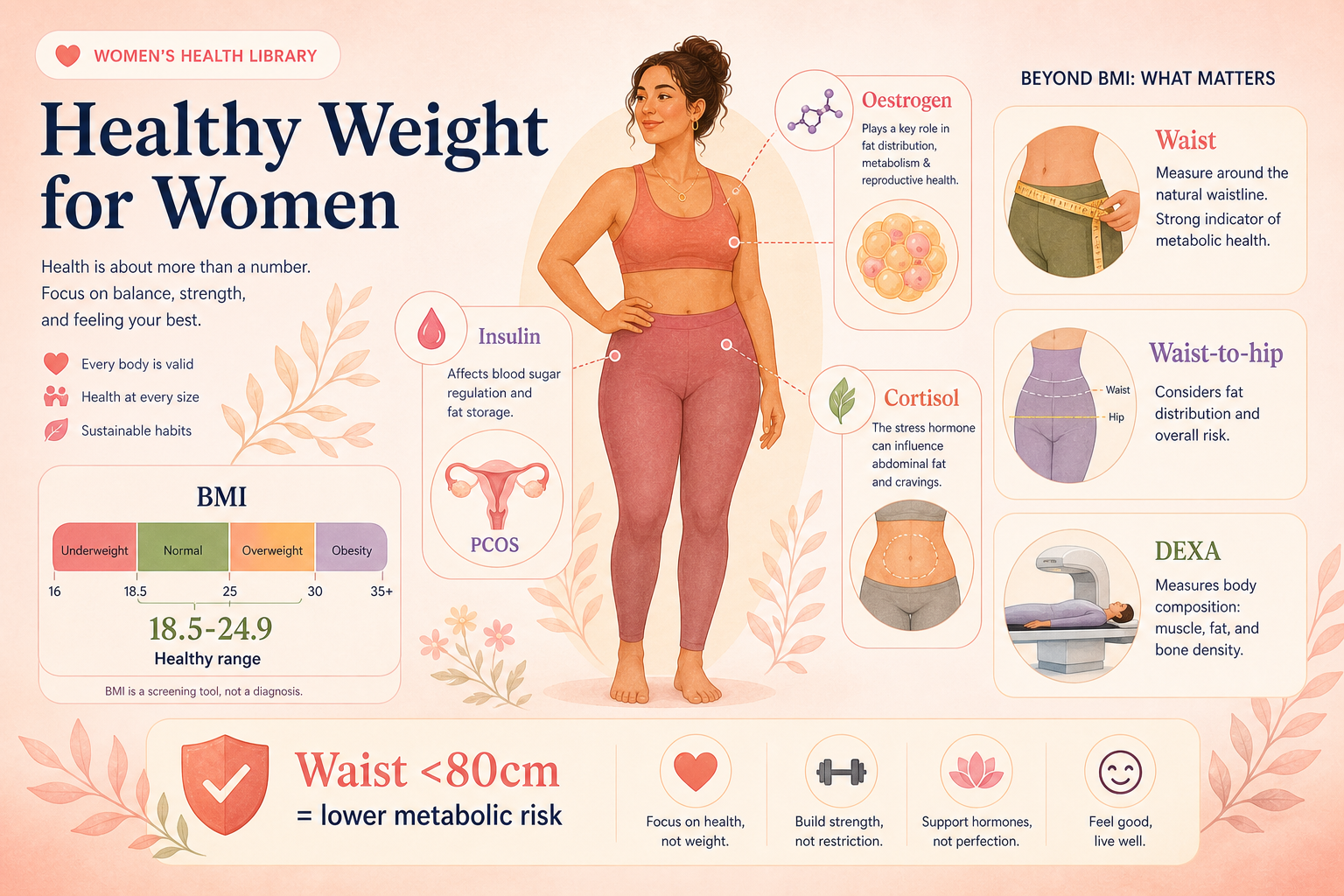
Healthy weight at a glance
When we talk about a 'healthy weight', it's easy to picture a single number on the bathroom scales — a target to hit, and a sense of failure if we don't. But health doesn't work that way. A healthy weight is really the weight at which your body works well for you: where your energy is steady, your periods are regular, you sleep and move comfortably, and your long-term risk of certain health problems is lower.
Numbers like BMI (body mass index) and waist measurement can give a useful rough guide, but they're just one part of the picture. They don't measure how much of your body is muscle versus fat, how strong your bones are, or where you carry weight — all of which matter. Two women at the very same weight can have completely different health profiles. And crucially, no number defines your worth as a person.
For women, weight that sits well outside a healthy range — in either direction — can affect periods, ovulation, fertility and conditions such as PCOS, as well as long-term health. That's worth understanding gently and honestly. But the path to a healthier weight is not crash dieting, punishing exercise or self-blame. It's kind, sustainable habits — balanced food you enjoy, movement that feels good, enough sleep and looking after stress — practised steadily over time. This guide takes that compassionate, lifestyle-first approach.
This is a no-shame zone
Weight is shaped by genetics, hormones, life stage, medicines, sleep, stress and circumstances — far more than willpower alone. You haven't 'failed' if your weight isn't where you'd like. The aim here is feeling well and caring for your health, not chasing a number or an ideal.
Useful tools
What Does 'Healthy Weight' Actually Mean?
A healthy weight isn't a single perfect figure — it's a range in which your body tends to function well and your risk of weight-related health problems is lower. There are a few common ways to get a sense of it, but each has limits, and none should be read in isolation.
BMI (body mass index) compares your weight to your height and gives a broad category. It's a handy population-level screen, but it has real limitations: it can't tell muscle from fat, so a very fit, muscular person may read as 'overweight' while someone in the 'normal' range may carry more fat than is healthy. BMI cut-offs may also differ for people of South Asian and other Asian backgrounds, who can face higher health risk at a lower BMI — so the standard numbers don't suit everyone.
Waist measurement adds important context, because fat carried around the middle (around the organs) is more strongly linked to health risk than fat elsewhere. A larger waist can flag higher risk even when BMI looks 'normal'. Body composition — how much of you is muscle, fat, bone and water — is closer to what actually matters for health, though it's harder to measure precisely at home. Put together, these give a fuller, kinder picture than the scales alone.
Don't read one number in isolation
BMI, waist and the scales are signposts, not verdicts. How you feel — your energy, your cycle, your sleep, your strength — and a doctor's view of your overall health matter far more than any single figure.
Healthy weight, in short
More than a number
Health is about how your body functions — energy, cycles, sleep, strength — not just what the scale says.
BMI is only a rough guide
BMI doesn't measure muscle, bone or where you carry fat. Waist size and body composition add useful context.
Weight and your cycle are linked
Being well outside a healthy range — either way — can affect periods, ovulation, fertility and conditions like PCOS.
Small habits, big change
Sustainable everyday habits beat dramatic diets. Slow, steady changes are the ones that actually last.
Kindness works better than shame
Self-criticism and guilt don't create lasting change. Compassion and consistency do.
Many factors are out of your hands
Genetics, hormones, medicines and life stage all affect weight. It's never just about willpower.
Why Weight Matters for Your Cycle, Fertility & Long-Term Health
Body weight and reproductive health are closely connected, because fat tissue is itself hormonally active and helps regulate the menstrual cycle. When weight sits well above or well below a healthy range, periods can become irregular or stop, and ovulation can be affected — which is why weight can influence fertility.
Carrying excess weight, particularly around the middle, is linked with insulin resistance, which plays a central role in PCOS — a common cause of irregular periods and difficulty conceiving in India and worldwide. For some women with PCOS, even a modest, sustainable change in weight can help cycles and symptoms; the emphasis is on small, steady steps, not dramatic loss. At the other end, being significantly underweight or having very low body fat can also switch off regular ovulation and periods.
Over the longer term, a weight that's well outside a healthy range is associated with higher risk of conditions such as type 2 diabetes, high blood pressure and heart disease — and in South Asian women, this risk can appear at a comparatively lower weight. None of this is about appearance. It's about giving your body what it needs to run smoothly now and to stay well in the years ahead.
Small, steady steps count
You don't need a dramatic transformation to feel benefits. Gentle, lasting changes to food, movement, sleep and stress can improve cycles, energy and long-term health — far more than any crash diet ever could.
Free with ParentVibes
Track your cycle for free
Get reminders, fertile window predictions, and personalised health insights — free.
- Know your fertile window
- Get period & ovulation reminders
- Predict your next period
- Plan for pregnancy
What Affects a Woman's Weight
Weight is the result of many factors working together — not just 'calories in versus calories out', and certainly not willpower alone. Understanding what's at play helps replace self-blame with a fairer, more useful picture.
Things largely outside your control
- Genetics and family build — some bodies naturally hold weight differently
- Hormones and life stage — puberty, pregnancy, postpartum and the years around menopause
- Conditions such as PCOS or an underactive thyroid, which can affect weight
- Certain medicines (including some for mood, contraception or other conditions)
- Age — muscle naturally declines over time, which shifts how the body uses energy
Things you can gently influence
- Everyday eating patterns — balance, portions and how regularly you eat
- How much you move across the day, not just formal 'exercise'
- Sleep — too little disrupts the hormones that govern hunger and fullness
- Stress, which can drive cravings and changes in appetite
- Alcohol and very sugary or ultra-processed foods, when they're frequent
Track while you read
Tick the symptoms that apply to you. This is a self-check, not a diagnosis — saved on this device only.
It's rarely about willpower
If weight were simply willpower, no one would ever struggle. So many of the factors above are biological or circumstantial. That's not an excuse to do nothing — it's a reason to be gentle with yourself while you build habits that genuinely help.
Letting Go of Diet Culture
So much weight advice is wrapped in shame, fear and impossible standards. It's worth naming this directly, because diet culture often does more harm than good — to both your body and your mind.
- Crash diets usually backfire
- Very restrictive diets are hard to sustain and often lead to weight cycling — losing weight quickly, then regaining it. This pattern can be more harmful than maintaining a steady weight, and it's demoralising. Slow and sustainable wins.
- Your body is not the enemy
- Your body is doing its best to keep you alive and well. Working with it — through nourishment, movement and rest — is far kinder and more effective than fighting it with punishment and restriction.
- Weight is not a measure of worth or discipline
- Carrying more or less weight says nothing about your value, your effort or your character. Health is something you tend to, not a moral test you pass or fail.
- Beware comparison and 'miracle' fixes
- Edited images, slimming teas, extreme plans and 'quick-fix' supplements set unrealistic expectations and can be unsafe. Real, lasting health rarely looks dramatic — it looks like ordinary habits, repeated kindly.
If the goal of 'healthy weight' ever starts to feel like punishment, pause. The aim is to feel well and care for your body — not to shrink yourself or chase someone else's ideal.
Sustainable Habits for a Healthier Weight
Forget crash diets, 'detoxes' and punishing routines — they rarely last and can leave you feeling worse. What genuinely works is a handful of kind, sustainable habits practised most days. Build them slowly, one at a time, and let them become part of how you live.
Eat in a balanced, non-restrictive way
- Build meals around whole foods — dal, beans, vegetables, fruit, whole grains (millets, brown rice, whole wheat), nuts and good protein
- Include protein and fibre at meals to feel fuller for longer and keep energy steady
- Eat regularly rather than skipping meals — long gaps often lead to overeating later
- Be mindful of portions and frequency of fried foods, sweets, refined snacks and sugary drinks — without banning any food outright
- No 'good' or 'bad' foods to feel guilty about; aim for balance over the week, not perfection at every meal
Move in ways you enjoy
- Aim for regular activity through the week — brisk walking, cycling, swimming, dancing or sport you actually like
- Add some strength work (bodyweight exercises, resistance bands, yoga) to build and protect muscle, which is especially valuable for women
- Move little and often — take the stairs, walk after meals, stand and stretch through the day
- Pick activities that feel good, not as punishment — enjoyment is what makes movement last
Protect your sleep
- Aim for a consistent sleep and wake time most nights
- Too little sleep disrupts the hormones that control hunger and fullness, increasing cravings the next day
- Wind down without screens; a calm, dark, cool room helps
- Treating sleep as part of weight care — not a luxury — makes everything else easier
Care for stress and emotions
- Ongoing stress can drive cravings and 'comfort eating' — noticing this without judgement is the first step
- Try breathing exercises, meditation, prayer, time in nature or a hobby you enjoy
- Reach out to friends or family; connection and support genuinely help
- If eating feels out of your control, or food brings a lot of distress, it's okay — and brave — to ask for help
Set kind, realistic goals
- Aim for slow, steady change — small habits you can keep beat dramatic ones you can't
- Track how you feel — energy, sleep, mood, strength — not just the scales
- Expect ups and downs; a tougher day or week isn't failure, just part of being human
- Celebrate non-scale wins: more energy, better sleep, clothes fitting more comfortably, regular cycles
Ditch the all-or-nothing mindset
One off-plan meal or missed walk doesn't undo your progress. The habit that lasts is the one you can return to gently, again and again — not the one you abandon after a single slip.
When to Speak to a Doctor
Weight is personal, and there's no need to wait for a crisis to ask for support. Please consider speaking to a doctor if:
- Your weight has changed noticeably without you trying, in either direction
- Your periods have become irregular, very heavy, or stopped
- You're trying to conceive and wonder whether weight may be a factor
- You think you may have PCOS, a thyroid problem or another condition affecting weight
- Lifestyle changes haven't helped after a fair, consistent try
- Weight or eating is causing you a lot of worry, low mood or distress
- You'd simply like personalised, judgement-free guidance for your body and health
Ask for support without shame
A good doctor will look at your whole health — not just the scale — and help you set realistic, kind goals. If eating or body image is causing real distress, that's an important reason to reach out, and support is available.
Ask a Doctor →Continue learning
Frequently Asked Questions
What is a 'healthy weight' for a woman?
It's a range in which your body tends to work well and your long-term health risk is lower — not a single perfect number. Tools like BMI and waist measurement give a rough guide, but how you feel (energy, cycles, sleep, strength) and your overall health matter far more. A doctor can help you understand what's healthy for your body and stage of life.
Is BMI a reliable measure of health?
BMI is a useful broad screen, but it has real limits. It can't tell muscle from fat or show where you carry weight, and the standard cut-offs may not suit everyone — South Asian women, for example, can face higher health risk at a lower BMI. It's best read alongside waist size, how you feel and a doctor's overall view, never on its own.
Can my weight affect my periods and fertility?
Yes. Fat tissue is hormonally active and helps regulate the menstrual cycle, so a weight that's well above or below a healthy range can lead to irregular or absent periods and affect ovulation and fertility. This works in both directions. If your periods have changed or you're trying to conceive, it's worth discussing with a doctor.
How does weight relate to PCOS?
Excess weight, especially around the middle, is linked with insulin resistance, which plays a key role in PCOS. For some women with PCOS, even a modest, sustainable change in weight can ease symptoms and help cycles. The focus is on small, steady, kind changes — not dramatic loss — and on working with a doctor.
What's the best way to reach a healthier weight?
Sustainable habits, not crash diets. Balanced, non-restrictive eating, movement you enjoy, enough sleep and looking after stress — built slowly, one habit at a time — work far better and last longer than restriction or punishing routines. Slow, steady change is the goal.
I've tried everything and my weight won't budge — what's wrong with me?
Nothing is 'wrong' with you. Weight is shaped by genetics, hormones, life stage, medicines, sleep, stress and circumstances — not willpower alone. If healthy habits aren't shifting things, a doctor can check for factors like thyroid issues or PCOS and offer personalised, judgement-free support. Please be kind to yourself.
Was this guide helpful?
Understand your cycle better with ParentVibes
- Track your period dates
- Predict your next cycle
- Understand your fertile window
- Save health notes
- Get gentle reminders
Related tools
Period Tracker
Log periods and learn your personal cycle pattern.
Open tool
Ovulation Calculator
Estimate your ovulation date and fertile window.
Open tool
Fertility Window
See your most fertile days for trying to conceive.
Open tool
Pregnancy Tracker
Follow your pregnancy week by week once you conceive.
Open tool
Due Date Calculator
Estimate your baby's due date from your last period.
Open toolShare this guide with someone who needs it 💛
Medical review
- Last reviewed
- June 2026
- Medical reviewer
- Dr. Vinika G.
- Next review due
- June 2027
- Status
- Medically reviewed by Dr. Vinika G.
References
This article is for general information and education only and is not a substitute for professional medical advice, diagnosis, or treatment. A 'healthy weight' is individual and depends on your body, health and stage of life — always consult a qualified doctor for guidance tailored to you, especially before making significant changes to your diet or activity, if you are pregnant or breastfeeding, or if you have a health condition. If concerns about weight, food or body image are causing significant distress, please reach out to a doctor or mental-health professional — support is available and you deserve it. Content reviewed against guidance from the NHS, the WHO, ACOG and MedlinePlus.
Women's Health Library journey
100%Related guides
Free resources
Start here
Your journey with ParentVibes
From your first period to your baby's vaccinations — one continuous, supported path.
Understand your cycle
Know your phases, hormones and what's normal.
Track your period
Log periods and learn your personal pattern.
Understand ovulation
Find your fertile window with the calculator.
Plan pregnancy
A calm, step-by-step start to trying to conceive.
Week-by-week pregnancy
Follow every week once you conceive.
Baby milestones
Track growth and development month by month.
Vaccination tracker
Stay on schedule and never miss a vaccine.
Medical disclaimer
This article is for educational purposes only and does not replace medical advice. If you have severe pain, heavy bleeding, missed periods, or unusual symptoms, please consult a qualified healthcare provider.