
ParentVibes
Women's Health Library · parentvibes.in
IVF (In Vitro Fertilisation): The Process, Success Rates & What to Expect
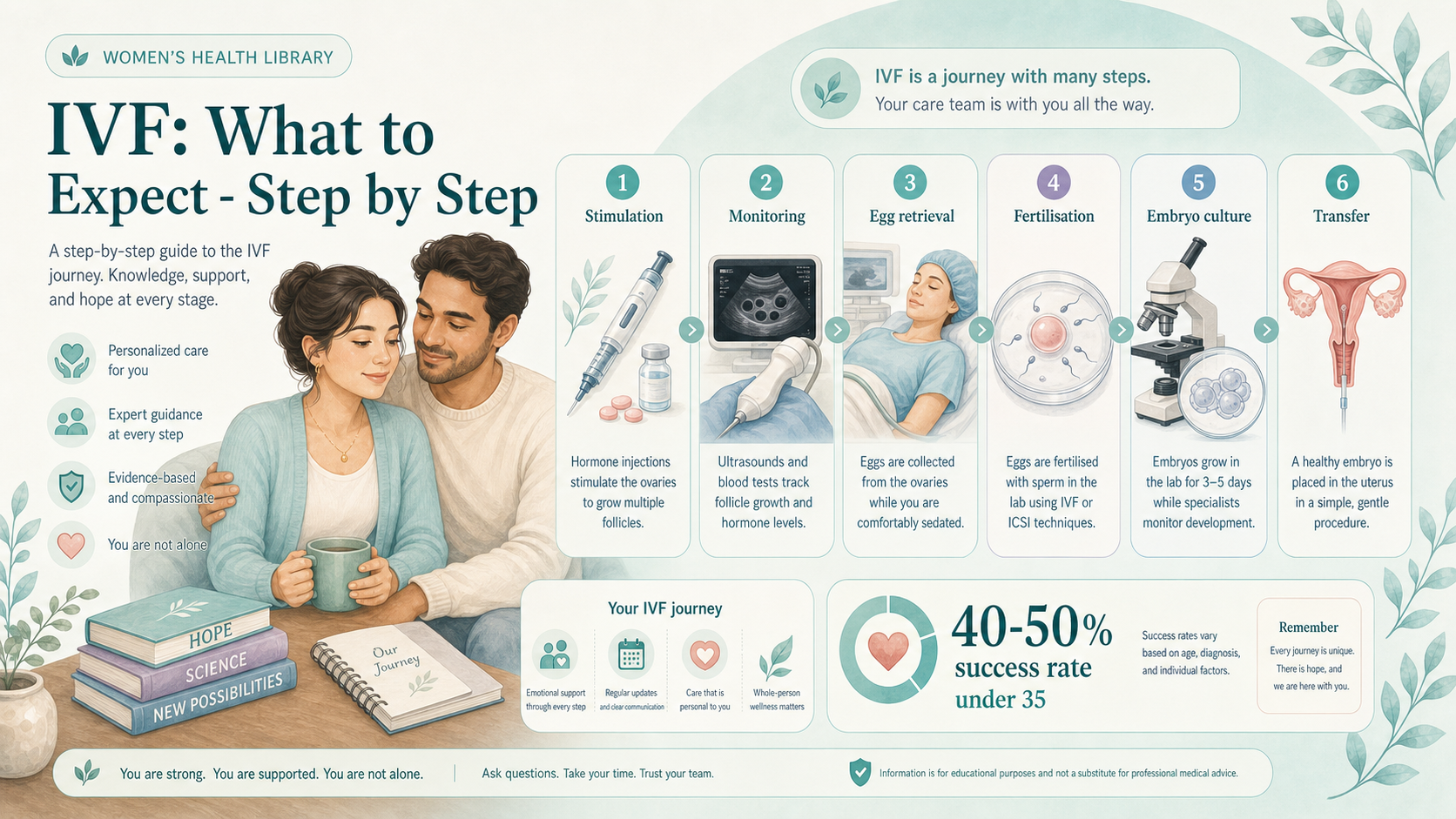
Quick Facts
In vitro fertilisation (IVF) is one of the most well-known and effective fertility treatments. "In vitro" means "in glass" — eggs and sperm are combined in a laboratory to create embryos, and an embryo is then placed in the womb to (hopefully) grow into a pregnancy. IVF has helped millions of people become parents.
IVF may be recommended for many reasons — blocked fallopian tubes, ovulation problems, endometriosis, male-factor infertility, unexplained infertility, or after other treatments haven't worked. The process runs in clear stages: ovarian stimulation, egg retrieval, fertilisation in the lab, embryo culture, and embryo transfer. Success depends on several factors — above all the woman's age at treatment — and it's normal to need more than one cycle.
This guide walks you through each step, what affects your chances, the risks to be aware of (like ovarian hyperstimulation and multiple pregnancy), and the emotional and practical side of treatment.
Stay organised
The ParentVibes IVF Dashboard helps you track medicines, appointments and each stage of your cycle.
Open IVF Dashboard →Useful tools
Things worth knowing
"In vitro" means "in glass"
Eggs and sperm are combined in a lab to create embryos, then an embryo is placed in the womb.
It runs in clear stages
Ovarian stimulation, egg retrieval, fertilisation, embryo culture, then transfer — usually a few weeks per cycle.
Age matters most
Success depends above all on the woman's age at treatment, and declines particularly after 40.
One cycle isn't a guarantee
Many people need more than one cycle, and frozen embryos allow further transfers without full stimulation again.
ICSI for male-factor cases
A single sperm is injected into each egg — often used when sperm quality is the issue.
Know the OHSS warning signs
Severe pain or swelling, rapid weight gain, severe nausea, or breathlessness need same-day clinic contact.
Everything You Need to Know (The IVF Process Step by Step)
IVF is a sequence of carefully timed stages, usually over a few weeks per cycle:
| Step | What happens |
|---|---|
| 1. Ovarian stimulation | Daily hormone injections encourage the ovaries to mature several eggs, monitored by scans and blood tests |
| 2. Egg retrieval (collection) | A minor procedure (under sedation) collects the mature eggs using ultrasound guidance |
| 3. Fertilisation | Eggs and sperm are combined in the lab — by standard IVF or ICSI (injecting a single sperm into each egg) |
| 4. Embryo culture | Fertilised eggs grow into embryos over a few days; fertilisation is expected in roughly 7 out of 10 eggs |
| 5. Embryo transfer | A healthy embryo is gently placed into the womb; good-quality spare embryos may be frozen for later |
| 6. The wait & test | A pregnancy test follows about two weeks later |
One "cycle" ≠ one guarantee
Many people need more than one cycle, and frozen embryos allow further transfers without repeating full stimulation. This is normal — not failure.
What to Expect (During Treatment)
IVF involves medicines and procedures, so some effects are expected:
Expected effects
- During stimulation: bloating, mood changes, injection-site soreness, tender ovaries
- Around egg retrieval: mild cramping, light spotting, tiredness after sedation
- After transfer: mild cramps or spotting; the two-week wait is often emotionally intense
Track while you read
Tick the symptoms that apply to you. This is a self-check, not a diagnosis — saved on this device only.
Report urgently (possible OHSS)
Severe abdominal pain or swelling, rapid weight gain, severe nausea/vomiting, breathlessness, or reduced urination — contact your clinic the same day.
Why IVF Is Recommended
IVF may be advised for:
- Blocked or damaged fallopian tubes
- A classic indication for IVF.
- Ovulation disorders
- Not resolved by simpler treatments (e.g. some PCOS cases).
- Endometriosis
- Affecting fertility.
- Male-factor infertility
- Often with ICSI.
- Unexplained infertility
- Or when IUI/medicines haven't worked.
- Age-related decline
- Reduced egg quantity/quality over time.
- Genetic reasons or donor gametes
- Use of donor eggs/sperm/embryos where appropriate.
Assessment Before IVF
Before IVF, a fertility specialist confirms it's the right option and personalises the plan.
What's involved
- Full fertility workup for both partners
- Ovarian reserve tests (e.g. AMH, antral follicle count) to plan the medicine dose
- Uterine assessment to ensure the womb is ready for transfer
- Screening tests as required by the clinic/regulations
- Counselling about the process, chances, risks and emotional impact
In India, fertility clinics and ART are regulated under national law (the ART Act); choose a registered, reputable clinic and ask about their verified success rates and your specific chances.
Success Factors & Variations
What affects IVF success: above all the woman's age at treatment, plus the cause of infertility, embryo quality, the clinic, and lifestyle. Success rates decline with age, particularly after 40. Ask your clinic for your estimated chances per cycle.
- ICSI
- A single sperm injected into each egg — for male-factor infertility.
- Frozen embryo transfer (FET)
- Using frozen embryos in a later cycle.
- Donor eggs/sperm/embryos
- When using donor gametes is appropriate.
- Genetic testing of embryos (PGT)
- In specific situations, discussed with a specialist.
Track your cycle
The ParentVibes IVF Dashboard keeps your medicines, scan dates and results in one place.
Open IVF Dashboard →Be cautious with costly add-ons
Many lack strong evidence — ask your clinic what is proven to improve your chances. All IVF medicines and procedures are specialist-led and monitored.
Looking After Yourself Through IVF
Practical and emotional self-care matters a lot:
Self-care through a cycle
- Follow the medicine schedule precisely — set reminders; ask your clinic if unsure
- Attend all monitoring appointments
- Eat well, stay hydrated, and rest — a balanced diet and gentle activity; avoid smoking and alcohol
- Manage stress — the process is demanding; lean on support
- Know the OHSS warning signs and your clinic's emergency contact
- Plan for the two-week wait — line up gentle distractions and support
IVF self-care checklist
- Medicine reminders set
- Appointments scheduled
- Balanced diet, no smoking/alcohol
- Emotional support arranged
- Clinic emergency contact saved
When to Contact Your Clinic
Contact your clinic/doctor:
- Urgently for severe abdominal pain/swelling, rapid weight gain, severe vomiting, breathlessness, or reduced urination (possible OHSS)
- For heavy bleeding, fever, or severe pain after any procedure
- If you're unsure about medicines or miss a dose
- For emotional distress that feels overwhelming during treatment
- To discuss next steps after a cycle, whatever the outcome
OHSS and procedure complications can be serious
Seek same-day care for the warning signs above. Use Ask a Doctor for general guidance (not emergencies).
Continue learning
Frequently Asked Questions
What are the main steps of IVF?
Ovarian stimulation, egg retrieval, fertilisation in the lab, embryo culture, and embryo transfer, followed by a pregnancy test about two weeks later.
What affects IVF success?
Mainly the woman's age at treatment, plus the cause of infertility, embryo quality, the clinic, and lifestyle. Success declines with age, especially after 40.
How many cycles will I need?
It varies — many people need more than one cycle, and frozen embryos can allow further transfers. Needing more than one cycle is common.
What is ICSI?
A form of IVF where a single sperm is injected into each egg, often used for male-factor infertility.
What are the main risks of IVF?
Ovarian hyperstimulation syndrome (OHSS), multiple pregnancy (if more than one embryo is transferred), and procedure-related risks. Your clinic will explain how they minimise these.
Is IVF painful?
Most steps are well tolerated; injections cause minor discomfort and egg retrieval is done under sedation. Some cramping/bloating is normal.
How do I choose a clinic in India?
Choose a registered, reputable clinic (ART is regulated in India), and ask for verified success rates and your individual chances.
Was this guide helpful?
Understand your cycle better with ParentVibes
- Track your period dates
- Predict your next cycle
- Understand your fertile window
- Save health notes
- Get gentle reminders
Related tools

Period Tracker
Log periods and learn your personal cycle pattern.
Open tool
Ovulation Calculator
Estimate your ovulation date and fertile window.
Open tool
Fertility Window
See your most fertile days for trying to conceive.
Open tool
Pregnancy Tracker
Follow your pregnancy week by week once you conceive.
Open tool
Due Date Calculator
Estimate your baby's due date from your last period.
Open toolShare this guide with someone who needs it 💛
Medical review
- Last reviewed
- June 2026
- Medical reviewer
- Dr. Vinika G.
- Next review due
- June 2027
- Status
- Medically reviewed by Dr. Vinika G.
References
This article is for general information and education only and is not a substitute for professional medical advice, diagnosis, or treatment. IVF is complex and individual; success rates, risks and protocols vary by person and clinic. Consult a registered fertility specialist for assessment, personalised chances, and care. Seek urgent medical attention for the OHSS warning signs described above. In a medical emergency, contact your clinic or local emergency services immediately. Content reviewed against guidance from the NHS, ACOG and peer-reviewed literature.
Planning Parenthood Library journey
100%Related guides
Free resources
Medical disclaimer
This article is for educational purposes only and does not replace medical advice. If you have severe pain, heavy bleeding, missed periods, or unusual symptoms, please consult a qualified healthcare provider.