
ParentVibes
Women's Health Library · parentvibes.in
Cervical Health: HPV, Screening & Prevention Explained
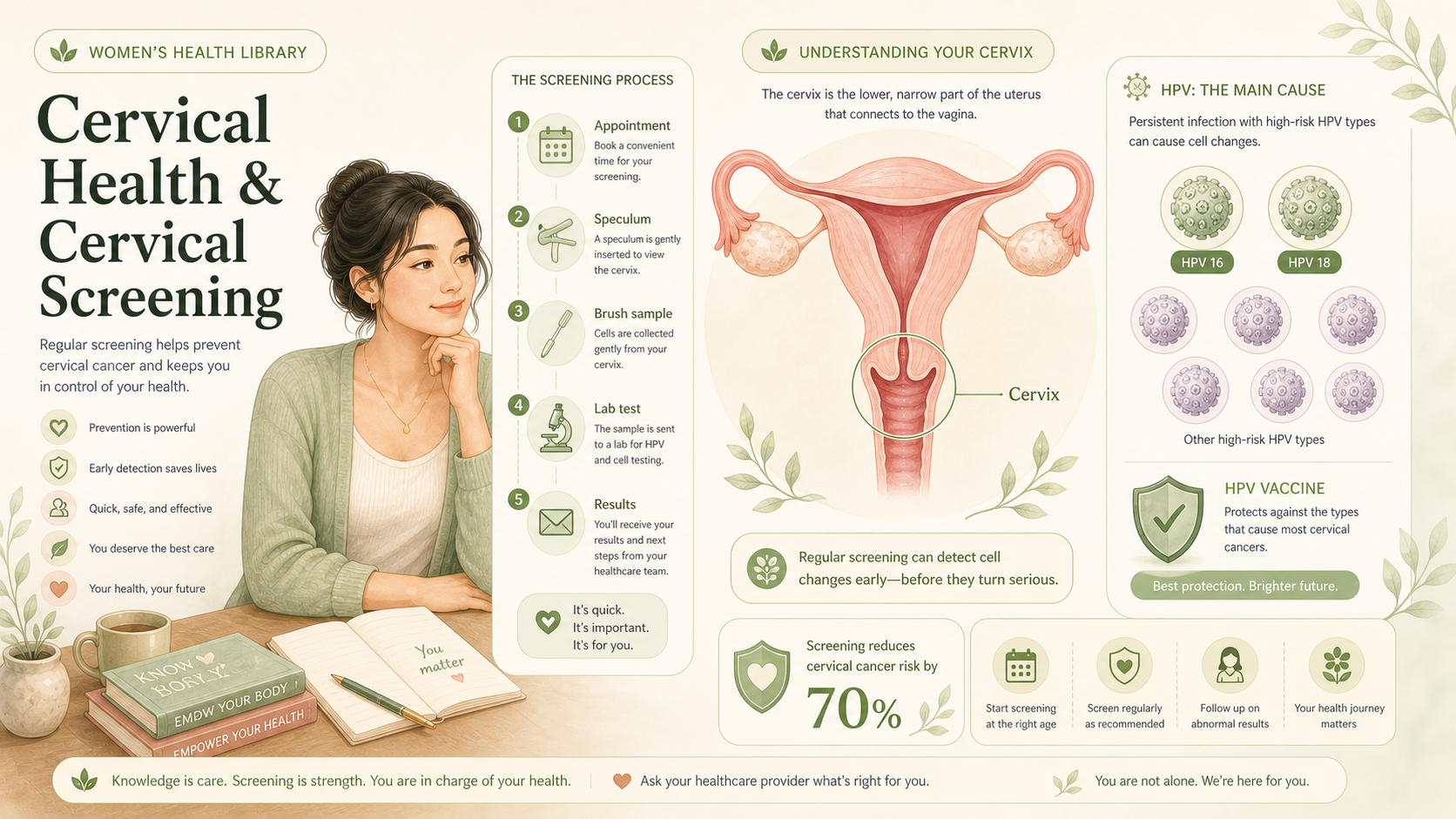
Cervical health at a glance
Cervical health rarely gets talked about openly — yet it's one of the brightest stories in women's health, because cervical cancer is largely preventable. The cervix is the narrow lower part of the uterus (womb) that opens into the vagina. Almost all cervical cancer is caused by long-lasting infection with certain 'high-risk' types of HPV (human papillomavirus), a very common virus that most sexually active people come into contact with at some point in their lives.
For the vast majority of people, the body clears HPV on its own and nothing happens. Only when a high-risk type lingers for years can it slowly cause changes in cervical cells — and even then, those changes usually take a long time and can be found and treated early. This is the heart of prevention: the HPV vaccine protects against the types that cause most cervical cancer, and regular cervical screening (a Pap smear or HPV test) catches early changes long before they could become a problem.
This guide explains what the cervix is, how HPV relates to cervical cancer, who the vaccine is for, what screening involves and when to have it, and the symptoms worth getting checked. The aim is simple: to make cervical health clear, unembarrassing and easy to act on.
Two simple steps, huge protection
HPV vaccination (ideally before any exposure) and regular cervical screening together protect against most cervical cancer. Whatever your age, it's worth knowing where you stand on both.
Ask a Doctor about screening →Useful tools
What Is the Cervix — and What Is Cervical Health?
The cervix is the lower, narrow part of the uterus (womb) that connects it to the vagina. It plays several important roles: it produces mucus that changes across your cycle, it helps protect the uterus from infection, it stays closed during pregnancy and opens during childbirth. The surface of the cervix is lined with cells, and it's changes in these cells — driven by long-lasting high-risk HPV infection — that screening is designed to catch.
'Cervical health' really means keeping those cells healthy and catching any changes early. Because cervical cancer almost always develops slowly from pre-cancerous cell changes, there is usually a long window in which screening can find and treat changes before they ever become cancer. That's why the cervix is one of the few parts of the body where we can genuinely prevent most cancers through vaccination and routine checks.
Pre-cancer is not cancer
Most abnormal screening results show early cell changes — not cancer. These changes are very treatable, and finding them early is exactly what screening is for. An abnormal result is a reason to follow up, not to panic.
Cervical health, in short
It's highly preventable
Vaccination plus regular screening protect against most cervical cancer — this is rare among cancers.
HPV is the main cause
Almost all cervical cancer is linked to long-lasting infection with certain high-risk types of HPV.
The vaccine works
The HPV vaccine protects against the types that cause most cervical cancer — ideally given before exposure.
Screening finds it early
A Pap smear or HPV test can spot cell changes years before they could ever become cancer.
Changes are slow
Cervical changes usually develop slowly — which is exactly why regular screening is so powerful.
It's nothing to be ashamed of
HPV is common and not a reflection of behaviour or worth — screening is routine, private health care.
Symptoms Worth Getting Checked
Early cervical changes — and even early cervical cancer — often cause no symptoms at all, which is exactly why screening (not waiting for symptoms) is the key to prevention. That said, some symptoms always deserve a check, especially if they're new or persistent.
See a doctor if you notice
- Bleeding between periods, after sex, or after menopause
- Periods that become heavier or longer than usual without explanation
- Unusual vaginal discharge — for example with a strong smell, or tinged with blood
- Pain or discomfort during sex
- Persistent pelvic or lower back pain that isn't explained by your cycle
Important to remember
- These symptoms are far more often caused by something other than cancer
- But they should always be checked rather than ignored or waited out
- Early cervical changes usually cause no symptoms — so don't wait for any to get screened
- Screening on schedule protects you even when you feel completely well
Track while you read
Tick the symptoms that apply to you. This is a self-check, not a diagnosis — saved on this device only.
Don't wait for symptoms
The most important point about cervical cancer is that it can develop silently. Regular screening — not symptom-watching — is what catches changes early. If you do have any of the symptoms above, please get them checked, but don't rely on symptoms to tell you it's time to screen.
HPV & What Raises Cervical Cancer Risk
Almost all cervical cancer is linked to long-lasting infection with certain high-risk types of HPV. HPV is extremely common and spreads through skin-to-skin and sexual contact. In most people the immune system clears it within a couple of years with no symptoms and no harm. Cancer risk arises only when a high-risk type persists for a long time. Understanding what influences this helps you focus on what you can control — vaccination and screening.
- High-risk HPV (the main cause)
- A small number of HPV types are classed as 'high-risk' because long-lasting infection with them can cause cervical cell changes over time. These types are responsible for almost all cervical cancer.
- Persistent infection over time
- It's not catching HPV that's the concern — most infections clear on their own. The risk comes from a high-risk type lingering for years, which is why regular screening across your life matters so much.
- Not being vaccinated
- People who haven't had the HPV vaccine miss out on strong protection against the types that cause most cervical cancer. The vaccine works best when given before any exposure to HPV.
- Smoking
- Smoking is linked with a higher risk of cervical changes and can make it harder for the body to clear HPV. Not smoking supports cervical health alongside vaccination and screening.
- A weakened immune system
- Conditions or treatments that lower immunity can make it harder to clear HPV, so high-risk infection is more likely to persist. People in this situation may need more frequent screening — a doctor can advise.
- Never or rarely screened
- Many cervical cancers occur in people who have never been screened or who stopped. Regular screening — even when you feel completely well — is the single most protective habit.
HPV is common — and not a judgement
Catching HPV is not a sign of anything 'wrong' with you, and it doesn't reflect your character or choices. It's a near-universal virus. What protects you is vaccination and regular screening, not shame.
Screening: Pap Smear, HPV Test & the Vaccine
Prevention has two pillars: vaccination (which lowers the chance of high-risk HPV infection in the first place) and screening (which catches cell changes early so they can be treated before cancer develops). Here's how each works.
Cervical screening — the Pap smear & HPV test
- Screening is a quick check of the cervix, not a test for cancer — it looks for early changes before they could become a problem
- A speculum is gently used to view the cervix, and a soft brush collects a small sample of cells; it takes only a few minutes
- An HPV test checks the sample for high-risk HPV; a Pap smear (cytology) checks the cells themselves for changes — many programmes now test for HPV first
- It may feel a little uncomfortable but should not be painful — you can ask for a smaller speculum, a female clinician, or to pause at any time
- Most results are normal; if HPV or cell changes are found, you'll simply be invited for follow-up or a closer look (colposcopy)
The HPV vaccine
- What it does
- Protects against the high-risk HPV types that cause most cervical cancer (and other HPV-related cancers and genital warts, depending on the vaccine).
- Who it's for
- Recommended mainly for adolescents — ideally before any exposure to HPV — and offered to both girls and boys in many programmes. Some older people may also benefit; a doctor can advise.
- Best timing
- It works best when given before someone becomes sexually active, which is why it's offered in the early teen years. It's still worth discussing if that window has passed.
- Vaccine + screening
- The vaccine doesn't replace screening. Even vaccinated people should still attend cervical screening, because the vaccine doesn't cover every high-risk type.
If a result isn't normal
- An abnormal result most often means early cell changes or HPV — not cancer
- You may be asked to repeat screening sooner, or have a colposcopy (a closer look at the cervix)
- Early changes can usually be monitored or treated simply and effectively
- Follow-up is routine and is the system working exactly as intended — finding things early
Screening in India — speak to a doctor about what's right for you
Cervical screening recommendations (which test, starting age and how often) vary by country and individual risk, and access in India can differ between public and private settings. A doctor or gynaecologist can tell you which screening is right for your age and situation, and when your next one is due. The key is to start, and to keep going.
Ask a Doctor →Prevention — What You Can Do
Cervical health is one area where everyday choices and a couple of key health steps genuinely add up to powerful protection. None of this is about blame — it's about giving yourself the best odds.
Get vaccinated (or vaccinate your children)
- The HPV vaccine is the strongest single step — most protective when given in the early teen years
- It's offered to both girls and boys in many programmes; ask your doctor if you or your child are eligible
- If the ideal window has passed, it's still worth discussing — some older people benefit too
Attend screening on schedule
- Go for cervical screening when invited or when your doctor recommends — even if you feel perfectly well
- Don't skip it because of embarrassment or being busy; it's a few minutes that can prevent cancer
- Keep a note of when your next screening is due, and follow up promptly on any results
Practise safer sex
- Condoms reduce (though don't fully eliminate) the spread of HPV and other infections
- Caring for your overall sexual health supports cervical health too
- See our guide to preventing STIs for more on staying protected
Vaccine + screening still matter
Condoms lower HPV transmission but don't cover all skin contact, so they don't replace the vaccine or screening. Think of all three as layers of protection that work best together.
Don't smoke
- Smoking is linked with a higher risk of cervical cell changes and makes it harder to clear HPV
- Stopping smoking supports cervical health (and your whole body)
- If you'd like to quit, a doctor can point you to support that works
Know your body and speak up
- Notice and report unusual bleeding, discharge or pelvic pain rather than waiting it out
- Ask questions at appointments — there are no silly questions about your own health
- Encourage the women in your life to screen and vaccinate too; openness saves lives
When to See a Doctor
Please speak to a doctor or gynaecologist if:
- You're due for cervical screening, or you're not sure when you last had it
- You or your child haven't had the HPV vaccine and would like to know if you're eligible
- You have bleeding between periods, after sex, or after menopause
- You have unusual vaginal discharge, pain during sex, or persistent pelvic pain
- You've had an abnormal screening result and want to understand the next steps
Bleeding after sex, between periods, or after menopause
Get it checked — it's usually not cancer, but it should always be assessed
Unusual or blood-tinged discharge, or a persistent strong smell
See a doctor; it's commonly an infection that's easily treated, but worth checking
Persistent pelvic or lower back pain not explained by your cycle
Book an appointment rather than waiting for it to pass
An abnormal screening result
Attend the recommended follow-up — early changes are very treatable
Asking is always the right move
Whether it's a symptom, a missed screening, or a question about the vaccine, reaching out to a doctor is never an over-reaction. Cervical health is most protected when you stay engaged — and the earlier anything is found, the simpler it is to deal with.
Ask a Doctor →Continue learning
Frequently Asked Questions
What is the cervix?
The cervix is the lower, narrow part of the uterus (womb) that opens into the vagina. It produces mucus across your cycle, helps protect the uterus from infection, and opens during childbirth. Cervical screening checks the cells on its surface for early changes.
Does having HPV mean I'll get cervical cancer?
No. HPV is very common and most infections clear on their own with no harm. Cervical cancer risk only arises when a high-risk type of HPV lingers for many years. That's exactly why regular screening matters — it catches any cell changes long before they could become cancer.
What's the difference between a Pap smear and an HPV test?
Both use a small sample of cells gently collected from the cervix. A Pap smear (cytology) looks at the cells themselves for changes, while an HPV test checks the sample for high-risk HPV. Many screening programmes now test for HPV first. A doctor can tell you which is used for you.
I've had the HPV vaccine — do I still need screening?
Yes. The vaccine protects against the HPV types that cause most cervical cancer, but not every high-risk type, so screening is still important even if you're vaccinated. Vaccine plus screening together give the strongest protection.
Does cervical screening hurt?
It may feel a little uncomfortable but shouldn't be painful, and it only takes a few minutes. You can ask for a smaller speculum, a female clinician, or to pause at any point. Telling the clinician you're nervous genuinely helps them help you.
When should I start cervical screening, and how often?
Recommendations on the test, starting age and frequency vary by country and personal risk, and access in India can differ between public and private settings. The best step is to ask a doctor or gynaecologist what's right for your age and situation — and then keep to the schedule.
Was this guide helpful?
Understand your cycle better with ParentVibes
- Track your period dates
- Predict your next cycle
- Understand your fertile window
- Save health notes
- Get gentle reminders
Related tools

Period Tracker
Log periods and learn your personal cycle pattern.
Open tool
Ovulation Calculator
Estimate your ovulation date and fertile window.
Open tool
Fertility Window
See your most fertile days for trying to conceive.
Open tool
Pregnancy Tracker
Follow your pregnancy week by week once you conceive.
Open tool
Due Date Calculator
Estimate your baby's due date from your last period.
Open toolShare this guide with someone who needs it 💛
Medical review
- Last reviewed
- June 2026
- Medical reviewer
- Dr. Vinika G.
- Next review due
- June 2027
- Status
- Medically reviewed by Dr. Vinika G.
References
This article is for general information and education only and is not a substitute for professional medical advice, diagnosis, or treatment. Always consult a qualified doctor or gynaecologist about cervical screening, the HPV vaccine, and any symptoms. Screening recommendations and vaccine eligibility vary by country, programme and individual risk — a doctor can advise on what's right for you. An abnormal screening result usually means early, treatable changes rather than cancer; please attend any recommended follow-up. Content reviewed against guidance from the World Health Organization, the NHS, ACOG, and MedlinePlus.
Women's Health Library journey
100%Related guides
Free resources
Start here
Your journey with ParentVibes
From your first period to your baby's vaccinations — one continuous, supported path.
Understand your cycle
Know your phases, hormones and what's normal.
Track your period
Log periods and learn your personal pattern.
Understand ovulation
Find your fertile window with the calculator.
Plan pregnancy
A calm, step-by-step start to trying to conceive.
Week-by-week pregnancy
Follow every week once you conceive.
Baby milestones
Track growth and development month by month.
Vaccination tracker
Stay on schedule and never miss a vaccine.
Medical disclaimer
This article is for educational purposes only and does not replace medical advice. If you have severe pain, heavy bleeding, missed periods, or unusual symptoms, please consult a qualified healthcare provider.