
ParentVibes
Women's Health Library · parentvibes.in
Ovulation: Signs, Your Fertile Window & How to Track It
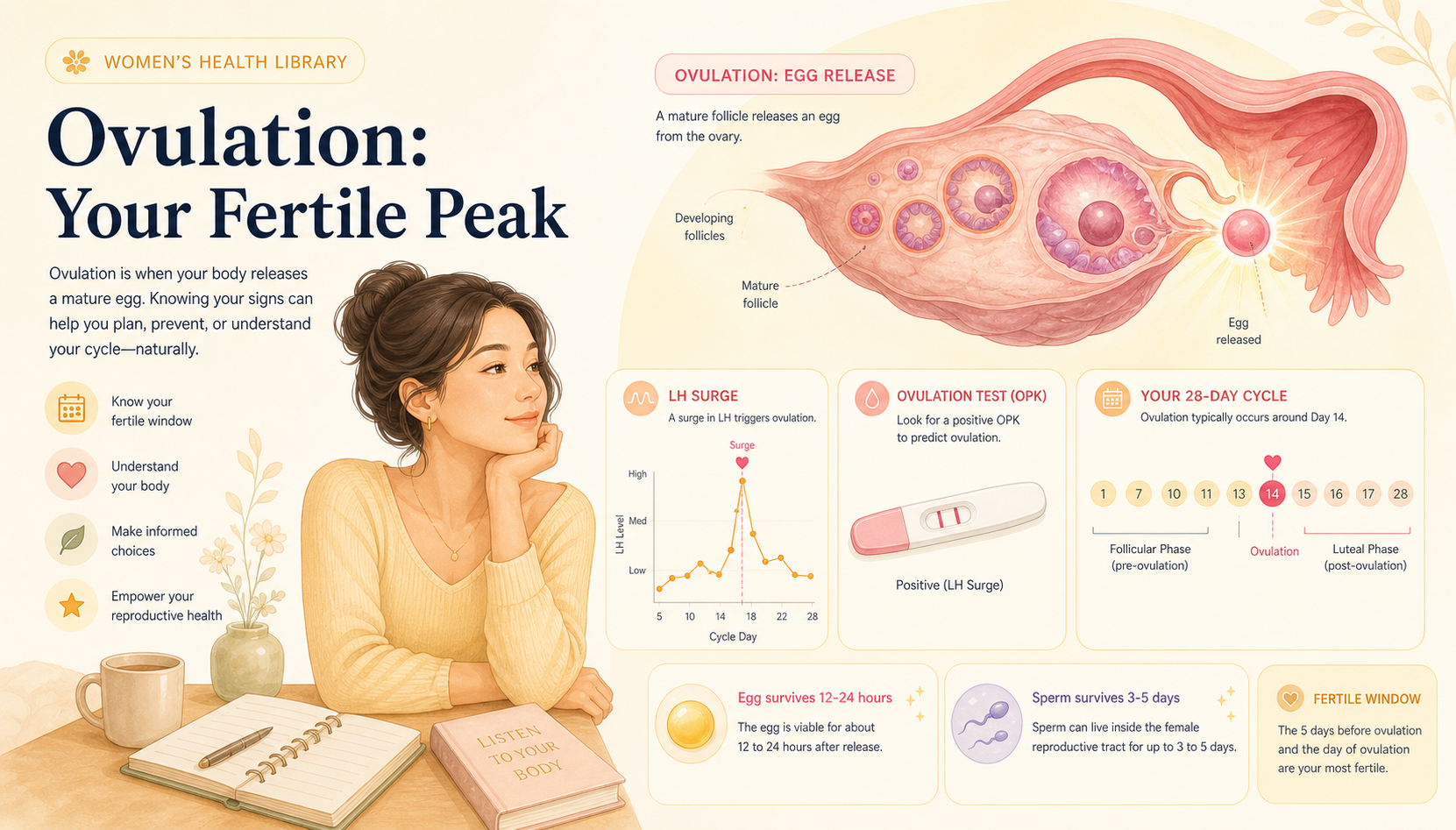
Ovulation is the moment an ovary releases a mature egg — the single most important event if you're trying to conceive, and a key part of understanding your body whatever your goals. The egg then travels down the fallopian tube, where it can be fertilised by sperm for a short window of time.
In most women, ovulation happens around 10 to 16 days before the next period. In a regular 28-day cycle that's often near day 14 — but this doesn't apply if your cycle is shorter or longer, which is why "day 14" is a rough guide, not a rule. Because sperm can survive in the body for up to 7 days, your fertile window actually spans several days before ovulation through to ovulation itself.
This guide explains exactly when ovulation happens, how to spot your fertile window using reliable signs, and how to track it.
Find your window fast
Enter your cycle details into the ParentVibes Ovulation Calculator for a personalised fertile-window estimate.
Open Ovulation Calculator →Everything You Need to Know (The Fertile Window)
The fertile window is the handful of days each cycle when pregnancy is possible:
| Key fact | Detail |
|---|---|
| When ovulation happens | ~10–16 days before your next period |
| Egg lifespan | The egg can be fertilised for about 12–24 hours after release |
| Sperm lifespan | Sperm can survive up to 7 days (commonly ~5) inside the body |
| Fertile window | Roughly the 5 days before ovulation plus ovulation day |
| Most fertile days | The 1–2 days before and the day of ovulation |
Why timing from your period beats "day 14"
Ovulation is more reliably counted backwards from your next period (10–16 days before) than forwards from day 1, because the first half of the cycle varies most between women and cycles. If your cycle is regular, count back ~14 days from when your next period is due.
Signs You're Ovulating
Combining signs is the most accurate approach.
Reliable signs
- Cervical mucus changes — around ovulation, secretions become clearer, thinner and stretchy, like raw egg white
- Basal body temperature (BBT) — a small rise in resting temperature happens after ovulation; charting it confirms ovulation rather than predicting it
- Ovulation predictor kits (OPKs) — detect the LH surge in urine 24–36 hours before ovulation
Less reliable signs (not for precise timing)
- Mild one-sided lower tummy twinge (mittelschmerz)
- Breast tenderness, bloating
- A slight rise in sex drive
Track while you read
Tick the symptoms that apply to you. This is a self-check, not a diagnosis — saved on this device only.
Symptoms like bloating or breast tenderness are not reliable on their own for predicting ovulation — use them alongside mucus, BBT or OPKs.
What Triggers Ovulation
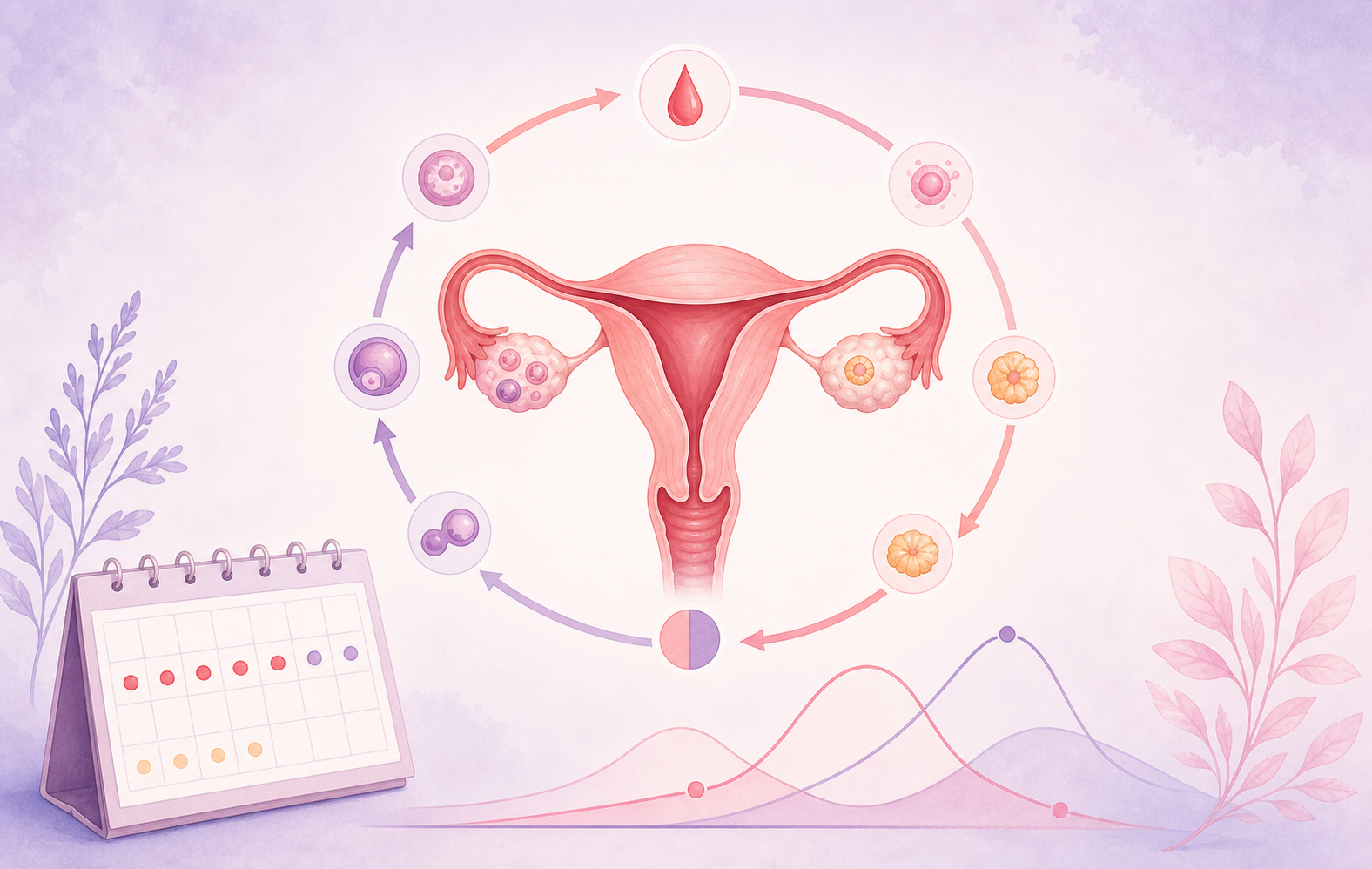
Ovulation is driven by the cycle's hormones:
- 1. FSH rises
- FSH helps an ovarian follicle mature, raising oestrogen.
- 2. Oestrogen peaks
- Rising oestrogen triggers a surge of LH from the brain.
- 3. The LH surge
- The LH surge causes the follicle to release its egg — that's ovulation.
- 4. Progesterone rises
- The empty follicle becomes the corpus luteum and makes progesterone, raising your temperature.
What can disrupt ovulation
PCOS, thyroid problems, high prolactin, significant weight changes, intense exercise, high stress, breastfeeding, and approaching menopause. Absent or irregular ovulation is a common, often treatable cause of difficulty conceiving.
Confirming Whether & When You Ovulate
If you're unsure whether you ovulate (e.g. with irregular cycles), a doctor can help confirm it.
What helps / what a doctor may do
- Tracking — cervical mucus, BBT charts and OPK results over a few cycles
- Blood test — a progesterone test ~7 days before your expected period ("day 21" in a 28-day cycle) helps confirm ovulation happened
- Ultrasound tracking (follicular monitoring) — used in fertility care to watch follicles develop and confirm release
- Tests for causes — thyroid, prolactin and androgen levels if ovulation seems absent
Store results in ParentVibes Medical Records, and bring your tracker data to appointments.
When Ovulation Needs Support
If you ovulate normally, nothing is needed — just track to time intercourse. If ovulation is absent or irregular, treatment targets the cause.
- Healthy ovulation, TTC
- Time intercourse to the fertile window (every 1–2 days across it).
- PCOS / irregular ovulation
- Lifestyle measures; ovulation-inducing medicines (e.g. letrozole/clomifene) under medical care.
- Thyroid / prolactin cause
- Treating the underlying condition often restores ovulation.
- No success after trying
- Fertility assessment with a specialist.
Track your fertile window
The ParentVibes Ovulation Calculator turns your cycle details into a personalised estimate.
Try Ovulation Calculator →Never self-medicate
Ovulation-inducing or hormone medicines are prescription-only and need specialist monitoring (they can affect how many eggs are released).
Supporting Healthy Ovulation
General healthy habits support regular ovulation:
Habits that support ovulation
- Aim for a healthy, stable weight — both very low and very high weight can stop ovulation
- Eat a balanced diet — fibre, protein, healthy fats, whole grains/millets; steady blood sugar helps (especially with PCOS)
- Exercise moderately — regular activity helps; extreme training can suppress ovulation
- Manage stress and sleep well — both influence the hormones that trigger ovulation
- Avoid smoking; limit alcohol and excess caffeine when trying to conceive
- Take folic acid if you're trying for a baby (start before conception), as advised by your doctor
TTC-friendly habits
- Track your fertile window
- Intercourse every 1–2 days across the window
- Folic acid (if TTC)
- Balanced meals & moderate exercise
- Manage stress & sleep
When to See a Doctor
See a doctor if:
- You have irregular cycles or signs you may not be ovulating (very unpredictable or absent periods)
- You've been trying to conceive for 12 months without success (or 6 months if over 35)
- You have signs of a hormonal cause (excess hair, acne, weight change, milky discharge, thyroid symptoms)
- You're planning pregnancy and want a pre-conception check
Use Ask a Doctor on ParentVibes for guidance, or book a fertility/gynae review via Doctor Visits & Appointments.
Continue learning

Frequently Asked Questions
When do I ovulate?
Usually 10–16 days before your next period — about day 14 in a regular 28-day cycle, but earlier or later if your cycle is shorter or longer.
How long is the fertile window?
About 6 days — the 5 days before ovulation plus ovulation day — because sperm can survive up to 7 days. The most fertile days are the 1–2 days before ovulation.
What are the signs of ovulation?
Clear, stretchy "egg-white" cervical mucus, a small rise in temperature after ovulation, and a positive ovulation predictor kit. Combining these is most accurate.
Can I get pregnant on any day?
You can only conceive during the fertile window around ovulation, but since timing varies and sperm survive several days, "safe" days aren't reliable for avoiding pregnancy.
How do ovulation kits work?
They detect the LH surge in urine, which happens 24–36 hours before ovulation.
Can I ovulate without a period, or have a period without ovulating?
Yes — some cycles are anovulatory (no egg released) even with bleeding, and ovulation can occur in irregular cycles. Tracking and, if needed, a doctor can clarify.
Does ovulation pain mean I'm fertile?
A mid-cycle twinge may coincide with ovulation but isn't reliable for timing — use it alongside mucus/OPK/BBT.
Was this guide helpful?
Understand your cycle better with ParentVibes
- Track your period dates
- Predict your next cycle
- Understand your fertile window
- Save health notes
- Get gentle reminders
Related tools
Period Tracker
Log periods and learn your personal cycle pattern.
Open tool
Ovulation Calculator
Estimate your ovulation date and fertile window.
Open tool
Fertility Window
See your most fertile days for trying to conceive.
Open tool
Pregnancy Tracker
Follow your pregnancy week by week once you conceive.
Open tool
Due Date Calculator
Estimate your baby's due date from your last period.
Open toolShare this guide with someone who needs it 💛
Medical review
- Last reviewed
- June 2026
- Medical reviewer
- Dr. Vinika G.
- Next review due
- June 2027
- Status
- Medically reviewed by Dr. Vinika G.
References
This article is for general information and education only and is not a substitute for professional medical advice, diagnosis, or treatment. Ovulation timing varies between individuals and cycles; tracking estimates fertility but cannot guarantee it, and fertility-awareness methods are not a reliable way to avoid pregnancy without proper training. Always consult a qualified doctor about fertility, ovulation problems, or before taking any medicine. In a medical emergency, contact your doctor or local emergency services immediately. Content reviewed against guidance from the NHS and peer-reviewed literature.
Women's Health Library journey
100%Related guides
Free resources
Start here
Your journey with ParentVibes
From your first period to your baby's vaccinations — one continuous, supported path.
Understand your cycle
Know your phases, hormones and what's normal.
Track your period
Log periods and learn your personal pattern.
Understand ovulation
Find your fertile window with the calculator.
Plan pregnancy
A calm, step-by-step start to trying to conceive.
Week-by-week pregnancy
Follow every week once you conceive.
Baby milestones
Track growth and development month by month.
Vaccination tracker
Stay on schedule and never miss a vaccine.
Medical disclaimer
This article is for educational purposes only and does not replace medical advice. If you have severe pain, heavy bleeding, missed periods, or unusual symptoms, please consult a qualified healthcare provider.