
ParentVibes
Women's Health Library · parentvibes.in
Ovarian Reserve: What It Means, AMH Testing & What Results Tell You
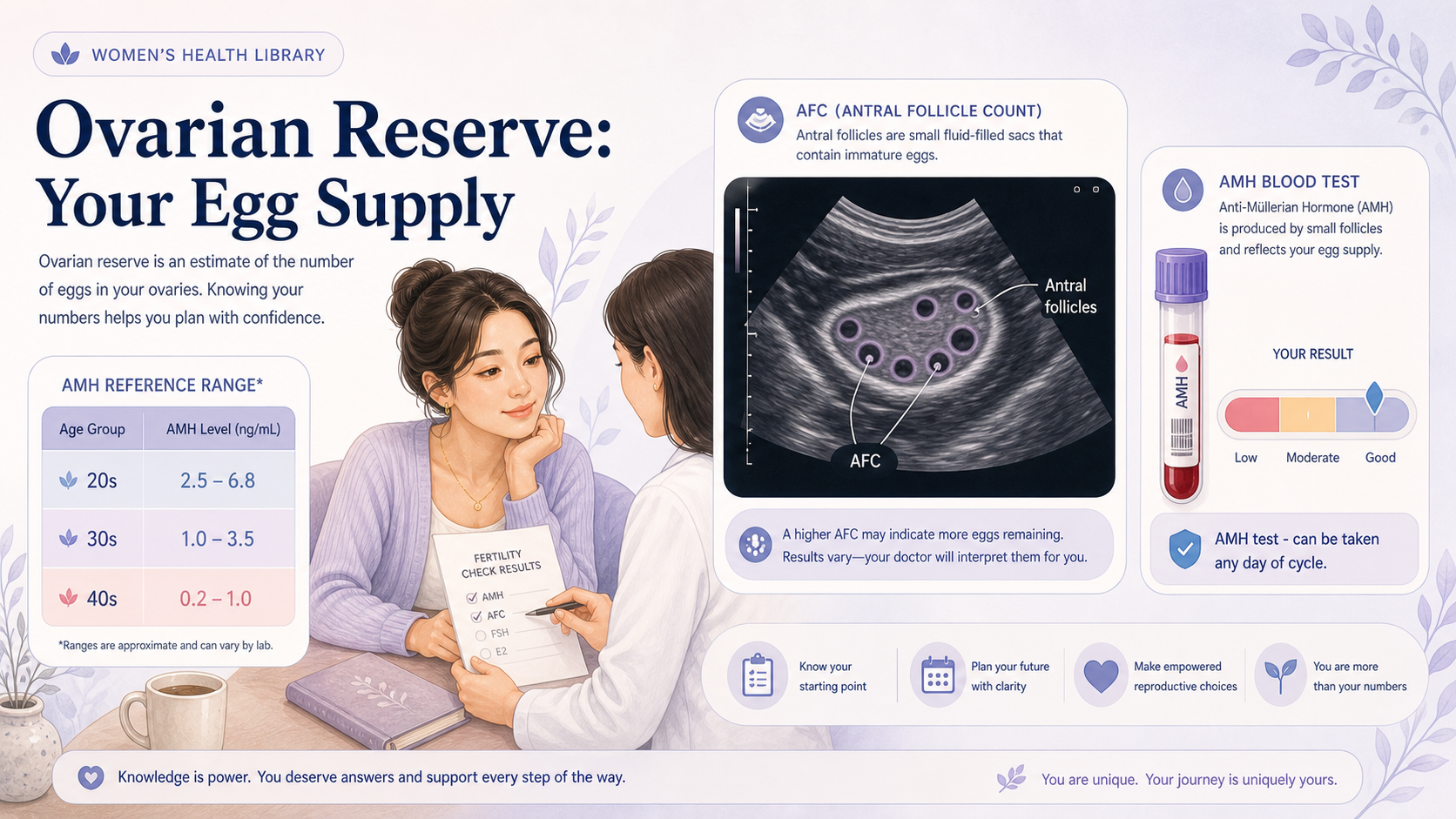
Ovarian reserve at a glance
If you've heard the term 'ovarian reserve' — perhaps while reading about fertility, planning a family, or considering tests — it can sound clinical and a little worrying. In plain language, ovarian reserve simply means the number of eggs remaining in your ovaries: your egg quantity. It's a normal part of how the body works, and understanding it can feel reassuring rather than frightening.
Here's the foundation: you are born with all the eggs you will ever have. From birth onwards, that number gradually declines over time, and this decline tends to become more noticeable as you get older. This is a natural process that happens to everyone with ovaries — it isn't something you've done wrong, and it isn't a sign that anything is broken.
There are two common ways doctors estimate ovarian reserve: a blood test called AMH (anti-Müllerian hormone) and an ultrasound measurement called the antral follicle count. These tests give a useful snapshot of egg quantity, which can help in certain situations — for example, when planning fertility treatment. But it's just as important to understand what they cannot tell you. This guide explains what ovarian reserve means, how the tests work in simple terms, what your results can and can't reveal, and when it makes sense to discuss testing with a doctor.
A low result is not a verdict
Ovarian reserve tests estimate egg quantity — not whether you can or can't get pregnant. Many people with a lower-than-expected result go on to conceive, and many with a reassuring result still need support. A result is a starting point for a conversation, never a final answer.
Explore Fertility →What Is Ovarian Reserve?
Ovarian reserve is the term for the number of eggs your ovaries hold at a given point in time — in other words, your egg quantity. Unlike many cells in the body, eggs are not made fresh throughout life. You're born with your entire lifetime supply, and from then on the number steadily reduces, with no new eggs added.
This gradual decline is completely normal and happens to everyone. It speeds up somewhat with age, which is why ovarian reserve tends to be higher in younger years and lower later on. It's helpful to think of reserve as quantity only — how many eggs are there — rather than as a measure of egg quality, your overall health, or your chances of having a baby. Those are separate things, influenced by many factors including age, general health and your partner's fertility.
A common source of confusion is mistaking a reserve test for a fertility test. They aren't the same. Ovarian reserve gives a sense of how many eggs remain, which can be useful information — particularly for fertility treatment planning — but it does not, on its own, tell you whether or when you'll be able to conceive.
Quantity is not the same as fertility
Two people of the same age can have different ovarian reserve and both conceive naturally. Reserve is one piece of a much bigger picture — age and egg quality often matter more for the chance of pregnancy.
Ovarian reserve, in short
It's about egg quantity
Ovarian reserve is how many eggs your ovaries hold — not how 'good' they are or whether you'll conceive.
It changes with age
You're born with all your eggs, and the number declines gradually over the years, more so with age.
AMH is a blood test
Anti-Müllerian hormone (AMH) is measured from a simple blood sample and reflects egg quantity.
Ultrasound counts follicles
The antral follicle count uses a scan to count small follicles, giving another view of reserve.
A result is a snapshot, not a verdict
Tests estimate quantity at one point in time — they can't tell you whether you can or can't conceive.
Context matters most
Results mean the most when a doctor reads them alongside your age, history and plans.
How Ovarian Reserve Changes With Age
Because you're born with a fixed supply of eggs, ovarian reserve naturally decreases over the years. In younger adulthood the decline is usually gentle, and it tends to become steeper with age. This is the main reason fertility, on average, changes as people get older — it reflects both falling egg quantity and changes in egg quality over time.
That said, this is an average pattern, not a personal prediction. Reserve varies a great deal from person to person at any given age — some people have a higher reserve than typical for their years, others lower, and both can be completely normal for them. Genetics, certain medical conditions and treatments (such as some cancer therapies or ovarian surgery), and other individual factors can also influence reserve.
The reassuring takeaway is that a declining reserve is expected and natural, and reserve alone doesn't decide your fertility. If you're thinking about when to have children, your age and overall health usually matter more than a single reserve figure — and a doctor can help you weigh these together for your own situation.
Average trends, not personal predictions
Age-related decline is a general pattern. Your own reserve can be higher or lower than 'typical' for your age, and either can be perfectly normal. Only a doctor who knows your full picture can interpret what it means for you.
Free with ParentVibes
Track your cycle for free
Get reminders, fertile window predictions, and personalised health insights — free.
- Know your fertile window
- Get period & ovulation reminders
- Predict your next period
- Plan for pregnancy
How Ovarian Reserve Is Tested
There's no single test that measures ovarian reserve perfectly. Instead, doctors usually use one or both of two common assessments together, alongside your age and history. Here's what each one is, in plain terms.
AMH blood test (Anti-Müllerian Hormone)
- AMH is a hormone produced by the small, developing follicles in the ovaries — and the amount in your blood broadly reflects how many of these follicles you have.
- It's measured from a simple blood sample, usually taken from the arm, much like any routine blood test.
- A useful feature is that AMH levels stay relatively stable across the menstrual cycle, so for most people the test can be done on any day — no need to time it precisely.
- A higher AMH generally suggests a larger pool of eggs; a lower AMH suggests a smaller one. It's an estimate of quantity, not quality.
Antral follicle count (ultrasound scan)
- This uses a transvaginal ultrasound — a painless scan that gives a clear view of the ovaries — to count the small (antral) follicles visible at that point in the cycle.
- The number of these follicles gives another estimate of how many eggs are available, complementing the AMH result.
- It's usually done in the early part of the menstrual cycle, when these follicles are easiest to see and count.
- Because it's a direct visual count, it also lets the doctor look at the ovaries themselves — useful alongside AMH for a fuller picture.
Reading them together
- Neither test is meant to stand alone — doctors interpret AMH and the antral follicle count together, in the context of your age, medical history and reasons for testing.
- Results are typically compared against expected ranges for your age group rather than judged as simply 'good' or 'bad'.
- Other hormone tests (for example, blood tests done early in the cycle) are sometimes added depending on your situation.
- What matters most is the overall picture a doctor builds — not any single number on its own.
These tests are simple and low-stress
An AMH test is just a blood draw, and the antral follicle count is a quick, painless ultrasound. Neither is a major procedure — and you don't usually need to time the AMH blood test to a particular day.
What Results Can — and Can't — Tell You
This is the most important part to understand. Ovarian reserve tests are genuinely useful in the right context, but they're often misread as a fertility prediction. Here's what they can and can't reveal:
- They CAN give an estimate of egg quantity — roughly how many eggs remain.
- They CAN help a fertility specialist plan treatment such as IVF — for example, anticipating how the ovaries may respond to stimulation.
- They CAN, alongside age and history, help start a useful conversation about timing and options.
- They CANNOT tell you whether you will or won't be able to conceive naturally — reserve is quantity, not a fertility guarantee.
- They CANNOT measure egg quality, which often matters more than quantity and is closely tied to age.
- They CANNOT predict exactly when you'll reach menopause or run out of eggs.
Please don't read a result as a verdict
A lower-than-expected result does not mean you can't have a baby, and a reassuring result is not a guarantee that you will. Reserve tests are most meaningful when a doctor interprets them alongside your age, history and goals. If a result worries you, talk it through with a doctor before drawing any conclusions — and be gentle with yourself in the meantime.
Ask a Doctor →Continue learning
Frequently Asked Questions
What does ovarian reserve actually mean?
Ovarian reserve refers to the number of eggs remaining in your ovaries — your egg quantity. You're born with all the eggs you'll ever have, and that number gradually declines over time. It's a measure of quantity, not of egg quality or of whether you can conceive.
What is the AMH test, and is it the same as a fertility test?
AMH (anti-Müllerian hormone) is a hormone made by small follicles in the ovaries, measured with a simple blood test that broadly reflects egg quantity. It is not a fertility test. It estimates how many eggs you have, but it cannot tell you whether or when you'll be able to get pregnant.
Does a low AMH or low ovarian reserve mean I can't get pregnant?
No. A lower result is information about egg quantity, not a verdict on your fertility. Many people with a lower-than-expected reserve conceive, including naturally. Reserve is just one factor — age and egg quality often matter more — so it's best discussed with a doctor who can see your full picture.
What is an antral follicle count?
It's a painless transvaginal ultrasound scan that counts the small (antral) follicles visible on the ovaries, usually early in the menstrual cycle. The count gives another estimate of egg quantity and is often used together with the AMH blood test for a fuller picture.
Do I need to do the AMH test on a specific day of my cycle?
For most people, no. AMH levels stay relatively stable across the menstrual cycle, so the blood test can usually be done on any day. The antral follicle count ultrasound, however, is typically done in the early part of the cycle. Your doctor will advise based on your situation.
Should I get my ovarian reserve tested 'just in case'?
Whether testing is helpful depends on your individual situation and plans, so it's best decided with a doctor. Testing is often more useful when there's a specific reason — for example, planning fertility treatment, certain medical history, or difficulty conceiving — rather than as a routine 'just in case' check, because a result can be misread without proper context.
Was this guide helpful?
Understand your cycle better with ParentVibes
- Track your period dates
- Predict your next cycle
- Understand your fertile window
- Save health notes
- Get gentle reminders
Related tools

Period Tracker
Log periods and learn your personal cycle pattern.
Open tool
Ovulation Calculator
Estimate your ovulation date and fertile window.
Open tool
Fertility Window
See your most fertile days for trying to conceive.
Open tool
Pregnancy Tracker
Follow your pregnancy week by week once you conceive.
Open tool
Due Date Calculator
Estimate your baby's due date from your last period.
Open toolShare this guide with someone who needs it 💛
Medical review
- Last reviewed
- June 2026
- Medical reviewer
- Dr. Vinika G.
- Next review due
- June 2027
- Status
- Medically reviewed by Dr. Vinika G.
References
This article is for general information and education only and is not a substitute for professional medical advice, diagnosis, or treatment. Ovarian reserve tests, including AMH and the antral follicle count, estimate egg quantity at a point in time — they cannot confirm whether you can or cannot conceive, and should be interpreted by a qualified doctor alongside your age, medical history and goals. Always consult a doctor or fertility specialist about your own situation, before deciding on any test, and before making decisions based on results. A lower-than-expected result is not a verdict on your fertility. Content reviewed against guidance from ASRM (ReproductiveFacts.org), the NHS, ACOG and the WHO. No specific numeric ranges or individual predictions are given here, as these depend entirely on your personal circumstances.
Planning Parenthood Library journey
100%Related guides
Free resources
Medical disclaimer
This article is for educational purposes only and does not replace medical advice. If you have severe pain, heavy bleeding, missed periods, or unusual symptoms, please consult a qualified healthcare provider.