
ParentVibes
Women's Health Library · parentvibes.in
Your Fertile Window: When You Can Get Pregnant & How to Find It
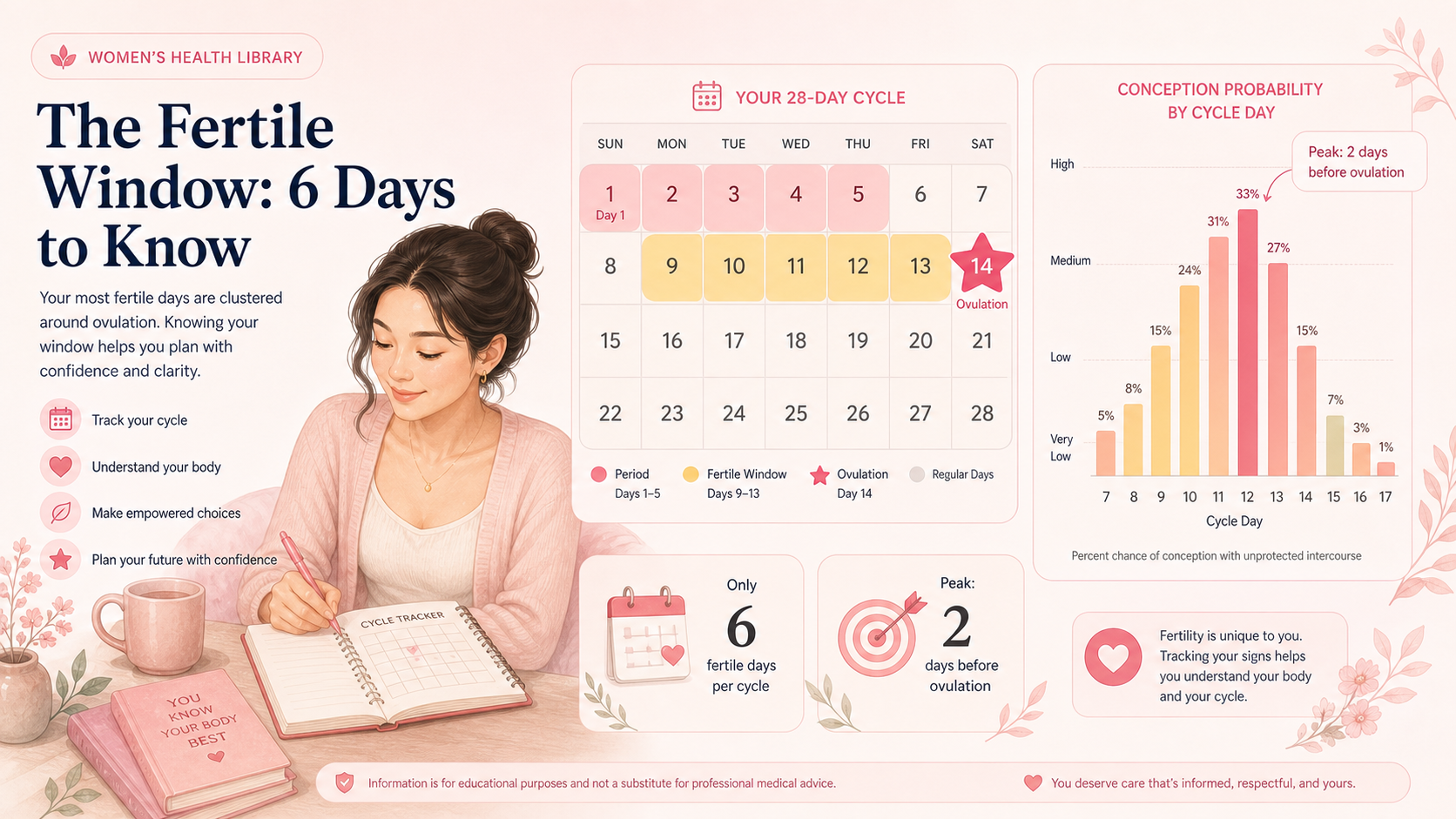
The fertile window at a glance
If you're hoping to conceive, one of the most useful things you can understand is your fertile window — the short stretch of each cycle when sex can actually lead to pregnancy. It's a common surprise that this window is only about six days long, and that it isn't simply 'the day you ovulate'.
Here's why. Each cycle, an ovary releases an egg (ovulation). That egg can only be fertilised for about 12 to 24 hours. But sperm are hardier — they can survive inside the body for several days, waiting. So the days that count are the five days leading up to ovulation plus ovulation day itself: about six fertile days in total. Sex in this window — especially in the two or three days just before ovulation — gives the best chance of conceiving.
The tricky part is knowing when that window is. For some, regular cycles make it fairly predictable with simple maths. For others — particularly with irregular cycles — ovulation moves around, so the calendar alone isn't enough and the body's own signs become far more useful. This guide walks through how to find your fertile window using cycle length, cervical mucus, basal body temperature and ovulation predictor kits, how to time intimacy, and when it's worth seeking help.
Why the window is days, not a moment
The egg lives only about a day, but sperm can wait a few days for it. So the fertile window opens before you ovulate — which is why sex in the days leading up to ovulation matters most.
Try the Fertile Window Calculator →What Is the Fertile Window?
The fertile window is the group of days in your menstrual cycle when having sex can result in pregnancy. It's made up of the five days before ovulation, plus the day of ovulation itself — roughly six days in all. It exists as a window, rather than a single moment, because of two simple facts: the egg survives only about 12 to 24 hours after it's released, while sperm can survive inside the body for several days. That means sperm present before ovulation can still be there to meet the egg when it arrives.
Fertility is highest in the two to three days right before ovulation and on ovulation day. The days before your window opens, and the days after the egg is gone, carry a very low chance of pregnancy. Because ovulation timing varies from person to person — and can shift cycle to cycle — your fertile window isn't fixed to a particular calendar date. Learning to recognise it, rather than assuming it falls on 'day 14', is what makes the real difference.
Fertile window vs ovulation day
'Ovulation day' is the single day the egg is released. The 'fertile window' is the wider stretch — the days before, plus ovulation — when sex can lead to pregnancy. You don't have to pinpoint ovulation exactly; covering the window is what counts.
Your fertile window, in short
It's about six days, not one
The fertile window covers the five days before ovulation plus ovulation day itself.
Sperm wait for the egg
Sperm can survive a few days inside the body, so sex before ovulation can still lead to pregnancy.
The egg is brief
Once released, an egg lives only about 12–24 hours — which is why the days before ovulation matter most.
Your body gives signs
Clear, stretchy 'egg-white' cervical mucus is one of the most reliable signals fertile days are near.
Temperature rises after
Basal body temperature rises slightly after ovulation — it confirms the window has passed, rather than predicting it.
It can shift
In irregular cycles ovulation moves around, so the window isn't fixed — tracking signs helps more than the calendar alone.
How the Fertile Window Affects Your Chance of Conceiving
Timing intimacy to your fertile window is one of the most effective natural ways to improve your chance of conceiving. Because sperm can survive for a few days, having sex in the days leading up to ovulation means healthy sperm are already waiting when the egg is released. Many couples find that having sex every one to two days throughout the fertile window — rather than trying to 'save up' for a single perfect day — works well, because it keeps fresh sperm available across the whole window and removes the pressure of hitting one exact moment.
It helps to keep expectations gentle. Even with perfect timing, conception doesn't happen every cycle — healthy couples having well-timed sex often take several months to conceive, and that is entirely normal. Age, overall health and individual factors all play a part. Knowing your window improves your odds each cycle; it isn't a guarantee, and a month without success doesn't mean anything is wrong.
Regular, relaxed timing beats pinpoint pressure
Aiming for sex every 1–2 days across your fertile window covers ovulation without the stress of getting one exact day right. Trying to conceive can feel pressured — being kind to yourself and your partner matters too.
Read: Trying to Conceive →Free with ParentVibes
Track your cycle for free
Get reminders, fertile window predictions, and personalised health insights — free.
- Know your fertile window
- Get period & ovulation reminders
- Predict your next period
- Plan for pregnancy
Signs Your Fertile Window Is Here
Your body gives several natural signals as ovulation approaches. Watching for these is often more reliable than the calendar alone — especially if your cycles vary. Most people notice a combination, and tracking them over a few cycles makes your personal pattern clearer.
Cervical mucus changes
- Discharge becomes clearer, wetter and more slippery as fertile days approach
- At its most fertile, it looks and stretches like raw egg white
- More mucus and a wetter sensation are among the most useful natural fertility signs
- After ovulation it usually turns thicker, stickier or drier again
Basal body temperature (BBT)
- A small, sustained rise in resting body temperature usually follows ovulation
- It confirms ovulation has happened — it doesn't predict it in advance
- Tracked over cycles, BBT helps you learn roughly when you tend to ovulate
- Measured first thing on waking, before getting out of bed, for consistency
Ovulation predictor kits (OPKs)
- Home urine kits detect the surge in luteinising hormone (LH) before ovulation
- A positive result suggests ovulation is likely in roughly the next day or two
- They help you target the most fertile days — a useful prompt for timing intimacy
- Results can be harder to interpret with irregular cycles or certain conditions
Other body cues
- Some notice a rise in sex drive (libido) around their fertile days
- Mild one-sided lower-tummy twinge ('mittelschmerz') for some, around ovulation
- Light breast tenderness or a heightened sense of smell for some people
- These cues vary widely and not everyone notices them — that's normal
Track while you read
Tick the symptoms that apply to you. This is a self-check, not a diagnosis — saved on this device only.
Combine the signs, don't rely on one
Cervical mucus and OPKs help predict the window ahead; temperature confirms it afterwards. Tracking two or three signs together gives a far clearer picture than any single one alone.
Log signs in the Period Tracker →How to Track Your Fertile Window
There's no single 'right' method — most people combine a calendar estimate with one or two body signs. Here's how each approach works, so you can pick what fits your cycle and routine.
Cycle-length maths (calendar method)
- Ovulation usually happens about 12–16 days before your next period starts, not a fixed 'day 14'
- For a roughly 28-day cycle, ovulation tends to fall around the middle; the fertile window covers the days just before
- Track several cycles to learn your average length and estimate your window more confidently
- Use our Fertile Window or Ovulation Calculator to do the maths for you
Calendar maths is a starting point
It works best with regular cycles. If your cycles vary in length, the calendar alone can be misleading — lean more on cervical mucus and ovulation kits.
Watch your cervical mucus
- Notice changes through the cycle: drier after a period, then wetter and clearer as fertile days near
- Clear, stretchy 'egg-white' mucus signals you're at your most fertile
- A simple daily note (dry / sticky / creamy / egg-white) builds a useful pattern over a couple of cycles
Chart basal body temperature
- Take your temperature first thing each morning before getting up, at a similar time daily
- Look for a small sustained rise that marks ovulation has occurred
- Over a few cycles this shows when you typically ovulate, helping you anticipate next time
Use ovulation predictor kits
- Start testing a few days before you expect to ovulate, following the kit instructions
- A positive (LH surge) suggests your most fertile day or two is just ahead
- Pair OPKs with cervical-mucus changes for a clearer signal, especially if cycles vary
When to Seek Help Conceiving
Trying for a baby naturally takes time, and most healthy couples conceive within a year. It's worth speaking to a doctor or fertility specialist if:
- You've been having regular, well-timed unprotected sex for about a year without conceiving (if you're under 35)
- You're 35 or older and haven't conceived after about six months of trying
- Your periods are irregular, very infrequent or absent — making your fertile window hard to pin down
- You have a known condition that can affect fertility (such as PCOS, endometriosis or thyroid problems)
- You've had previous pelvic infections, surgery or miscarriages, or your partner has known fertility concerns
- You simply want reassurance or advice before or while trying — that's always okay
Seeking help early is sensible, not premature
If your cycles are irregular or you're 35+, it's reasonable to seek advice sooner. Many causes of difficulty conceiving are treatable, and a doctor can check both partners and guide next steps. Asking for help is a positive, proactive choice.
Ask a Doctor →Continue learning

Frequently Asked Questions
How many days is the fertile window?
About six days each cycle — the five days before ovulation plus ovulation day itself. It spans several days because sperm can survive inside the body for a few days, even though the egg lives only about 12–24 hours after it's released.
Is the fertile window the same as ovulation day?
No. Ovulation day is the single day the egg is released. The fertile window is wider — it includes the days leading up to ovulation, when sperm can already be waiting. That's why sex in the days before ovulation, not just on the day, can lead to pregnancy.
When in my fertile window am I most likely to conceive?
Fertility is highest in the two to three days just before ovulation and on ovulation day. Having sex every one to two days across the window is a relaxed, effective way to cover the most fertile days without trying to hit one exact moment.
How do I find my fertile window if my cycles are irregular?
With irregular cycles, ovulation shifts around, so calendar maths alone can be misleading. Watching your cervical mucus, charting basal body temperature and using ovulation predictor kits are more reliable. If cycles are very irregular or absent, see a doctor for guidance.
Which sign is the most reliable for predicting ovulation?
No single sign is perfect. Clear, stretchy 'egg-white' cervical mucus and a positive ovulation kit (LH surge) help predict the window ahead, while a basal body temperature rise confirms ovulation afterwards. Combining two or three signs gives the clearest picture.
Can I use the fertile window to avoid pregnancy?
Fertility-awareness methods can be used to avoid pregnancy, but only when learned properly and followed carefully — usually with guidance from a trained instructor. Casually 'avoiding the fertile days' without proper training is unreliable. If you want dependable contraception, speak to a doctor about your options.
Was this guide helpful?
Understand your cycle better with ParentVibes
- Track your period dates
- Predict your next cycle
- Understand your fertile window
- Save health notes
- Get gentle reminders
Related tools
Period Tracker
Log periods and learn your personal cycle pattern.
Open tool
Ovulation Calculator
Estimate your ovulation date and fertile window.
Open tool
Fertility Window
See your most fertile days for trying to conceive.
Open tool
Pregnancy Tracker
Follow your pregnancy week by week once you conceive.
Open tool
Due Date Calculator
Estimate your baby's due date from your last period.
Open toolShare this guide with someone who needs it 💛
Medical review
- Last reviewed
- June 2026
- Medical reviewer
- Dr. Prachi
- Next review due
- June 2027
- Status
- Medically reviewed by Dr. Prachi
References
This article is for general information and education only and is not a substitute for professional medical advice, diagnosis, or treatment. Fertile-window estimates and tracking methods are approximate and vary from person to person and cycle to cycle; they cannot guarantee or rule out pregnancy. If you are trying to conceive and have concerns — or if you wish to use fertility awareness to avoid pregnancy — please consult a qualified doctor or gynaecologist, and seek proper training for fertility-awareness methods. Content reviewed against guidance from the NHS, ACOG, ASRM and the WHO.
Women's Health Library journey
100%Related guides
Free resources
Start here
Your journey with ParentVibes
From your first period to your baby's vaccinations — one continuous, supported path.
Understand your cycle
Know your phases, hormones and what's normal.
Track your period
Log periods and learn your personal pattern.
Understand ovulation
Find your fertile window with the calculator.
Plan pregnancy
A calm, step-by-step start to trying to conceive.
Week-by-week pregnancy
Follow every week once you conceive.
Baby milestones
Track growth and development month by month.
Vaccination tracker
Stay on schedule and never miss a vaccine.
Medical disclaimer
This article is for educational purposes only and does not replace medical advice. If you have severe pain, heavy bleeding, missed periods, or unusual symptoms, please consult a qualified healthcare provider.