
 ← Women's Health Library
Women's Health FAQs
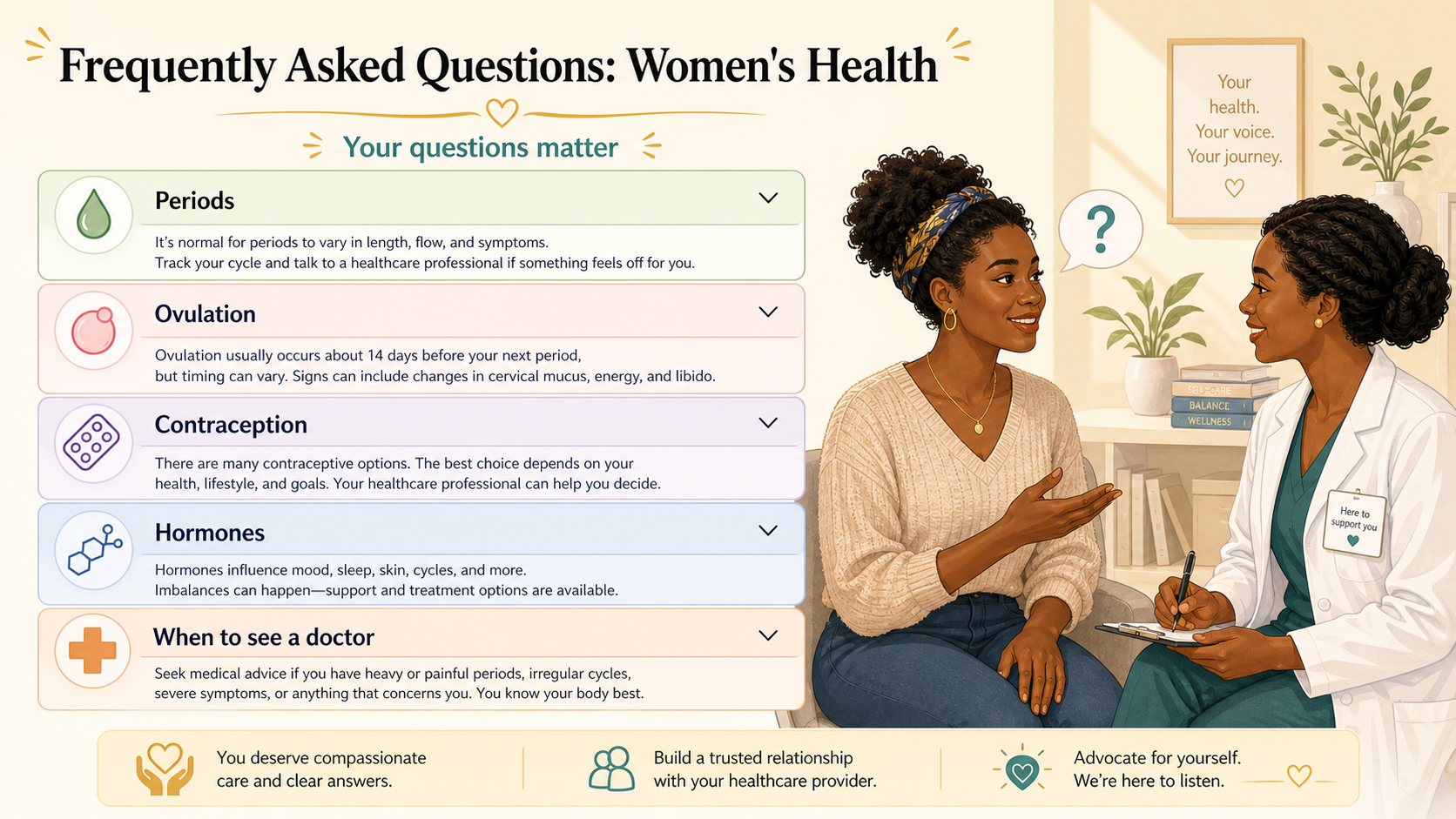
Clear, judgment-free answers to the questions women ask us most — about periods, ovulation, hormones, contraception, mood and more. Every answer links to a deeper, doctor-reviewed guide if you want to read on.
What does a normal menstrual cycle look like?
A typical cycle runs about 21–35 days, with 2–7 days of bleeding. "Normal" varies a lot from person to person — what matters most is what's normal for you, and noticing changes from your own pattern.
Understanding your cycle →Why are my periods irregular?
Common causes include stress, weight change, thyroid issues, PCOS, perimenopause, and some medicines. The occasional off-month is usually fine; a persistent change is worth checking.
Irregular periods →How do I know when I'm ovulating?
Ovulation usually happens about 14 days before your next period. Signs include clear, stretchy cervical mucus, a small rise in basal body temperature, and a positive ovulation predictor kit. Your fertile window is the ~6 days ending on ovulation day.
Your fertile window →What's the difference between PCOS and PCOD?
They overlap and the terms are often used loosely. Both involve the ovaries and hormone imbalance; PCOS (a syndrome) tends to be the more significant metabolic condition, while "PCOD" is often used in India for milder ovarian changes. A doctor can clarify which fits you.
PCOS explained →Is my vaginal discharge normal?
Some clear or white discharge that changes across your cycle is healthy and normal. See a doctor if it becomes itchy, smelly, green/grey, or comes with pain — these can signal an infection that's easily treated.
Vaginal health →Which contraception is right for me?
There's no single best method — it depends on your health, plans and preferences. Options range from condoms (the only method that also protects against STIs) to pills, IUDs, implants and more. A doctor can help you choose.
Contraception methods →What's PMS, and how is it different from PMDD?
PMS is the physical and emotional symptoms in the days before a period that ease once it starts. PMDD is a severe form with marked mood symptoms that disrupt daily life — less common, but recognised and treatable.
PMS & PMDD →Why am I getting acne, hair loss or extra hair growth?
These can be linked to hormones — including conditions like PCOS — as well as stress, thyroid and iron levels. They're common and treatable, and a doctor can help find the cause.
Hormonal health →How often should I have cervical screening?
Cervical screening (a Pap or HPV test) checks for early changes long before they could become a problem, and the HPV vaccine adds protection. Ask your doctor about the right schedule for you.
Cervical health →I feel low or anxious a lot — could it be hormonal?
Hormones, your cycle, and life load can all affect mood, and low mood or anxiety are common and very treatable. It's never "just hormones" to be dismissed — if it's persistent, please reach out for support.
Mental wellbeing →What supplements do women actually need?
Food comes first. Some women benefit from iron, folic acid (especially before and in early pregnancy), vitamin D or B12 — but doses and safety matter, so always check with a doctor before starting anything.
Supplements guide →When should I see a doctor about my symptoms?
See a doctor for anything that's new, persistent, severe, or worrying — very heavy or painful periods, bleeding between periods or after sex, persistent pelvic pain, or symptoms affecting daily life. Trust your instincts; getting checked is always reasonable.
Ask a Doctor →Still have a question?
Explore the full Women's Health Library, or ask a doctor directly.
These answers are for general information and education only and are not a substitute for professional medical advice. Please consult a qualified doctor about your own symptoms.