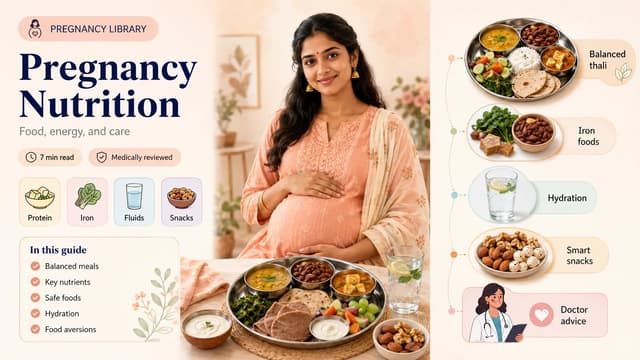
You don't need to track every nutrient — a varied plate usually covers most. These are the ones that matter most, with everyday Indian food examples.
Folic acid (folate)
Supports your baby's early brain and spinal-cord development, especially in the first weeks.
Foods: Dark leafy greens (palak, methi), legumes and dals, oranges, and fortified cereals.
Vegetarian: Easily met on a vegetarian diet through greens, dals and citrus fruit.
A folic-acid supplement is very commonly advised from before conception through early pregnancy — take only the dose your doctor recommends.
Iron
Your blood volume rises in pregnancy, so iron helps carry oxygen to you and your baby and lowers the risk of anaemia.
Foods: Dals and legumes, green leafy vegetables, ragi, dates and jaggery, and (for non-vegetarians) meat and liver.
Vegetarian: Pair iron-rich vegetarian foods with vitamin C (lemon, amla, tomato) to help absorption.
Iron needs in pregnancy are hard to meet by diet alone; doctors commonly prescribe iron-folic-acid (IFA) tablets — follow their guidance.
Calcium
Helps build your baby's bones and teeth while protecting your own bone health.
Foods: Milk, curd and paneer, ragi, sesame seeds (til), and tofu.
Vegetarian: Ragi, til, dairy and tofu make calcium easy to get without meat.
Your doctor may suggest a calcium supplement if your diet is low — ask before starting one.
Protein
The building block for your baby's growth and your changing body, with needs rising as pregnancy progresses.
Foods: Dals, rajma, chana and other legumes, paneer, milk and curd, eggs, nuts, and (for non-vegetarians) chicken, fish and lean meat.
Vegetarian: Combining dals with grains (dal-rice, roti-chana) gives a fuller range of amino acids.
If you struggle to eat enough protein — for example with nausea — tell your doctor rather than relying on protein powders.
Vitamin D
Helps your body absorb calcium and supports bone health for you and your baby.
Foods: Sensible sunlight exposure, fortified milk, and eggs.
Vitamin D deficiency is common in India; your doctor may test your levels and advise a supplement.
Vitamin B12
Needed for healthy nerves and red blood cells, and for your baby's developing nervous system.
Foods: Dairy and eggs; for non-vegetarians, fish, meat and poultry.
Vegetarian: Strict vegetarians and vegans are more likely to fall short — discuss a B12 supplement with your doctor.
B12 is one to check if you eat little or no animal food; your clinician can guide testing and supplements.
Iodine
Supports your thyroid and your baby's brain development.
Foods: Iodised salt and dairy.
Using iodised salt usually covers this; don't take iodine supplements without medical advice.
Choline
Contributes to your baby's brain and memory development.
Foods: Eggs, dairy, legumes, and peanuts.
Vegetarian: Legumes, dairy and peanuts provide choline for vegetarians.
Choline is often overlooked — a varied diet usually covers it; ask your doctor if unsure.
Omega-3 fatty acids (DHA)
Support your baby's brain and eye development.
Foods: Walnuts, flaxseeds (alsi), chia seeds, and (for non-vegetarians) low-mercury oily fish.
Vegetarian: Walnuts, flax and chia are good plant sources; your doctor can advise if a supplement is needed.
If you don't eat fish, ask your doctor whether an algae- or fish-oil DHA supplement is right for you.
Fibre
Eases the constipation many people experience in pregnancy and supports steady energy.
Foods: Whole grains and millets, fruits and vegetables, and legumes.
Increase fibre gradually and with plenty of fluids to avoid bloating.
Fluids
Support your rising blood volume and amniotic fluid, and help prevent constipation and urinary infections.
Foods: Water through the day, plus nimbu pani, coconut water and buttermilk (chaas).
Needs rise in India's heat and with activity; ask your doctor if you have any fluid restriction.