
Cervical mucus changes
More usefulIn the days before ovulation, cervical mucus often becomes clearer, wetter and stretchy — like raw egg white. This is one of the more useful signs.
Fertility & your cycle
If you're trying to understand your cycle — whether you're hoping to conceive or simply getting to know your body — spotting the signs of ovulation can help. No single symptom is a guarantee, and everybody is different, but learning to read a few signals together can help you estimate your most fertile days with more confidence.
Sign in to see your week, child or cycle context. The guide remains fully available without an account.
Medically reviewed guidance
Practical tools alongside trusted information.
Your ParentVibes experience
Use the interactive tools now, then continue with the detailed, medically reviewed guide below.
Mini fertile-window calculator
Fertile window
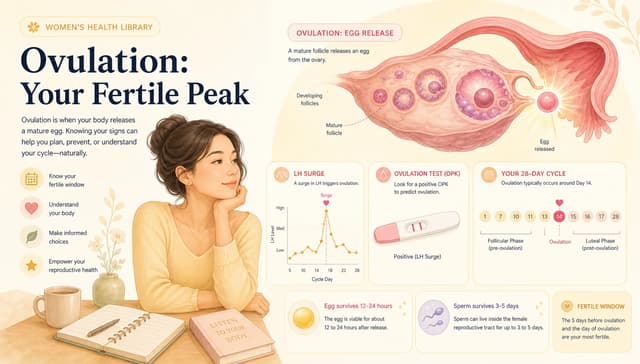
Estimated fertile window: days 9–15. Use this estimate with body signs, not as contraception.
Your progress
Day 14 of a 28-day cycle
Contextual help
Choose a common question for a guided next step from ParentVibes.
Continue your journey
Save it for later
Printable resources for your appointments or fridge.
What to look for
Signs fall roughly into two groups — the more useful, trackable indicators, and the more subjective ones that vary a lot between people.
In the days before ovulation, cervical mucus often becomes clearer, wetter and stretchy — like raw egg white. This is one of the more useful signs.
A small, sustained rise in your resting body temperature usually appears just after ovulation — helpful for confirming it happened.
A home ovulation predictor kit detects the surge in luteinising hormone that comes shortly before ovulation — one of the more predictive signals.
Some people notice a one-sided twinge or ache around ovulation (sometimes called mittelschmerz). Many feel nothing at all.
A rise in sex drive around the fertile window is common for some people.
Tender or sensitive breasts can appear, though often after ovulation rather than before.
The cervix may feel higher, softer and slightly more open near ovulation. This takes practice to read and is less reliable.
A little light spotting mid-cycle is uncommon but can occur around ovulation.
Some people report a sharper sense of smell or taste — this is anecdotal and hard to rely on.
Mild bloating or fluid retention can occur, but has many other everyday causes too.
At a glance
| Sign | When it may appear | Reliability | How to track | Limitations |
|---|---|---|---|---|
| Cervical mucus | In the days before ovulation | Moderate to high (predictive) | Note the texture each day | Affected by infections, semen and some products |
| BBT rise | Just after ovulation | Moderate (confirms, doesn't predict) | Same-time temperature each morning before rising | Disturbed by illness, broken sleep or alcohol |
| LH surge (OPK) | About 1–2 days before ovulation | High (predictive) | Test urine daily during the fertile window | Can be confusing with PCOS or irregular cycles |
| Ovulation pain | Around ovulation | Low to moderate | Note the timing and side | Not everyone feels it; other causes exist |
| Libido & other body signs | Around ovulation | Low (subjective) | Jot down in a journal or app | Influenced by mood, stress and many factors |
Reading your body
Cervical mucus changes in a fairly predictable way across the cycle. Watching how it shifts is one of the most accessible ways to sense your fertile window.
Just after your period
Often dry or very little mucus.
Approaching ovulation
Becomes sticky, then creamy and lotion-like.
Most fertile
Clear, wet and stretchy — like raw egg white.
After ovulation
Usually turns thicker, drier or disappears.
Confirming ovulation
Testing at home
Is this normal?
What can be normal
A mild, one-sided twinge or ache lasting a few hours to a day or so — often called mittelschmerz — can be a normal part of ovulation for some people.
See a doctor promptly if you have
Enter your cycle details and our free ovulation calculator estimates your most fertile days — then refine it with the signs above.
Timing
Learn more about your menstrual cycle and fertility awareness. Already expecting? Get a head start with our pregnancy nutrition guide.
When it's harder to predict
Several things can make ovulation harder to predict. This isn't a diagnosis — if any of these apply and you're unsure, a doctor can help you understand your own cycle.
If you're not sure whether you're ovulating, our guide on when to seek help can point you in the right direction.
Safety first
Speak to a doctor if
Answers
Yes. Many people ovulate regularly without noticing clear symptoms. An absence of signs does not mean you aren't ovulating. If you want more certainty, combining cervical-mucus tracking, basal body temperature and ovulation tests gives a fuller picture than symptoms alone.
You release eggs during a single window in a cycle — you don't ovulate twice at separate times weeks apart. However, more than one egg can be released within roughly a day of each other, which is how non-identical twins can occur. You cannot ovulate again later in the same cycle after that window.
True ovulation during your actual period is very unlikely, but in short or irregular cycles ovulation can come soon after bleeding ends. Because sperm can survive several days, sex towards the end of a period can occasionally overlap with an early fertile window. Track your own cycle rather than assuming any days are “safe”.
Egg-white-like cervical mucus suggests you're approaching your fertile window, but on its own it doesn't confirm that ovulation has actually happened. Discharge can also change for other reasons, such as arousal, infections or products. Pairing it with temperature tracking or an ovulation test gives a clearer answer.
Ovulation itself — the release of the egg — happens in a short window, and the egg survives for roughly 12 to 24 hours. Because sperm can live for several days beforehand, your fertile window is longer than ovulation itself, at around six days.
Yes, significant stress, illness, travel or disrupted sleep can delay or occasionally prevent ovulation in a given cycle, which can make periods late or irregular. If this happens often, or your cycles are consistently unpredictable, it's worth speaking to a doctor.
No. Apps and calculators estimate ovulation from your cycle history and averages, so they're a helpful guide rather than an exact prediction — especially if your cycles vary. Confirming with your body's own signs (mucus, temperature, LH tests) improves accuracy.
Bring your cycle, ovulation and trying-to-conceive journey together in one calm, private place.
Was this guide helpful?
Continue your journey